

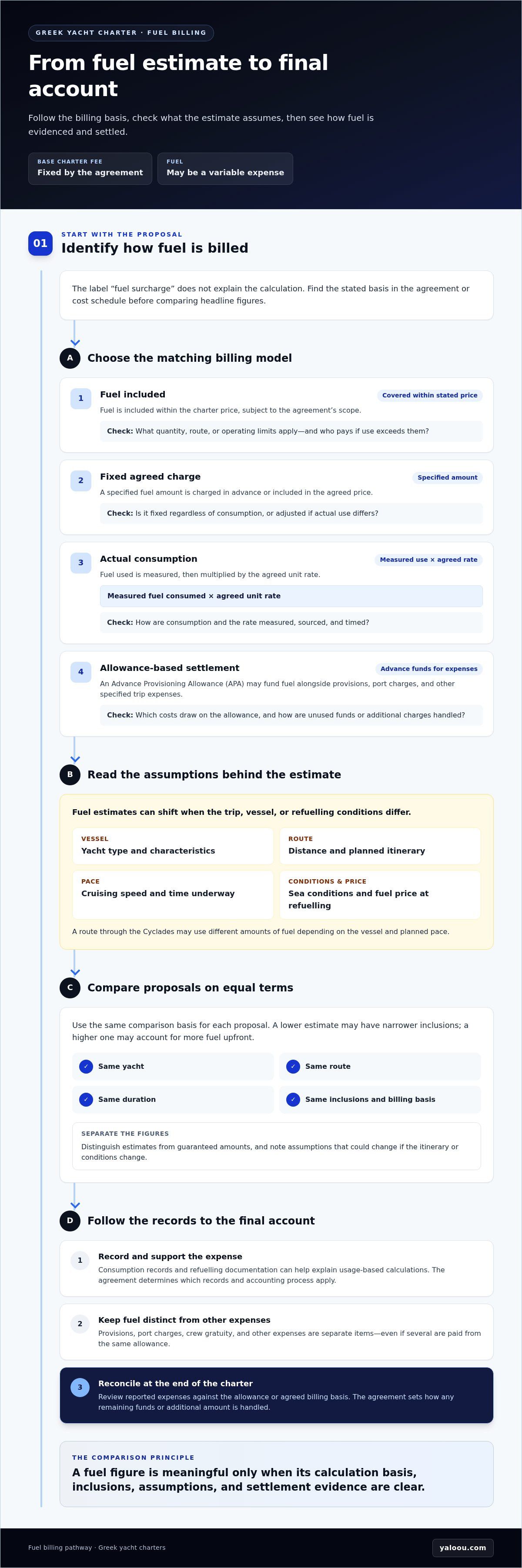
Two Greek yacht charter proposals can show very different fuel figures, even when the trips look similar on paper. The difference often comes down to what each estimate includes, how fuel is billed, and what happens if the route or conditions change. Navigating Greek yacht charter fuel surcharge calculation models starts with one key distinction: under a common “plus all expenses” arrangement, fuel is a variable cost settled through the Advance Provisioning Allowance (APA), while the base charter fee is fixed.
It’s reasonable to want a clear figure before setting sail, but a fuel estimate is useful only when you understand its assumptions. Yacht type, distance, cruising speed, time underway, sea conditions, and the fuel price at refuelling can all affect the final amount. A route through the Cyclades, for example, may use different amounts of fuel depending on the vessel and planned pace.
This guide explains the main billing approaches, what fuel inclusions to compare, and how to assess proposals on equal terms. You’ll also learn what records can support the final account and how fuel expenses are reconciled against the APA, so you can plan your Greek charter with greater clarity.
Key Takeaways
- Identify whether fuel is included, charged at a fixed amount, billed by actual consumption, or settled through an allowance.
- When navigating Greek yacht charter fuel surcharge calculation models, compare proposals using the same yacht, route, duration, inclusions, and billing basis.
- Separate estimates from guaranteed amounts, and note which assumptions may shift if the itinerary or conditions change.
- Account for how distance, speed, time underway, and vessel characteristics can shape fuel use on Cyclades and Aegean routes.
- Understand what records support the final fuel account and how any balance is reconciled at the end of the charter.
What Does a Greek Yacht Charter Fuel Surcharge Actually Cover?
A Greek yacht charter fuel surcharge is a charge linked to fuel use or to an agreed fuel allowance. The label alone doesn’t explain how the amount is calculated. One agreement may include a stated quantity of fuel in the charter fee, while another may bill fuel separately based on recorded use or settle expenses from an advance allowance. Read the calculation and settlement terms, not just the heading on a proposal.
This distinction matters because the base charter fee and fuel are different parts of the account. The fee covers what the agreement specifies, while fuel may be a variable expense. Provisions, port charges, and other onboard expenses can also be separate. A fuel charge is comparable only when its calculation basis and inclusions are clear.
For a broader look at how the charter fee fits into the overall experience, explore Luxury Yacht Charter: The Ultimate Guide to Private Yachting. To see a discussion of charter pricing in Greece, watch:
Fuel surcharge, fuel allowance, and APA: how the terms differ
An Advance Provisioning Allowance (APA) is money paid in advance for specified trip expenses, subject to the charter agreement. In a common “plus all expenses” arrangement, it may fund fuel alongside provisions and port charges, with actual expenses reconciled at the end. It isn’t automatically the same as a fixed fuel charge: a fixed amount sets a charge in advance, while consumption-based billing calculates fuel from measured use. An allowance is an advance against expenses, not necessarily the final amount owed.
Labels can vary between proposals. When navigating Greek yacht charter fuel surcharge calculation models, compare the stated basis: a quantity or amount included, a fixed charge, measured consumption, or expenses drawn from an allowance. Also check how any unused balance or additional amount is handled. Fuel type may matter if the contract specifies a rate by product; the overview of Types of Marine Fuel Oil explains distinctions among marine fuel categories.
What the charter agreement should say about fuel
Look for the operational details that make an estimate understandable and the final account traceable. The agreement or supporting cost schedule should state:
- Charging basis: included fuel, a fixed amount, measured consumption, or an allowance.
- Inclusions and rate source: any included quantity, the applicable fuel rate or how it is determined, and whether the rate can change at refuelling.
- Settlement timing: when expenses are reported and how remaining funds or additional charges are reconciled.
Keep fuel distinct from provisions, port charges, crew gratuity, and other expenses, even if several items draw on the same allowance. A captain’s consumption records and refuelling documentation can help explain a usage-based calculation; the agreement determines which records and accounting process apply. Clear wording gives you a sound basis for comparing proposals before departure and understanding the final statement afterward.
How Greek Yacht Charter Fuel Surcharge Calculation Models Work
The same itinerary can produce different fuel estimates because charter agreements use different billing methods. Compare the calculation, who carries the risk if consumption differs from expectations, and how the final account is settled. A lower estimate may reflect a narrower inclusion, while a higher one may account for more fuel upfront. The contract’s assumptions matter as much as the headline figure.
Use this comparison as a starting point, then review the yacht-specific terms. A fuel-included arrangement could still have defined limits, and an allowance might cover several expenses rather than fuel alone. For policy context, the European Commission explains the FuelEU Maritime Regulation. Whether it is relevant to a particular charter depends on the vessel and operation, so don’t assume it automatically creates a separate guest surcharge.
ModelCalculation basisUseful comparison questionSettlement evidence
Fuel included
Fuel is covered within the stated charter price, subject to the agreement’s scope.
What quantity, route, or operating limits apply, and who pays if use exceeds them?
Agreement terms and any records used to assess limits or additional use.
Fixed agreed charge
A specified fuel amount is charged in advance or as part of the agreed price.
Is it fixed regardless of consumption, or adjusted if actual use differs?
Agreement and final statement showing whether an adjustment applies.
Actual consumption
Measured fuel used is multiplied by the agreed unit rate.
How are use and the rate measured, sourced, and timed?
Consumption readings, refuelling records, and the rate calculation.
Allowance-based settlement
Advance funds cover fuel and possibly other specified trip expenses.
Which costs draw on the allowance, and how are unused or additional funds handled?
Expense records and an end-of-charter reconciliation.
Actual consumption and agreed-rate calculations
The basic formula is measured fuel consumed × agreed unit rate. If the contract measures fuel in litres, for example, the calculation uses the recorded litres consumed and the applicable agreed price per litre. This illustrates the method, not a quote. Opening and closing readings, where used, can help establish consumption; refuelling receipts or logs can support the account. The agreement should define the measurement method, unit, rate source, and timing. Without those details, two estimates described as “actual use” may not be directly comparable.
Fixed charges, included fuel, and allowance settlements
A fixed charge can make budgeting simpler, but its scope needs to be explicit. Check whether it covers the planned itinerary or comes with stated limits. Included-fuel terms also depend on their wording, such as any quantity, route, or usage assumptions. An allowance is different: it is an advance against specified expenses, not automatically the final price of fuel. Under actual-use billing, the guest bears more variation; with a fixed amount, the agreement determines who bears any difference.
When navigating Greek yacht charter fuel surcharge calculation models, compare like with like: the same yacht, route, duration, inclusions, and settlement rules. Coordinated Greek yacht experiences connect itinerary assumptions to the planning conversation, giving the estimate a clearer basis before departure.
How to Compare Fuel Estimates and Final Bills Fairly
A useful comparison starts by putting each proposal on the same footing. A short island-hopping plan and a longer route with more time underway aren’t equivalent, even if the charter duration matches. Two fuel estimates are comparable only when their routes and billing assumptions match. Use this checklist to separate itinerary differences from differences in the billing model.
A like-for-like checklist for charter proposals
Compare the route, expected cruising time, yacht category, and stated operating assumptions. Then note whether fuel is included, charged separately, prepaid, or settled against an allowance. This creates a practical baseline before you assess the estimates. If proposals describe different plans or use different terms, record those differences rather than treating the figures as directly comparable.
- Align the itinerary. Compare the same planned stops, distances, and expected time underway. Note whether either estimate assumes optional detours or additional cruising.
- Match the yacht and duration. Vessel type and trip length affect the projection. A daily charter and a multi-day itinerary shouldn’t be compared as though they involve the same operating time.
- Identify what the amount covers. Record any included fuel, separate charges, advance payments, or other expenses drawn from an allowance. Keep fuel distinct from provisions and port costs.
- Write down the calculation assumptions. Note the measurement unit, rate source, how consumption is recorded, and when the rate applies, especially if refuelling occurs during the trip.
- Check the close-out process. Identify what records support the final account and how unused funds or additional amounts are handled under the agreement.
How to interpret an estimate without mistaking it for a cap
An estimate is a projection based on stated inputs, not automatically a maximum charge. Its assumptions may change if guests adjust the route, add cruising time, or alter the operating plan. Sea conditions and the yacht’s actual operation can also affect fuel use. Treat a figure as a contractual limit only if the agreement explicitly defines it as one and explains how it applies.
To make the comparison useful, keep the proposal’s assumptions alongside the number. If one estimate is based on a planned route while another assumes a different itinerary, align the route assumptions before comparing figures. Don’t infer that “included” means unlimited or that “estimated” means capped. The written terms determine the scope and consequences of a change.
Navigating Greek yacht charter fuel surcharge calculation models also means checking the final account against the agreed terms, not just the initial projection. Review available consumption readings, refuelling records, applicable rates, and expense statements. For an allowance-based arrangement, compare itemised expenses with the advance and note any remaining balance or additional amount. If the route changed, match the records to the revised plan and the agreement’s settlement process. This creates a clear trail from estimate to final bill.
Why Greek Routes and Yacht Choices Change Fuel Calculations
A fuel projection is tied to a particular journey and vessel, not simply to the number of charter days. Distance influences how long the yacht may be underway, while cruising speed and operating choices affect the engine time behind that plan. A route between islands in the Cyclades, for example, can involve a different pattern of passages and stops from an itinerary focused on nearby anchorages. These details shape an estimate, but they don’t guarantee actual consumption.
For route context, The Ultimate Guide to a Greek Islands Yacht Charter in 2026 can help you consider the destinations and itinerary choices that make a trip distinctive. Keep the route plan and fuel assumptions connected as the itinerary takes shape.
Itinerary, distance, and Aegean operating conditions
Island-hopping distance is only one part of the calculation. The number and location of stops, the time spent cruising between them, and the pace of travel all help determine projected engine-running time. An estimate based on a relaxed itinerary with shorter passages may not describe a plan with longer crossings or added stops. Compare the route assumptions, not just the destination names.
Actual conditions can differ from the plan. Wind and sea state may influence how a captain operates or adjusts a route. The seasonal Meltemi is one Aegean planning variable, but it shouldn’t be translated into a universal fuel increase or fixed surcharge. Its effect depends on the itinerary, vessel, and conditions during the charter. Treat projections as based on stated assumptions, then consider how a changed plan might alter them.
Why yacht type and onboard operation matter
Yacht specifications and operating profiles differ. A motor yacht and a sailing yacht, for example, won’t necessarily consume fuel in the same way, and vessels within a broad category can still have different characteristics. Speed, engine use, and time underway also matter. An estimate for one yacht is therefore a poor shortcut for predicting another’s fuel use, even on a similar Greek route.
For a fair comparison, align vessel category and itinerary first. Then note the assumptions behind the projection, including planned speed or cruising time where stated. Compare Greek yacht options by their relevant characteristics rather than applying one vessel’s fuel estimate to another.
As you’re navigating Greek yacht charter fuel surcharge calculation models, connect the route plan to the billing terms: identify which assumptions inform the estimate and how actual use will be recorded if conditions or plans shift. YAL’OOU coordinates tailored Greek routes and charter logistics, bringing itinerary planning into the conversation about expected fuel use. Plan a Greek yacht experience around your itinerary and its practical operating assumptions.
Plan a Clearer Greek Yacht Charter Fuel Budget with YAL’OOU
A clear fuel budget comes from connecting the billing model to the charter plan. First identify how fuel is charged. Then align the estimate with the yacht, itinerary, and expected time underway. Review the agreement’s terms, including how usage is recorded and how expenses are reconciled. This turns a headline estimate into a more useful planning tool without treating a projection as a promise about the final account.
YAL’OOU coordinates tailored Greek itineraries, crew logistics, and charter accounting procedures. The company’s daily yacht charters and weekly crewed yacht rentals bring itinerary planning and charter logistics together, so guests can consider route assumptions alongside the yacht and its relevant charter terms. A plan that reflects the intended journey gives everyone a clearer basis for understanding projected fuel use.
YAL’OOU’s Greek charter and travel planning spans Mykonos, Paros, Antiparos, Athens, Aegina, Poros, Spetses, Syros, Tinos, Sifnos, Serifos, Milos, Poliaigos, Kimolos, Santorini, Ios, Koufonisia, Amorgos, Crete, Corfu, and Zakinthos. Whether you’re considering passages in the Cyclades or a different island route, keep the intended destinations and expected time underway visible when comparing fuel assumptions.
Questions to resolve before confirming the charter
Use the written agreement and supporting cost details to build a compact checklist. The aim is to understand both the calculation and how changes are handled.
- Which fuel model applies? Identify whether fuel is included, charged separately, billed by actual consumption, or settled through an allowance.
- What expenses does the amount cover? Separate fuel from provisions, port charges, and other trip expenses, even if some costs are paid from the same allowance.
- How is consumption measured? Look for the stated unit and the records used to establish usage, such as readings or refuelling documents where applicable.
- Which rate is used, and when? Understand the rate source and how its timing relates to refuelling and the final calculation.
- How are changes and reconciliation handled? Check how a revised itinerary affects the estimate and how unused funds or additional expenses appear in the final account.
These details make it easier to distinguish a planning estimate from a fixed charge or contractual limit. If the route changes, the original projection may no longer reflect the journey actually taken. Clear terms explain how that difference is recorded and settled.
Turn a fuel estimate into a route-aware plan
Match the planned route to the selected yacht before relying on a projection. A vessel’s characteristics and operating profile matter, as do the destinations, distances between stops, and likely time underway. YAL’OOU’s tailored itineraries and coordination of crew and charter logistics bring these planning factors into one conversation, helping guests review cost assumptions in the context of the trip they want to take.
For navigating Greek yacht charter fuel surcharge calculation models, the practical goal is clarity: know the billing basis, understand the assumptions, and see how the final accounting will be supported. Explore tailored Greek yacht experiences shaped around your itinerary, and explore Greek yacht charter experiences with route planning in mind.
Set Your Greek Charter Plans in Motion
Fuel clarity isn’t about predicting every mile before departure. It’s about making sure the cost assumptions fit the kind of trip you want: leisurely island time, more ground to cover, or room to adapt as the journey unfolds. With the terms understood, you can focus on the experience rather than wonder how a line in the final account was calculated.
Use navigating Greek yacht charter fuel surcharge calculation models as part of shaping your charter, not just checking a number on a proposal. Think about the pace you want, the destinations that matter most, and how much flexibility you’d like in your plans. Then let those priorities guide the itinerary and its cost assumptions.
Ready to picture your time on the water? Explore tailored Greek yacht experiences and start imagining a charter that feels like your own. A well-planned journey leaves more space for discovery, connection, and the simple pleasure of being at sea.
Frequently Asked Questions
Is a yacht charter fuel surcharge the same as APA?
No. A fuel surcharge refers to a fuel-related charge, while the Advance Provisioning Allowance (APA) is an advance used for expenses specified in the charter agreement. Fuel may be one of several costs paid from it. For example, an APA statement might list fuel alongside provisions or port expenses. Check the itemised accounting and agreement terms to see whether “fuel surcharge” means a separate fixed charge or fuel expenditure paid through the allowance.
Can fuel be included in a Greek yacht charter fee?
Yes, if the charter agreement says fuel is included and explains the scope. The wording may set a limit or rely on assumptions about the itinerary or operation, so “included” doesn’t necessarily mean unlimited use. For a charter around Mykonos and Paros, for instance, compare the stated inclusion with the intended route. Look for how the agreement treats use beyond any stated limit or changes to the plan.
How is yacht charter fuel consumption estimated?
Fuel projections commonly start with the planned route and expected time underway, then account for the yacht’s characteristics and anticipated operating profile. The estimate may rely on vessel-specific consumption information, but the basis can vary. For example, a projection built around steady cruising may not match a plan with different speeds or more engine-running time. When navigating Greek yacht charter fuel surcharge calculation models, treat an estimate as meaningful only alongside its assumptions.
What happens to the fuel estimate if the Greek itinerary changes?
A changed itinerary can make the original projection less representative, especially if it adds distance or time underway. Keep a record of the revised route and any agreed changes to the charter plan. Then compare the final expense statement with the revised assumptions and the contract’s billing method. A change from nearby stops to longer passages around the Cyclades, for example, may affect expected fuel use, but the agreement governs how charges are settled.
Does the Meltemi affect yacht charter fuel calculations?
It can be a planning consideration, but there’s no single fuel adjustment that applies to every yacht or route. Conditions during the charter, the vessel, and the captain’s operating decisions all matter. If the Meltemi influences timing or routing in the Aegean, the actual journey may differ from the estimate’s assumptions. Consider it a variable in route planning, not a standard surcharge or a guaranteed increase in consumption.
Should a fuel charge be supported by receipts or meter readings?
Supporting records make a usage-based charge easier to understand, though the agreement determines which records apply. A refuelling receipt can show the amount purchased and the price charged at a particular stop; it may not, by itself, establish total fuel consumed over the charter. Meter readings, where used, can help show changes in onboard fuel levels. Compare the records with the stated calculation method and the final itemised account.
When is yacht charter fuel usually settled?
Timing depends on the billing arrangement. With an allowance, expenses are commonly accounted for at the end of the charter, when the remaining funds or amount due can be reconciled under the agreement. A fixed charge may be collected at a different point, while usage-based terms may specify a final calculation after records are reviewed. Check the contract for the settlement date, statement details, and how any balance is handled.
Disclaimer
The YAL’OOU Travel Guide is curated with care to inspire and inform discerning travelers. While every effort is made to ensure the accuracy and relevance of the information provided, all content is offered for general guidance only and may evolve over time.
Details such as local regulations, availability, pricing, and services are subject to change without prior notice. We encourage guests to seek personalized advice and confirm arrangements directly when planning their journeys.
YAL’OOU accepts no liability for any inaccuracies, omissions, or outcomes arising from the use of this information. The Travel Guide may feature recommendations, insights, and selected third-party experiences, presented solely as a source of inspiration and not as formal endorsements.
By accessing this section of our website, you acknowledge and accept this disclaimer as part of your experience with YAL’OOU.