
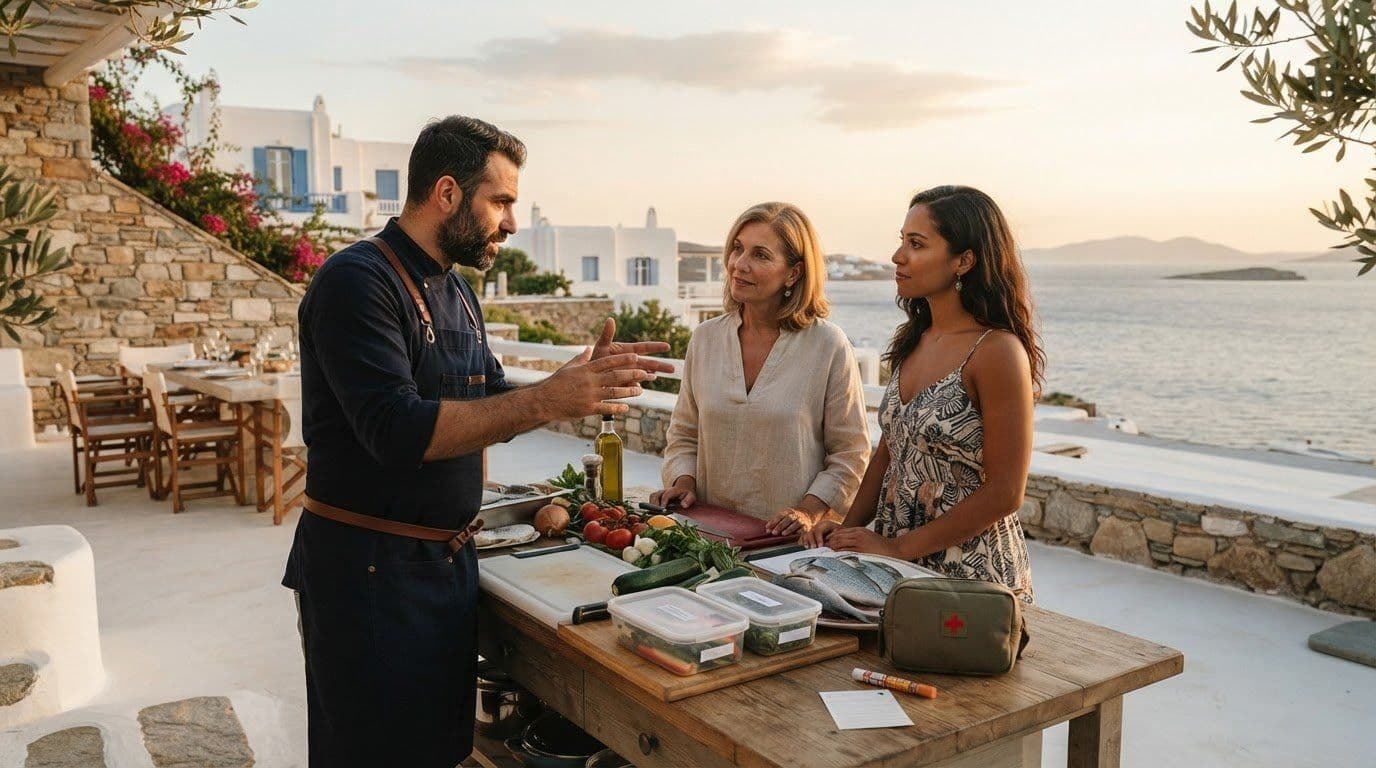
A private-chef dinner can feel personal, but it cannot make severe allergy risk disappear. Managing severe food allergies with a private chef in Paros starts with clear information, realistic expectations, and decisions guided by the guest’s medical professional.
If you’re worried about accidental exposure far from home, that concern is valid. A private chef gives you the opportunity to discuss ingredients and shape a meal around your needs, but a private setting is not automatically safer, and no menu promise can remove every risk. The important question is not simply whether a dish can be adapted. It’s whether you have enough specific information to decide what feels appropriate for you.
This guide explains what to share before travel and before a meal, how private-chef dining compares with other options, and what a tailored experience can and cannot offer. It also covers ways to communicate clearly and coordinate your plan with your clinician, travel party, and dining team during your stay in Paros.
Key Takeaways
- Understand how a severe food allergy differs from an intolerance, and why the distinction matters when planning meals away from home.
- Learn how direct menu conversations can clarify ingredients and preparation, while recognizing that a private chef cannot promise zero risk.
- Compare private-chef dining, restaurants, and self-catering by how each handles communication and meal choices.
- Use a practical planning sequence for managing severe food allergies with a private chef in Paros, including what to share with your clinician, travel party, and chef.
- See how early, written communication can help coordinate a tailored dining experience as part of your Paros stay.
Why Severe Food Allergies Change the Private-Chef Decision in Paros
Island dining can feel more complicated when a food allergy may cause a serious reaction. You’re away from familiar kitchens and routines, so even a carefully planned holiday meal calls for practical, direct communication. A private chef makes it possible to discuss a menu directly, but customization alone does not answer questions about ingredients or preparation.
A tailored menu is not proof that a meal is allergen-free. Treat menu planning as one part of an informed decision, not as a safety guarantee. Understanding the difference between an allergy, an intolerance, and a preference helps everyone involved respond appropriately.
Food allergy, intolerance, and preference are not interchangeable
A food allergy involves the immune system reacting to a food. An intolerance generally has a different cause and is not the same type of immune response. The distinction can matter when planning meals, but this article cannot determine what condition a guest has. For an accessible overview of food allergy, see Understanding Severe Food Allergies.
If a clinician has diagnosed an allergy, describe it clearly as an allergy when sharing meal details. Don’t call it a preference or a general dietary request. That wording helps the chef and travel party understand that the information is medically significant, not simply a choice about taste or ingredients. If you’re unsure how to describe a reaction or suspected allergy, ask your treating clinician. Don’t test a suspected allergen yourself to settle the question.
Why cross-contact matters in a holiday kitchen
Cross-contact happens when an allergen is unintentionally transferred to food that wasn’t meant to contain it. It differs from deliberately adding an ingredient. For example, a dish may not list a particular ingredient, yet traces could transfer through a shared utensil, work surface, storage container, or preparation area.
That’s why discussing only the recipe can leave important questions unanswered. A guest planning a meal around a severe allergy may need to explain which cross-contact concerns matter to them, based on their clinician’s guidance. Shared kitchens, equipment, and ingredients can make preparation details relevant in any dining setting. A private kitchen isn’t automatically safer than a restaurant kitchen; the setting alone doesn’t establish how food is handled.
For managing severe food allergies with a private chef in Paros, discuss both the menu and its preparation. Clear details help the dining team understand the request, while giving the guest information to make a personal, informed choice.
How a Private Chef Can Plan Around a Severe Allergy Without Promising Zero Risk
A private chef offers a direct conversation about a planned meal. That can turn a broad request into specific questions about ingredients, substitutions, and preparation. It doesn’t remove uncertainty: ingredients can change, packaged products may need review, and a chef may not control every part of a supplier’s process or the kitchen environment.
What direct menu planning can clarify
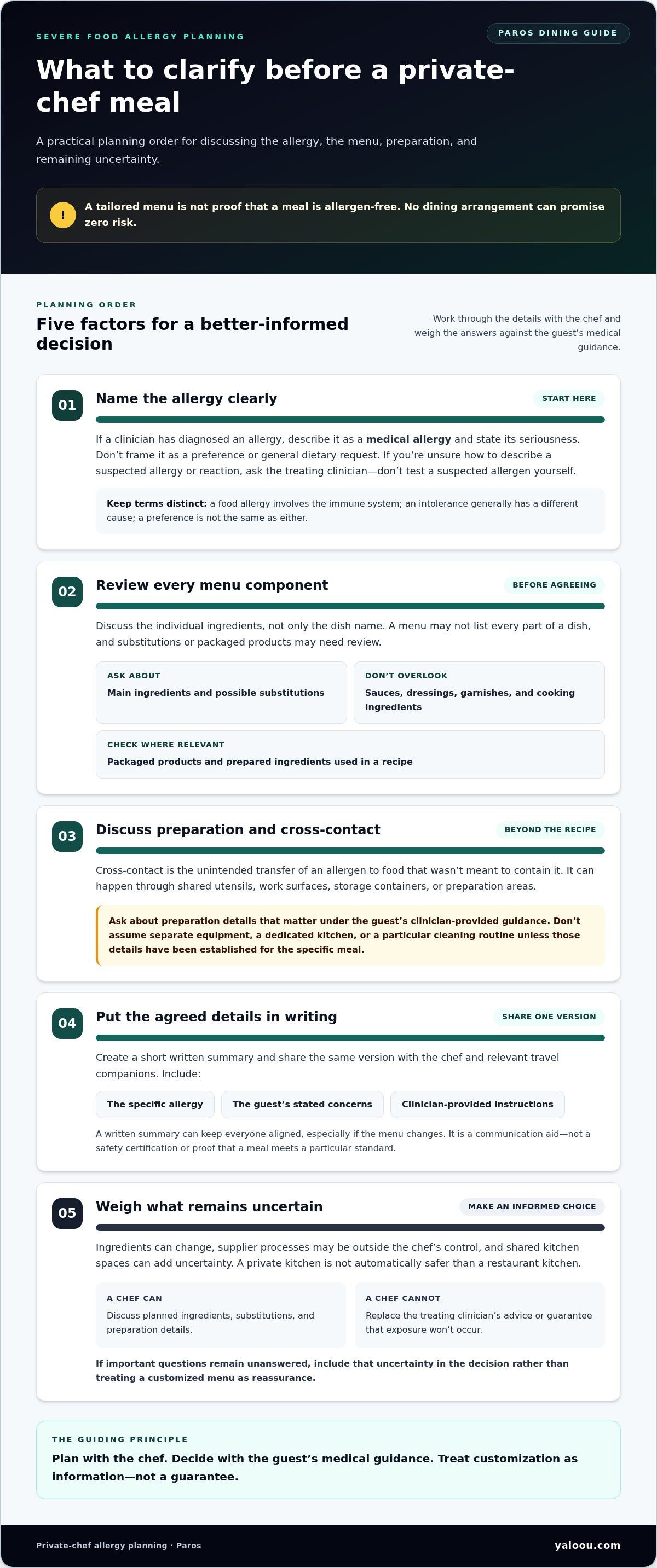
State the specific, medically diagnosed allergy and its seriousness plainly. Avoid relying on a broad label such as “dietary restriction,” which may not convey why the detail matters. Before agreeing on a menu, discuss the individual components as well as the dish name:
- Main ingredients and possible substitutions
- Sauces, dressings, garnishes, and cooking ingredients
- Packaged products or prepared ingredients used in a recipe
- Preparation details relevant to the guest’s clinician-provided guidance
For example, a menu may name a main dish without listing every sauce or garnish. Asking about those components gives the chef a clearer picture of what you need to consider. The Food Allergy Research & Education resource on Preventing Cross-Contact with Food Allergens offers further context for discussing preparation concerns.
Put the agreed details in a short written summary and share the same version with the chef and relevant travel companions. Include the allergy, the guest’s stated concerns, and any instructions provided by their clinician. This gives everyone a consistent reference, especially if the menu changes. It is a communication aid, not a safety certification or proof that a meal meets a particular standard.
What a private chef cannot guarantee
Menu customization can guide choices, but it cannot guarantee that exposure won’t occur. No dining arrangement should be described as zero-risk. Ingredients may change, products may come from suppliers with processes the chef doesn’t control, and shared kitchen spaces can add uncertainty. Don’t assume separate equipment, a dedicated kitchen, or a particular cleaning routine unless those details have been established for the specific meal.
Keep the conversation specific without treating it as a guarantee. Ask for clear information about planned ingredients and preparation, then weigh the answers against the guest’s own medical guidance. A chef can discuss the meal but is not a medical professional and cannot replace the treating clinician’s advice. If important questions remain unanswered, include that uncertainty in the decision rather than treating a customized menu as reassurance.
For guests managing severe food allergies with a private chef in Paros, the goal is a better-informed dining decision, not a promise of complete protection. YAL’OOU offers private-chef services as part of a coordinated Paros stay. Early written communication helps align the guest, travel party, and chef. Explore YAL’OOU’s curated experiences as you plan your stay.
Private Chef, Restaurant, or Self-Catering in Paros: Compare the Trade-Offs
Each dining option changes who selects the ingredients, prepares the meal, and communicates with the guest. None is automatically safer than the others. Compare the practical trade-offs, then make choices in line with the guest’s individual medical guidance.
OptionCommunicationControl and considerations
Private chef
Direct discussion about the planned menu and its components.
The menu can be discussed in advance, while kitchen setup, ingredients, and preparation still need consideration.
Restaurant
Questions and allergy details go through restaurant staff and the dining team.
The guest chooses from the restaurant’s menu, and details about ingredients or preparation may require clear communication.
Self-catering
The guest or travel party manages shopping and meal planning.
There’s more choice over groceries and preparation, alongside responsibility for unfamiliar products and the kitchen environment.
Private-chef dining at a Paros villa
At a villa, a private chef can prepare a meal where the group is staying. That makes it convenient to discuss the planned menu directly and coordinate meal timing with the day’s activities. A villa kitchen is still a specific kitchen, not a guarantee of any particular equipment, storage arrangement, or preparation setup. Guests considering private villa rentals in Paros can factor the accommodation into their dining plans while keeping allergy questions specific to the meal and kitchen.
A restaurant has its own menu, workflow, and staff communication. The guest may have less influence over preparation, but can ask about ingredients and explain their needs before ordering. With self-catering, the guest or travel party makes more of the choices, from selecting packaged groceries to preparing food. That can offer greater involvement in meal decisions, but unfamiliar labels, ingredients, or kitchen supplies may add planning work.
Restaurant dining and self-catering alternatives
Language can shape any of these conversations. A menu may use unfamiliar terms, and a packaged product’s label may be difficult to interpret. Prepare a clear written description of the allergy and relevant questions so you can communicate consistently. For managing severe food allergies with a private chef in Paros, the useful comparison is not “Which setting is safest?” but “Which setting’s communication and practical arrangements fit the guest’s needs and clinician’s advice?”
Kitchens also differ by setting. A villa kitchen is part of the accommodation, a restaurant kitchen follows its own service routines, and a yacht galley may have different workspace, equipment, and food storage. Ask setting-specific questions rather than making assumptions. Guests exploring yacht options in Greece can consider how onboard dining fits their plans alongside other meal arrangements.
A Paros Allergy-Planning Checklist for Before Arrival and Mealtime
A simple, shared plan keeps essential allergy information clear as travel arrangements and meal details take shape. Start with the guest’s clinician, then communicate early with the travel organizer and chef. Review the key points again before preparation begins. This checklist supports planning, but it doesn’t replace personal medical advice.
Before the trip: prepare a clear allergy brief
Build the brief from the guest’s own medical guidance. Keep it factual and easy to share, so everyone involved can refer to the same information instead of relying on memory or assumptions.
- Follow the clinician’s guidance. Ask the treating clinician what information the dining team needs, what precautions are relevant, and how to describe the guest’s needs while travelling. Base the plan on the clinician’s instructions.
- Write the allergy details clearly. Name the specific diagnosed allergen, describe the reaction’s severity as advised by the clinician, and record relevant cross-contact concerns. Avoid broad phrases such as “food sensitivity” if they don’t accurately explain the medical need.
- Include emergency instructions from the care plan. Note any prescribed emergency medication and response directions only as provided by the clinician. Don’t add doses, treatment advice, or steps based on guesswork.
- Share the brief during meal planning. Send it to the travel organizer and chef early enough to inform menu discussions. If the guest is travelling with others, make sure relevant companions know where the written plan is and understand their role.
- Plan for language clarity. If details need to be communicated in another language, use wording reviewed by a qualified professional or the guest’s clinician. Don’t rely on an unverified translation for critical allergy or emergency information.
Before and during the meal in Paros
Use the written brief to guide a final, direct conversation. Keep it short and consistent. Confirm the planned dishes and ingredients before preparation starts, and restate the allergy and the concerns that matter for this guest.
- Review menu changes. If an ingredient, sauce, garnish, or packaged product changes, pause to discuss it before the meal proceeds. Don’t assume a previously discussed dish remains the same after a substitution.
- Keep prescribed medication accessible. Follow the guest’s personal medical plan and make sure the emergency instructions are available to the people who need them.
- Respond to a reaction according to the plan. Follow the clinician-provided emergency instructions and seek urgent medical care. Don’t wait for dining staff to determine what medical response is needed.
For managing severe food allergies with a private chef in Paros, early written communication gives the guest, travel party, and chef a shared reference point, while the clinician’s guidance remains central. To coordinate a tailored dining experience as part of your stay, explore YAL’OOU’s Paros experiences.
Plan a Tailored Private-Chef Experience in Paros with YAL’OOU
A private-chef meal can be one part of a thoughtfully coordinated Paros stay. YAL’OOU offers private-chef services within its concierge offering, so guests can plan a dining experience alongside other travel arrangements. For guests managing a severe allergy, the aim is clear coordination, not a medical solution or a promise that a meal will be free from risk.
Make allergy communication part of the experience plan
Bring the meal details together in one written brief. Include the guest’s clinician-provided guidance and allergy information, along with practical preferences such as meal timing, dishes they enjoy, and ingredients they’d like to discuss. Keeping those details together gives the guest, travel party, and chef a shared reference as the experience takes shape.
Share the brief early, while there’s time to discuss the menu. If plans or ingredients change, update the people involved and restate the relevant allergy details before the meal. Clear, consistent communication can reduce misunderstandings, especially when several companions are helping coordinate a holiday. It does not certify a kitchen or guarantee a particular outcome.
YAL’OOU coordinates tailored travel experiences in Paros. That coordination can bring the guest’s dining plans into the wider stay, while decisions about acceptable risk and medical precautions remain with the guest and their treating clinician. A chef can discuss the meal but should not be treated as a substitute for medical advice.
Choose your next planning step
Before planning, gather three essentials: the guest’s current medical guidance, a written summary of the diagnosed allergy and relevant concerns, and clear meal preferences. Add clinician-provided emergency instructions where appropriate, and make sure the people involved know which details are essential. Keep the brief easy to update if preferences or plans shift.
Use that information to start a focused conversation about the experience. Discuss what kind of meal suits the occasion, when it fits into the day, and which questions about ingredients or preparation need answers. Consider the responses in light of the guest’s care plan. If important details remain uncertain, factor that into the decision rather than assuming a customized menu resolves every concern.
For managing severe food allergies with a private chef in Paros, good planning means aligning the travel experience with informed, personal choices. Explore private experiences in Paros as you shape your stay, with medical decisions guided by the guest’s clinician and no assumption that any meal is allergen-free.
Shape a Paros Stay That Fits Your Needs
Let your dining plans support the island stay you want, without expecting any single arrangement to remove uncertainty. Managing severe food allergies with a private chef in Paros is a personal decision shaped by your medical guidance, the information available, and your comfort with the details of a proposed meal.
As you plan your itinerary, consider how dining fits with the rest of your day. A relaxed meal at your accommodation may suit one occasion, while another plan may feel more appropriate on a different day. Give yourself room to make those choices thoughtfully, and adjust plans if new information changes your comfort level.
YAL’OOU’s concierge support helps bring tailored experiences into the rhythm of a Paros stay. Its Greek travel planning spans Mykonos, Paros, Antiparos, Athens, Aegina, Poros, Spetses, Syros, Tinos, Sifnos, Serifos, Milos, Poliaigos, Kimolos, Santorini, Ios, Koufonisia, Amorgos, Crete, Corfu, and Zakinthos. Explore tailored experiences in Paros and start planning your stay with YAL’OOU.
Frequently Asked Questions
Is a private chef safer than a restaurant for severe food allergies?
Not automatically. A private chef may offer a more direct conversation, but that alone doesn’t show that a meal is safer. Consider how clearly each setting can explain the planned dishes and what information is available about ingredients and preparation. A restaurant may have established menu information, while a private meal can be discussed individually. Neither setting guarantees an outcome, so use the guest’s clinician’s advice to guide the decision.
Can a private chef guarantee an allergen-free meal in Paros?
No dining arrangement should be presented as completely risk-free. Even if a proposed recipe avoids a named allergen, a substitution or an ingredient’s source may raise questions that the menu description does not answer. Before accepting a meal plan, consider what information is available and whether it addresses the guest’s concerns. The guest’s clinician can help them decide what level of uncertainty is acceptable for their situation.
What should I tell a private chef about a severe food allergy?
For managing severe food allergies with a private chef in Paros, share the diagnosed allergen and explain the seriousness in plain, specific language. For instance, identify whether the concern applies to a particular ingredient or also to possible traces, based on the guest’s medical guidance. Include the guest’s own emergency-plan instructions, not advice you’ve added yourself. Ask the chef to discuss the proposed menu in enough detail for the guest to make an informed choice.
How far ahead should I discuss food allergies with a private chef in Paros?
Raise the allergy as soon as meal planning begins, rather than waiting until arrival or the day of the meal. This gives the people coordinating the experience time to discuss the request alongside the itinerary. For example, a planned dinner after a full day out may call for different timing than a meal at the start of the stay. The right lead time depends on the arrangements, so share the details as early as you can.
Can a private chef in Paros prepare traditional Greek food for someone with allergies?
A traditional Greek menu can be discussed, but a dish name alone may not reveal every ingredient. Ask about the full recipe, including components such as tahini, cheese, yogurt, filo pastry, sauces, and garnishes where relevant to the allergy. Recipes can vary, so don’t rely on a familiar name as a complete ingredient list. If you need another language, use professionally reviewed wording for allergy information instead of guessing at translations.
What happens if someone has an allergic reaction during a private-chef meal?
Follow the person’s clinician-provided emergency plan immediately. Use prescribed emergency medication only as directed, and seek urgent medical care in line with that plan and the situation. Don’t wait for the chef or another companion to decide whether a reaction is serious. Before the meal, make sure the people present know where the written instructions and medication are kept, and who will act if the guest needs help.
What should I do if the proposed menu changes after I share an allergy?
Pause and review the changed dish before it’s prepared or served. A new sauce, garnish, side dish, or packaged ingredient can change the information you previously discussed. Ask for the updated ingredient details and consider them against the guest’s medical guidance. If the change can’t be clearly understood, don’t assume the original discussion still applies; the guest should decide whether to proceed based on their care plan.
Disclaimer
The YAL’OOU Travel Guide is curated with care to inspire and inform discerning travelers. While every effort is made to ensure the accuracy and relevance of the information provided, all content is offered for general guidance only and may evolve over time.
Details such as local regulations, availability, pricing, and services are subject to change without prior notice. We encourage guests to seek personalized advice and confirm arrangements directly when planning their journeys.
YAL’OOU accepts no liability for any inaccuracies, omissions, or outcomes arising from the use of this information. The Travel Guide may feature recommendations, insights, and selected third-party experiences, presented solely as a source of inspiration and not as formal endorsements.
By accessing this section of our website, you acknowledge and accept this disclaimer as part of your experience with YAL’OOU.