
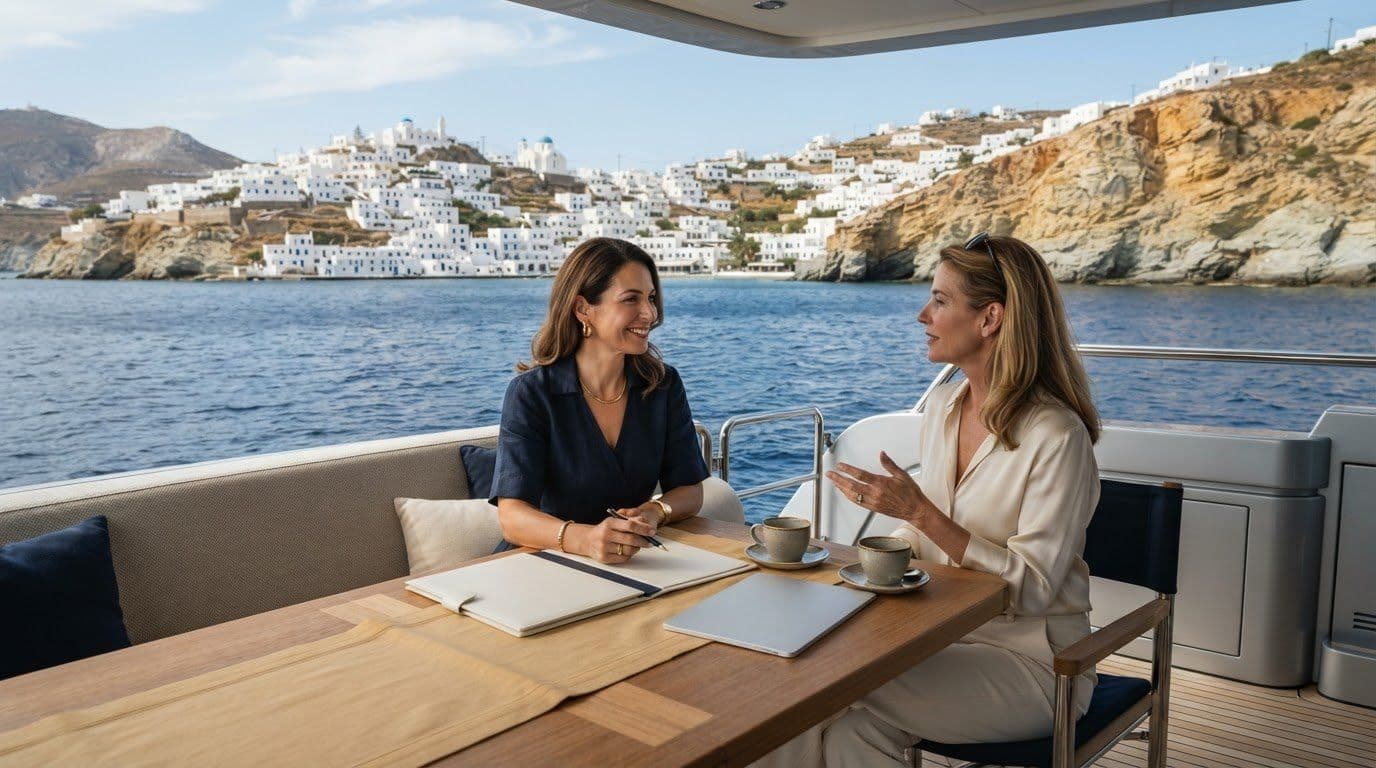
What makes a Greek yacht journey feel personal is not only the itinerary, but also the relationship behind the planning. Maintaining a relationship with a trusted yacht broker starts with open conversation. You do not need to have every detail figured out before sharing what matters to you, especially when preferences may change.
A useful working relationship develops as you explain what you enjoy, what you would rather avoid, and how your plans evolve. Those details help guide conversations about pace, destinations, and the experience you want. Local knowledge can also bring relevant possibilities into view, while keeping the decisions in your hands.
This article explains how to communicate preferences clearly, keep your broker informed when plans shift, and build continuity for future Greek yacht experiences. From the first conversation to another island escape, thoughtful communication helps make planning more personal and considered.
Key Takeaways
- Build trust through mutual clarity, discretion, realistic expectations, and steady communication, not familiarity alone.
- Make your charter brief easier to act on by separating must-haves, flexible preferences, and open questions.
- Notice whether planning feels relationship-led: look for careful listening, useful local context, clear expectations, and continuity.
- Make maintaining a relationship with a trusted yacht broker a simple habit: revisit priorities, share changes, discuss options, and reflect after each journey.
- YAL’OOU’s curated routes, crew coordination, and local partnerships support a personal Greek yacht-charter experience.
What a Trusted Yacht Broker Relationship Means for Your Charter
A trusted yacht-broker relationship is more than a familiar name in your inbox. It is a working partnership built on clarity, discretion, realistic expectations, and responsive communication. You explain what matters; the broker listens, presents options plainly, and keeps your priorities central to the conversation. Trust grows through consistent actions, not promises alone.
A trusted yacht-broker relationship is a collaborative planning partnership where clear advice and personal preferences guide each charter decision. Personal service should make it easier to express what you want, not pressure you to accept a particular yacht, route, or arrangement. The choices remain yours, supported by an informed discussion.
A broker can connect a traveler with yacht options and help shape a charter. For a concise overview of the broader role, see What is a Yacht Broker? In practice, the value of the relationship shows in the details: explanations are understandable, expectations are grounded, and your preferences carry through the planning conversation.
What should a traveler expect from a trusted broker?
Look for observable habits. A broker listens before proposing options, checks their understanding of your priorities, and explains trade-offs without making every choice sound urgent. If you say you value a slower pace, for example, that preference should inform the discussion rather than disappear when route ideas come up. Questions and changing opinions are part of planning.
Trust grows through repeated interactions. A single warm conversation can make a good first impression, but consistency helps you judge whether the working relationship fits. The broker brings knowledge and perspective; you bring your priorities and make the decisions. That balance keeps expert guidance useful without making the experience feel transactional or pressured.
Why does continuity matter when planning a yacht charter?
An ongoing relationship can give future conversations a useful starting point. A concise understanding of your preferences, such as the pace you enjoy, the kinds of stops that appeal, or what you would rather avoid, means you may not need to rebuild the entire picture each time. You can revise any preference as your plans or interests change.
That context can also make route discussions more relevant. Someone drawn to lively island visits may want to explore different possibilities from a traveler who prefers a slower rhythm. In Greece, local destination knowledge can help frame the conversation around the experience you want while leaving room to discover something new. Maintaining a relationship with a trusted yacht broker means building shared context over time, not expecting every future charter to be identical.
How Communication and Shared Expectations Build Trust
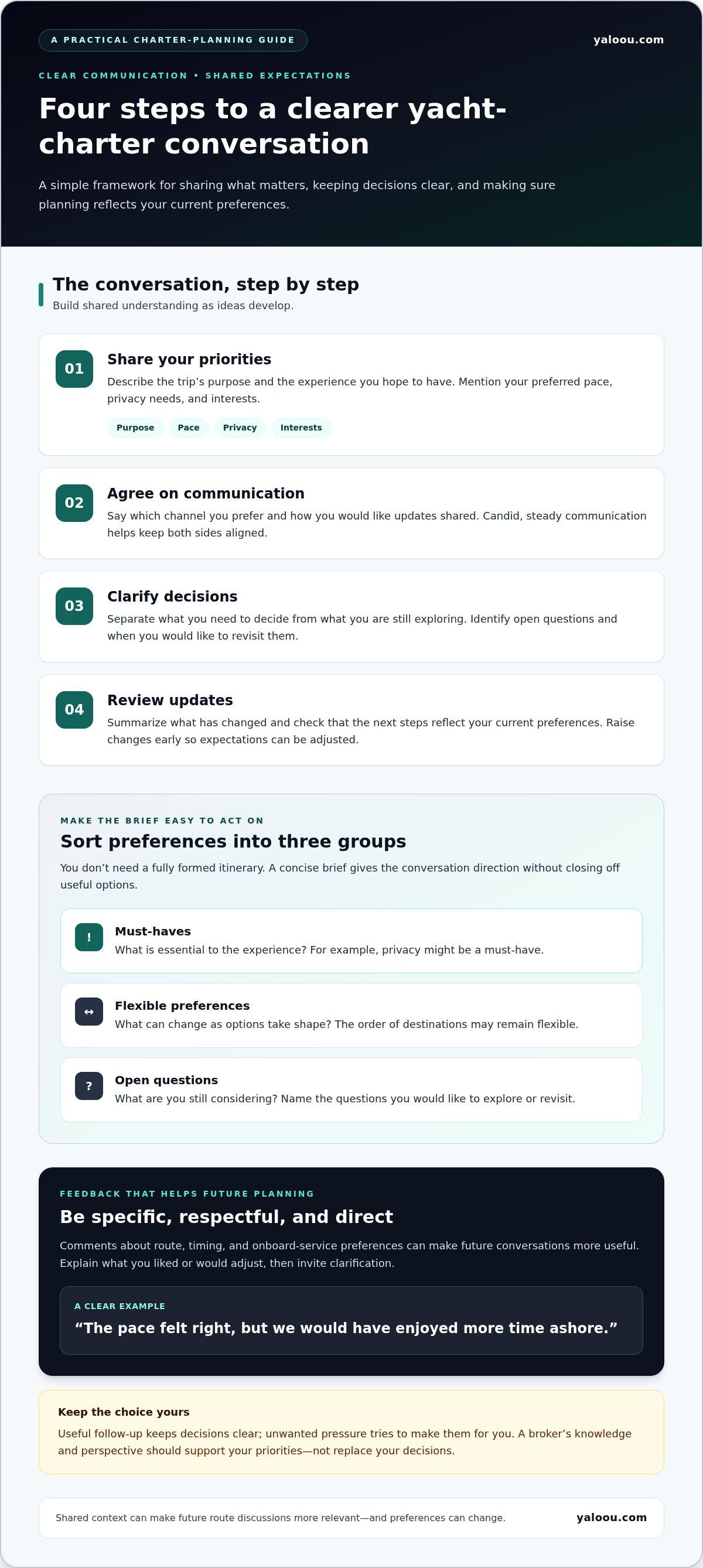
Good charter planning does not require a long, complicated brief. It does require the right information at the right time and a shared understanding of how decisions and updates will work. Use this simple framework to keep conversations clear as ideas develop:
- Share priorities. Explain the trip’s purpose, preferred pace, privacy needs, and interests.
- Agree on communication. Say which channel you prefer and how you would like updates shared.
- Clarify decisions. Identify what you need to decide, what you are still exploring, and when you would like to revisit open questions.
- Review updates. Summarize what has changed and make sure the next steps reflect your current preferences.
This structure makes it easier to raise a change early, whether you are reconsidering the pace or want to explore a different Greek destination. Clear updates give both sides a chance to resolve misunderstandings before they shape expectations. Professional conduct matters, too. The Yacht Brokers Association of America (YBAA) Standards offer a reference point for the competence and ethical conduct expected in yacht brokerage.
What information helps a broker understand your preferences?
Start with the experience you hope to have, not a fully formed itinerary. Are you marking a special occasion, seeking a slower escape, or hoping to discover Greek islands? Then separate must-haves from flexible preferences and open questions. For example, privacy might be essential, while the order of destinations remains undecided. Describe service preferences in plain language, too. You do not need to guess technical details or describe features you are unsure about. A concise brief gives the conversation direction without closing off useful options.
How can clients give feedback that improves future planning?
Be specific, respectful, and direct. “The pace felt right, but we would have enjoyed more time ashore” gives a clearer signal than “We wanted something different.” Feedback on route, timing, and onboard-service preferences helps shape future conversations. Keep it reciprocal: explain what you liked or would adjust, then invite the broker to clarify how the options were approached. That openness makes feedback useful rather than adversarial.
Useful follow-up keeps decisions clear; unwanted pressure tries to make them for you. Maintaining a relationship with a trusted yacht broker means keeping communication candid as plans evolve, not agreeing to every suggestion. If you are shaping ideas for a Greek journey, browsing YAL’OOU’s private yacht experiences in Greece can help you identify destinations and experiences to discuss.
How to Recognize a Broker Relationship That Fits Your Needs
A good fit is not defined by one communication style. Some travelers want detailed options and active involvement; others prefer concise updates and room to make decisions at their own pace. Look for a working rhythm that respects your preferences and keeps planning clear. Rather than judging a relationship by warmth or frequent contact alone, notice what the broker does with the information you share.
Use these observable behaviors to assess whether planning feels transactional or relationship-led:
- Communication: Updates address the decisions at hand, and you can agree on how you prefer to receive them.
- Listening: Your priorities are reflected accurately instead of being replaced with assumptions about what travelers usually want.
- Local context: Route ideas connect to the places and experiences you are considering, with clear explanations of relevant choices.
- Expectation-setting: Trade-offs, open questions, and next steps are discussed plainly rather than glossed over.
- Continuity: Preferences you have already shared inform later conversations, while you remain free to change them.
These signs do not require constant contact or elaborate reports. They show whether the conversation is helping you make informed choices. Professional associations also provide context for industry conduct: the International Yacht Brokers Association (IYBA) Professionalism resource offers a reference point for professionalism and ethics in yacht brokerage. In your own planning, what matters is how clearly and consistently your priorities are handled.
Which signs show that a broker understands your priorities?
Listen for an accurate reflection of what you have said. If you express interest in a slower pace, recommendations should connect to that preference rather than default to a packed itinerary. A useful conversation also makes trade-offs visible: what a route may emphasize, which decisions remain open, and where your priorities might point in different directions. This gives you a chance to correct misunderstandings before they shape the plan.
How does local knowledge strengthen a charter conversation?
Destination familiarity can make route discussions more specific. Mykonos, Paros, Delos, and Rhenia each bring different possibilities to a Greek island journey. A meaningful conversation connects those places to your interests and preferred pace instead of treating destinations as interchangeable names. YAL’OOU curates private yacht experiences across Greek destinations and tailors routes around the journey. For broader itinerary context, explore this Greek island yacht-charter guide.
The right fit makes it easier to express your preferences and understand the choices before you. That is a practical foundation for maintaining a relationship with a trusted yacht broker: not matching someone else’s idea of ideal service, but finding a collaborative approach that works for you.
Practical Habits for Maintaining a Yacht-Broker Relationship
A useful broker relationship does not need constant contact. It benefits from a simple rhythm that keeps your priorities current, makes changes easy to discuss, and turns each charter into useful context for the next. Keep a short preference summary in whatever format suits you. A few notes can capture what matters and what remains flexible.
Use this four-step routine as plans take shape:
- Revisit priorities. Before a new conversation, review what you most want from the trip. Note preferred destinations, pace, privacy priorities, and any questions you want to resolve.
- Share changes. Explain what is different since your last discussion, such as a new travel purpose or a shift from an active itinerary to a more relaxed one. Also state what still matters.
- Discuss options. Explore how possible routes and arrangements align with your priorities. Ask for clear explanations of trade-offs, and keep open questions visible rather than treating them as settled decisions.
- Reflect after the experience. Capture what felt memorable, what you would adjust, and which preferences you would carry forward. Share that feedback while the details are still fresh.
How should you prepare for a new charter conversation?
Keep preparation light but specific. A concise note might say, “We would like a slower pace, value privacy, and are interested in island stops; we are open on the exact route.” That gives a broker a clear starting point without locking you into every detail. Browse YAL’OOU’s private yacht experiences for route inspiration, then identify which destinations or experiences you would like to discuss.
Your summary should evolve with you. A preference that mattered on one trip may be less important on another. Mark what is essential, what is flexible, and what you are curious about. This small distinction helps prevent an old note from being treated as a permanent instruction and makes it easier to keep expectations realistic as ideas develop.
How can post-trip feedback support future journeys?
After the charter, take a moment to identify the details that shaped the experience. Perhaps the pace felt ideal, you especially enjoyed a particular destination, or you would prefer different onboard services next time. Be constructive and precise: “We would like more unstructured time” is easier to use than “Make it more relaxing.” Not every preference will suit every route, but useful feedback gives future planning a more personal starting point.
Over time, this practice makes maintaining a relationship with a trusted yacht broker more meaningful. Each conversation can build on what you have learned while leaving room for new ideas. Keep the summary brief, update it when your priorities shift, and use it to start a dialogue, not dictate a fixed plan. Your Greek yacht journeys can change with the moment while communication stays clear and collaborative.
Building a Personal Greek Charter Relationship with YAL’OOU
A Greek yacht journey should feel shaped around the traveler, not pulled from a template. YAL’OOU’s approach centers on privacy, ease, and authentic Greek hospitality. Those values give an ongoing broker relationship practical purpose: as you share what matters, planning can reflect your preferred rhythm and the kind of island experience you want to create.
YAL’OOU coordinates tailored routes, crews, and local supplier partnerships as part of its yacht-charter work. That coordination brings the pieces of a journey into one conversation. You can discuss the overall experience you have in mind, then consider how route ideas and onboard services might support it. The aim is thoughtful, personal planning, with clear communication and room for your preferences to evolve.
What does personal charter planning look like in Greece?
Start with your priorities, then use them to guide the discussion about destinations and pace. If Mykonos is important to your plans, consider what you hope to experience there. If you are drawn to Paros or Antiparos, share what appeals to you. These preferences can shape a conversation about possible routes without assuming a fixed itinerary or adding destinations that do not fit your plans.
Some travelers want a lively island atmosphere; others value privacy and a more unhurried feel. You might focus on one island or explore how different places could fit the journey. Share what feels essential and what you are open to shaping. YAL’OOU’s listed experiences include “Mykonos Southern Coast - Private 5-hour yacht experience,” “Antiparos & Panteronisi from Paros - Private 5-hour yacht experience,” and “Sifnos Tsocha Beach Fikiada and Vathi - Private 8-hour yacht experience.” For broader charter-planning context, explore YAL’OOU’s yacht charter guide.
How can you begin planning your next experience?
Bring three simple starting points to the conversation: the Greek destinations you are curious about, the pace you would enjoy, and how important privacy is to your plans. Add any preferences from a previous journey that you would like to carry forward, along with anything you would like to change. You do not need a finished itinerary. A few clear thoughts can give planning direction while leaving room for local insight and new possibilities.
This is where maintaining a relationship with a trusted yacht broker becomes part of the experience itself. Shared context can help future conversations begin with a better sense of what you value, while each journey remains its own. YAL’OOU’s curated yacht experiences bring together personal planning and Greek hospitality, with room for the details that make a charter feel like yours.
Browse the destinations and experiences that spark your interest, then use those ideas to guide your planning conversation. Explore private yacht experiences.
Let Your Next Greek Journey Take Shape
Your next charter does not have to repeat the last one. Let a new interest, a different pace, or a destination you have been curious about shape the conversation. Maintaining a relationship with a trusted yacht broker gives those evolving ideas somewhere to begin, while leaving room for the unexpected discoveries that make a journey feel personal.
YAL’OOU’s approach is rooted in privacy, ease, and authentic Greek hospitality. Its curated private yacht experiences include routes in Mykonos, Paros, Santorini, Delos, Rhenia, and Sifnos. The listed experiences also connect with destinations such as Antiparos and Ios. These routes can inspire a journey shaped around what matters to you. Start with the feeling you want to take home, then explore the places that might bring it to life.
Explore YAL’OOU’s private yacht experiences and let your next Greek escape begin with a spark of inspiration. Your next journey can be entirely its own.
Frequently Asked Questions
How do you build trust with a yacht broker?
Trust grows through clear expectations, attentive listening, transparent conversations, and consistent follow-through. Share what matters to you and ask questions whenever a choice or detail is unclear. For example, if a proposed route differs from what you pictured, explain your concern and invite a practical discussion. A broker’s title alone cannot establish trust; you learn whether the relationship works through observable interactions over time.
How often should I communicate with my yacht broker?
There is no single communication schedule that suits every trip. Agree on a rhythm that fits your planning stage and personal preferences, such as discussing updates when a decision is ready or a key detail changes. Keep messages concise and useful: mention the change, explain its relevance, and note any decision needed. This helps distinguish practical coordination from unnecessary contact without assuming a particular response time.
Can I keep working with the same yacht broker for future trips?
Yes. An ongoing relationship can give future planning a familiar starting point and save you from restating every preference. Before discussing another journey, make a quick note of what worked well, what you would change, and what is new in your plans. Maintaining a relationship with a trusted yacht broker can create continuity, but it should not lock you into past choices. Each itinerary should reflect your current priorities.
What should I tell a yacht broker before planning a charter?
Share the trip’s purpose, destinations you are considering, preferred pace, privacy priorities, and the needs that matter to your group. Separate essentials from preferences you are happy to discuss, such as a destination you are keen to visit versus a route you have not decided on. You do not need every answer before starting. A useful first conversation can clarify what information is still needed as planning develops.
How can I raise a concern with my yacht broker?
Raise it directly and respectfully. Describe the specific decision or expectation that concerns you, explain how it affects your plans, and ask for clarification or a discussion of next steps. For example, if an itinerary no longer fits your preferred pace, say what feels mismatched and what you would like to reconsider. Clear wording helps both sides understand the issue; avoid assuming intent before hearing the broker’s perspective.
Does a yacht broker help tailor a Greek island itinerary?
A charter broker can discuss route preferences and coordinate a tailored experience around your priorities. YAL’OOU’s curated private yacht experiences include Greek destinations such as Mykonos, Paros, Santorini, Delos, Rhenia, Sifnos, Antiparos, and Ios. You can begin by describing the pace and atmosphere you are seeking, then discuss which places interest you. That gives the conversation direction while leaving itinerary decisions open to your plans.
What if my travel preferences change after I start planning?
Tell your broker as soon as your priorities shift, and explain what has changed and what remains important. A new preference, such as wanting more time ashore, may affect other itinerary choices, so discuss possible trade-offs rather than assuming earlier decisions still fit. You can also distinguish a firm change from an idea you are exploring. That helps keep the planning conversation aligned with your current needs.
Disclaimer
The YAL’OOU Travel Guide is curated with care to inspire and inform discerning travelers. While every effort is made to ensure the accuracy and relevance of the information provided, all content is offered for general guidance only and may evolve over time.
Details such as local regulations, availability, pricing, and services are subject to change without prior notice. We encourage guests to seek personalized advice and confirm arrangements directly when planning their journeys.
YAL’OOU accepts no liability for any inaccuracies, omissions, or outcomes arising from the use of this information. The Travel Guide may feature recommendations, insights, and selected third-party experiences, presented solely as a source of inspiration and not as formal endorsements.
By accessing this section of our website, you acknowledge and accept this disclaimer as part of your experience with YAL’OOU.