
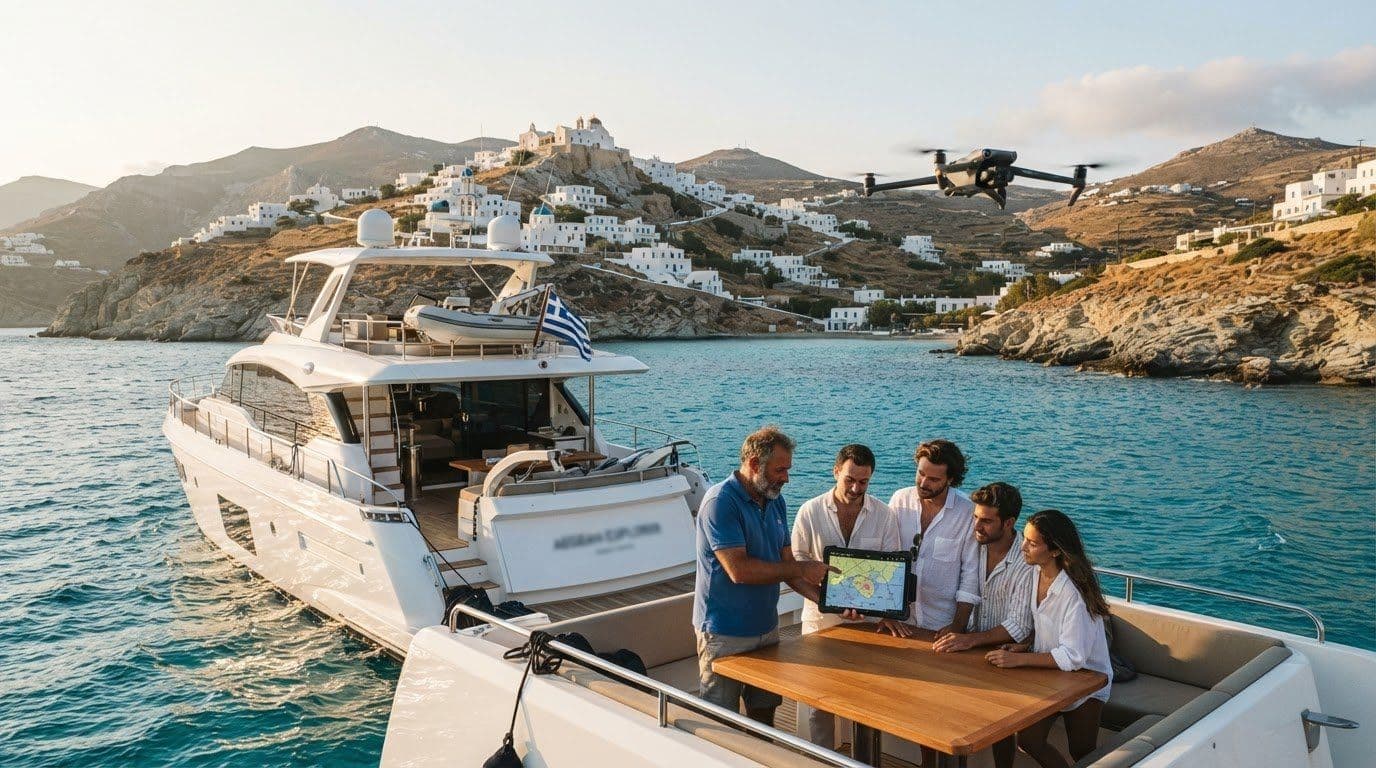
Can you film from a yacht in Greece with a drone? Sometimes, but a beautiful anchorage doesn’t automatically mean a flight is allowed. The drone filming rules for yacht charters in Greece combine EU requirements with Greek airspace restrictions. Check the location before you launch, not after the perfect shot appears.
It’s natural to want sweeping views of the islands and a personal film to remember the trip. The best footage, though, comes from a plan that respects the rules, protects other people’s privacy and keeps the crew and charter experience running smoothly. A drone also needs a safe launch and recovery plan, especially when the yacht is moving.
This 2026 guide explains what to verify through current official sources, including the Drone Aware GR (DAGR) map, and why restricted zones and archaeological sites need particular care. You’ll also find practical ways to plan considerate filming around people, other boats and the day’s route. Get the checks right, and your Greek-island film can complement the charter rather than take it over.
Key Takeaways
- The drone filming rules for yacht charters in Greece depend on the flight, location and current restrictions, so don’t assume permission.
- Use a repeatable pre-flight sequence: identify the location, consult current HCAA guidance and official Greek airspace tools, then confirm what applies before deciding to fly.
- A yacht’s movement, wind, visibility and recovery conditions can change quickly. Include them in the go-or-no-go decision instead of trying to solve them mid-flight.
- Plan around the charter route, coordinate with the crew, respect people’s privacy and have a non-drone filming option ready.
- Keep the charter at the heart of the day. The Mykonos Southern Coast - Private 5-hour yacht experience offers a setting for a personal island film, with filming kept optional.
Drone filming rules for yacht charters in Greece: what to know before you fly
A drone can turn a Greek-island cruise into a striking personal film, but the view from the deck doesn’t determine whether a flight is allowed. The drone filming rules for yacht charters in Greece depend on the operation, the precise location and any restrictions in force at the time. A flight that may be possible in one area could be restricted in another.
This section focuses on recreational filming from a yacht, not commercial aviation advice. EU drone rules are risk-based, so the flight’s category depends on how and where you intend to operate, not simply on whether you’re filming for yourself. An overview of drone technology and applications can help explain the range of devices and uses, but it can’t establish whether a particular flight is permitted in Greece.
Does a private yacht charter allow drone filming in Greece?
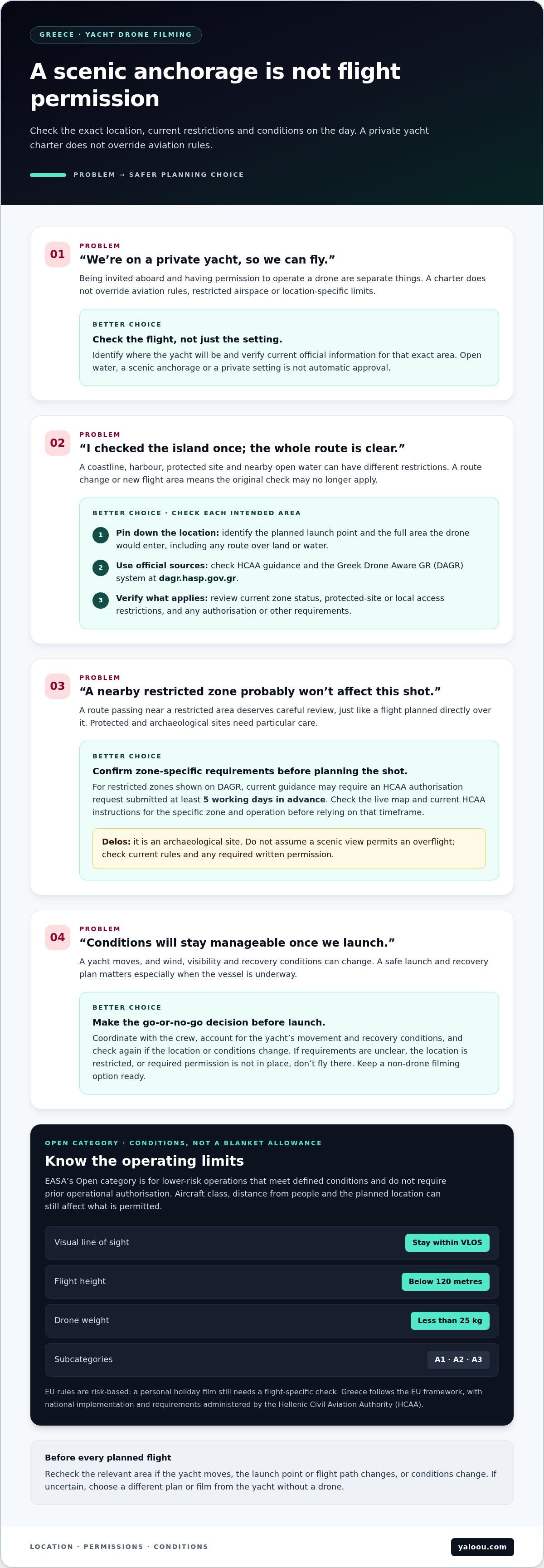
Being invited aboard a private yacht and having permission to fly a drone are separate matters. A charter arrangement doesn’t override aviation rules, restricted airspace or location-specific limits. Before planning a shot, identify where the yacht will be and check current official Greek information for that exact area. Don’t treat a scenic anchorage, open water or the yacht’s private setting as automatic approval.
Which rules apply to a drone pilot in Greece?
Greece follows the EU framework set by the European Union Aviation Safety Agency (EASA), including Regulations (EU) 2019/947 and 2019/945, with national implementation and requirements administered by the Hellenic Civil Aviation Authority (HCAA). EU-wide rules and Greek-specific restrictions may both apply. The rules focus on operational risk rather than drawing a simple line between recreational and commercial flying, so a personal holiday film still needs a flight-specific check.
What does the Open category mean?
The Open category is EASA’s lower-risk category for drone operations that meet defined conditions and don’t require prior operational authorisation. In general, the operation must stay within visual line of sight and below 120 metres, and the drone must weigh less than 25 kilograms. The category is divided into A1, A2 and A3 subcategories, each with its own conditions. These are not blanket allowances: aircraft class, distance from people and the planned location can affect what’s permitted.
For a yacht guest, the takeaway is simple: a familiar drone and a recreational purpose don’t settle the question. Check current HCAA guidance and official Greek airspace tools before each planned flight. If your operation doesn’t meet Open-category conditions, a different category and authorisation process may apply. Requirements depend on the details, so verify them through current official sources rather than relying on an old travel summary or a previous flight elsewhere in Greece.
How to check Greek drone zones and authorisation requirements before filming
Plan around the exact flight area, not just the island on your itinerary. A coastline, harbour, protected site and nearby stretch of open water can have different restrictions. The drone filming rules for yacht charters in Greece are location-specific, and conditions may change, so build the checks into your planning rather than making a last-minute decision on deck.
Checking a destination once does not clear every flight location. If the yacht moves, the intended take-off point or flight path changes, or conditions change, check the relevant area again. Follow this sequence:
- Pin down the location. Identify the planned launch point and the area the drone would enter, including any route over land or water.
- Check official airspace information. Use HCAA guidance and the official Greek Drone Aware GR (DAGR) system. DAGR is available at dagr.hasp.gov.gr.
- Verify what applies. Check the current zone status, any protected-site or local access restrictions, and whether your operation requires authorisation or other steps.
- Decide before launch. If requirements are unclear, the location is restricted, or the relevant permission is not in place, don’t fly there. Choose a different plan or film from the yacht without a drone.
How to check a planned Greek island location
For example, a charter itinerary might include Mykonos, Paros, Santorini or Delos. Treat each intended take-off and flight area as a separate check, even if two locations are close together. Review current DAGR information and HCAA guidance, then verify restrictions for protected or archaeological sites and local access. Delos is an archaeological site, so don’t assume a scenic view permits an overflight. Check current rules and any required written permission before planning one.
For restricted zones shown on DAGR, current guidance may require an HCAA authorisation request submitted at least five working days in advance. Check the live map and current HCAA instructions for the specific zone and operation before relying on that timeframe. A route that passes near a restricted area deserves the same careful review as a planned flight directly over it.
When registration, training or authorisation may apply
Requirements can depend on the drone’s class and weight, the operation and its category. Check current EASA and HCAA guidance for the relevant operator-registration, pilot-training and authorisation rules. This matters for visiting pilots too: whether an existing registration or certificate applies can depend on where it was issued and the operator’s circumstances.
Regulatory snapshot: October 2026. Recheck HCAA guidance and DAGR close to publication, and again before each planned flight. For a charter that prioritises the journey as much as the views, explore private yacht experiences in Greece while keeping any aerial filming plan flexible.
What makes drone filming from a yacht different from filming ashore?
On land, a pilot can usually choose a stable launch point and assess the surroundings from fixed ground. At sea, the launch platform may move, the yacht may change position, and wind or visibility can shift during the outing. A camera plan that looks straightforward from shore may be difficult to execute from a deck.
That difference affects both the flight and the return. The pilot needs to judge whether they can maintain control and visual awareness, keep clear of people and other vessels, and recover the drone without creating risk. Calm conditions at departure don’t guarantee suitable conditions later. The pilot must assess the actual conditions and follow the applicable rules, without treating any flight as assured safe.
Launch and recovery from a moving vessel
Agree on a possible launch and recovery window with the captain or crew before the yacht is underway. Their priorities remain navigation and onboard safety, so filming should never distract from either. The pilot should assess whether conditions and surroundings are suitable, including whether the deck is stable enough and whether there’s room to handle the aircraft without involving other guests. If not, don’t launch.
Recovery deserves as much thought as take-off. The yacht may have moved, nearby traffic may have changed, or the wind may have become less manageable. Don’t ask the crew to alter navigation or rush a manoeuvre for a shot. A no-flight decision is responsible planning, not a failed filming plan. Capture the coastline from the deck instead and let the day continue at its own pace.
Privacy and respectful filming around Greek islands
A wide island view can still include identifiable people, swimmers, neighbouring boats or private outdoor spaces. Frame carefully, avoid lingering over people or homes, and seek appropriate consideration and permission before recording identifiable individuals. Privacy obligations may also apply to footage, so don’t assume that filming from offshore makes every subject fair game.
Scenery doesn’t cancel location restrictions. A public-looking beach, harbour or landmark may sit near a restricted or protected area, and archaeological sites need particular care. For example, the itinerary title Rhenia, Delos & Mykonos South Coast - Private 8-hour yacht experience names a charter setting; it doesn’t mean drone flights near or over Delos are cleared. Check the exact flight area and applicable site restrictions before planning a shot.
Build a simple go-or-no-go check into the filming plan. Pause if wind, vessel movement, visibility, nearby activity or privacy concerns make the flight unsuitable. Keep the camera operator and crew aligned on timing, and make sure everyone aboard knows when a launch is being considered. If the situation changes, stop and reassess rather than trying to rescue a shot.
The best yacht film doesn’t need constant aerial footage. Choose a few considered moments, then give the route and company on board your attention. That balance keeps filming personal and polished while allowing the charter itself to remain the experience, whether the drone flies or stays packed away.
How to plan a polished Greek yacht film without rushing the flight
Start with the charter route, then shape a small film around what the day offers. Don’t build a schedule that depends on flying at a particular cove or capturing every landmark from above. Locations, conditions and the crew’s priorities can change. A relaxed plan leaves room to film from the yacht, pause the camera or skip the drone without losing the story.
A simple approach: plan the moments, prepare alternatives, then assess each flight separately. The drone filming rules for yacht charters in Greece are only one part of the decision; weather, surroundings, privacy and onboard coordination matter too.
Create a simple shot list before departure
Choose a few story beats, such as departure, a coastline view, a quiet pause and the return. Keep each one optional and subject to the pilot’s assessment, current restrictions and the crew’s instructions. Pair every proposed aerial view with an alternative: a deck-level panorama, a handheld shot of the water, or a quiet moment captured without filming other guests. A prepared ground-level shot list preserves the story when flying is unsuitable.
Use a pre-flight and no-flight checklist
Before any planned flight, work through the checks in order. Revisit them if the yacht changes location or conditions shift. A “no” or uncertain answer means pause, postpone or use the alternative shot.
- Location: Pinpoint the planned launch area and flight path, not just the island or anchorage name.
- Official rules: Check current HCAA guidance and the Greek DAGR airspace information for the exact area. Verify any applicable authorisation and operating requirements.
- Conditions: Assess wind, visibility, vessel movement, battery readiness and whether the planned recovery can be managed. Follow the drone manufacturer’s limits and the pilot’s judgement; don’t improvise thresholds.
- Crew coordination: Agree on timing with the captain or crew. Don’t launch if filming would distract from navigation or interrupt onboard activity.
- Privacy: Consider whether people, swimmers, neighbouring vessels or private spaces could be captured. Reframe, wait or leave the drone packed away if the shot would intrude.
- Alternatives: Have a deck-level or shore-based version ready, so the film still works if the flight can’t go ahead.
Keep the shot list short enough to adapt. If the yacht is moving, the view changes naturally; there’s no need to pressure the crew or guests to repeat a moment for the camera. The captain’s instructions and the pilot’s assessment come before footage. If the rules aren’t clear, conditions deteriorate or recovery becomes uncertain, stop and choose the alternative.
Let the route lead the film, not the other way around. Explore private yacht experiences in Greece as the setting for a personal island story, with drone footage kept optional.
Choose a Greek yacht experience that leaves room for the journey
Choose the charter for the day you want to have, not for a shot you hope to capture. A private yacht experience can offer a memorable setting for a personal Greek-island film, but drone footage is an optional layer, never an assumed part of the trip. The route, current conditions and official flight requirements all matter. If flying isn’t suitable, the experience and the story can still be complete.
Think about the island setting and pace that appeal to you. Would you prefer a shorter outing or more time on the water? Which moments would you most like to remember: the changing coastline, time together on board, or simply the feeling of being away? These preferences can guide your charter choice without turning the day into a production schedule.
Match the route to the story you want to remember
The Mykonos Southern Coast - Private 5-hour yacht experience is a listed 5-hour example for travellers considering a private outing around Mykonos. The Rhenia, Delos & Mykonos South Coast - Private 8-hour yacht experience is a listed 8-hour example. Their titles and durations help distinguish the experiences, but they say nothing about whether a drone may fly at a particular location.
Build your drone filming rules for yacht charters in Greece around what the outing offers without assuming a location is available for aerial filming. A route name is not airspace clearance, and an itinerary that mentions an archaeological or protected site does not grant permission to fly there. If a drone is part of your personal plan, check the current official requirements for each intended flight area separately. Keep ground-level footage and quiet moments on board in mind, too.
Let filming complement the experience
YAL’OOU Exclusive Yachting & More curates private yacht experiences with a focus on privacy, personal service and unhurried Greek hospitality. That makes the charter itself the centre of the day. A camera can help you hold on to a view or a shared moment, but it shouldn’t compete with the crew’s instructions, the comfort of other guests or the pleasure of being present. Capture selectively and leave space for the unexpected.
It also helps to set expectations with everyone travelling with you. Agree that a drone flight may not happen, and that no one needs to pause an activity or repeat a moment for footage. Your alternatives can be simple: a coastline filmed from the deck, a detail that captures the atmosphere, or a few candid memories made with everyone’s consideration. The result can feel personal without constant aerial coverage.
Choose the experience first, then decide whether filming fits the day and complies with current requirements. Explore private yacht experiences in Greece and find a setting for a journey worth remembering, whether the drone flies or stays packed away.
Plan a film that leaves room for the Greek island experience
Let your next step be choosing the feeling you want to take home, not committing to a shot before you know what the day allows. The drone filming rules for yacht charters in Greece are one part of planning; your best memories may come from a quiet moment on deck, the coastline unfolding, or simply being present with the people you came with.
YAL’OOU’s private yacht experiences bring together settings including Mykonos, Santorini, Delos, Rhenia, Paros and Sifnos. Across each journey, the focus is on privacy, ease and authentic Greek hospitality. Keep filming flexible, and let the experience lead.
Explore private yacht experiences in Greece and start imagining a journey that feels like your own. The most beautiful film is the one that lets you enjoy the moment as it happens.
Frequently Asked Questions
Can you fly a drone from a yacht in Greece?
Sometimes, but being aboard a private yacht doesn’t itself allow a drone flight. For the drone filming rules for yacht charters in Greece, assess the planned operation and exact location, then consult current official Greek and EU guidance. Also consider whether the yacht’s movement, nearby traffic or people make the flight unsuitable. Coordinate timing with the captain or crew, and don’t launch while any rule or safety concern remains unresolved.
Do I need a permit to film with a drone in Greece?
It depends on the drone, operation and location; registration, training or authorisation may apply. Before travelling, check current HCAA guidance and official airspace information for your intended flight area. For example, don’t assume that a flight allowed at one anchorage is also allowed at a nearby harbour. A general travel article or destination suggestion isn’t evidence that your specific flight is permitted.
Can I fly a drone near Delos or other archaeological sites?
Don’t assume you can fly near or over an archaeological site. For Delos or another protected location, check current airspace information and site-specific restrictions for the exact area and intended operation. A view from the sea doesn’t establish flight permission. If you can’t verify that the planned flight is allowed, leave the drone packed away and capture the scene from the yacht without flying over the site.
Does a small drone have different rules in Greece?
It can. Weight and class can affect which requirements apply, but a compact size doesn’t automatically exempt a drone from rules or location restrictions. Check the classification and requirements for your particular model, then consider how you intend to operate it. For instance, a lightweight camera drone still needs a location check before use. Don’t rely on a broad claim about exemptions without confirming it against current official guidance.
Is it safe to launch or land a drone from a moving yacht?
There’s no automatic yes: the pilot must judge the vessel’s movement, wind, visibility, nearby activity and ability to recover the drone. If the yacht is manoeuvring, guests are moving through the launch area, or the return point is uncertain, wait or skip the flight. Coordinate with the captain or crew, follow their instructions, and remember that a no-flight decision can be the right call.
Can I film other people or private property with a drone in Greece?
Be considerate and avoid recording identifiable people or private spaces without appropriate consideration and permission. A wide coastal view may include swimmers, residents or guests on another vessel, so review the frame before filming and avoid lingering over people or homes. Check applicable privacy requirements for your situation. If you can’t frame the shot respectfully, use a ground-level view or wait until the area is clear.
What should I check before flying a drone on a Greek yacht charter?
Before launch, match the planned flight area to current official airspace information and confirm the requirements for your drone and operation. Then assess weather, visibility, surrounding vessels and people, and whether you can recover the aircraft appropriately. Check that the battery is ready, agree on timing with the crew, and choose a non-drone shot in advance. Reassess if the yacht changes position or conditions shift.
Disclaimer
The YAL’OOU Travel Guide is curated with care to inspire and inform discerning travelers. While every effort is made to ensure the accuracy and relevance of the information provided, all content is offered for general guidance only and may evolve over time.
Details such as local regulations, availability, pricing, and services are subject to change without prior notice. We encourage guests to seek personalized advice and confirm arrangements directly when planning their journeys.
YAL’OOU accepts no liability for any inaccuracies, omissions, or outcomes arising from the use of this information. The Travel Guide may feature recommendations, insights, and selected third-party experiences, presented solely as a source of inspiration and not as formal endorsements.
By accessing this section of our website, you acknowledge and accept this disclaimer as part of your experience with YAL’OOU.