
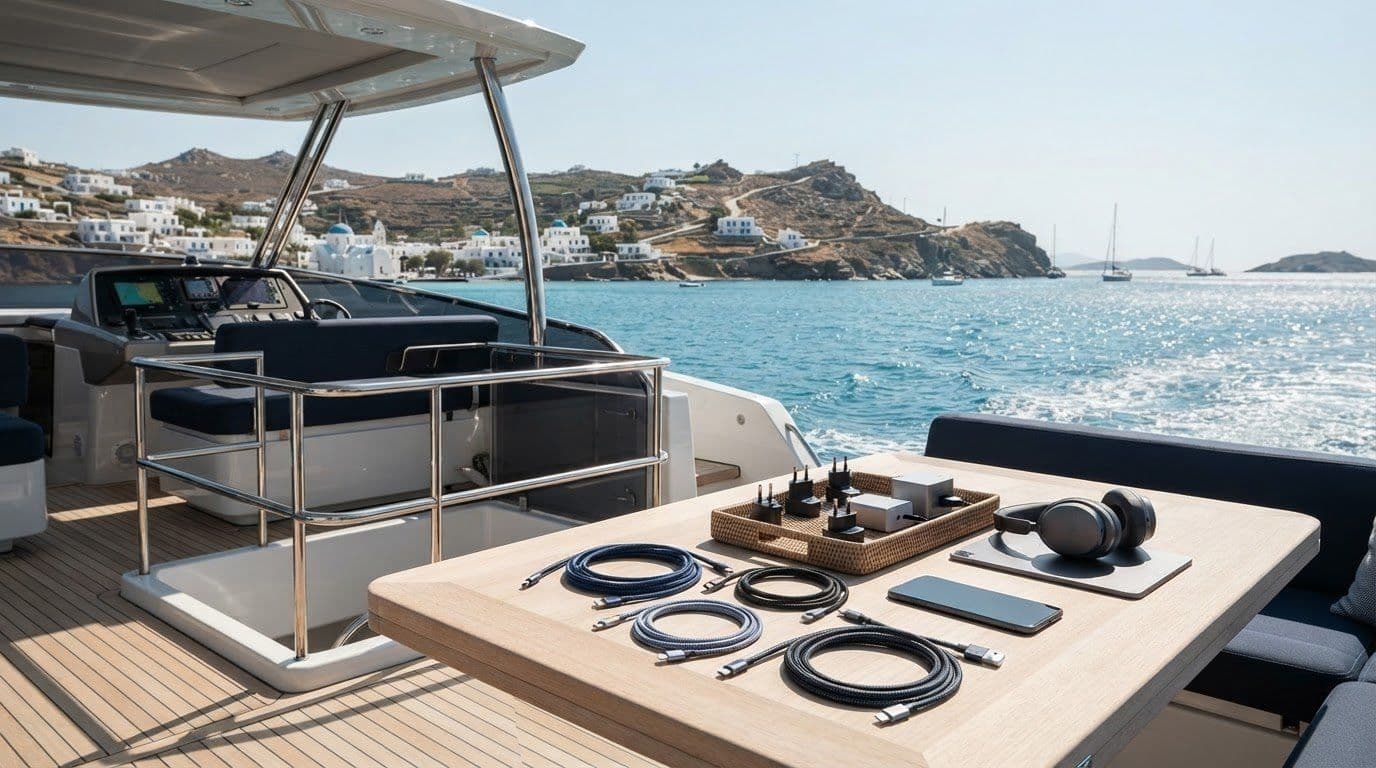
What if the right charging kit for a Greek yacht trip starts with understanding the yacht’s power, not buying another adapter? The electronics and charging converter setup on European luxury yachts can seem confusing when plugs, voltage converters, and device chargers appear to do similar jobs. They don’t. Packing the wrong gear can leave you without a reliable way to charge the devices you rely on.
Prepare before you set sail. European shore power is generally 230V at 50Hz, but onboard outlets and electrical arrangements vary by yacht. A plug adapter changes the shape of a plug; a voltage converter changes the electrical supply. Many modern chargers accept a range of voltages, so checking the label can help you avoid bringing equipment you don’t need.
This guide explains common yacht power sources, how to choose compatible charging equipment, and what to check before plugging in. You’ll learn how to build a simple charging kit, recognize when a converter may be necessary, and prepare for a more effortless voyage around Greece and Europe. A few practical checks before departure can keep your devices ready while you focus on the journey.
Key Takeaways
- Plan around the yacht’s onboard power arrangements first, then choose charging gear that suits the available supply.
- Know the difference: an adapter changes plug fit, a converter changes voltage, and a charger supplies power to your device.
- For the electronics and charging converter setup on European luxury yachts, check each device’s charger label, connector fit, and power requirements before packing.
- Build a compact kit with the devices, compatible chargers and cables, plus only the adapter or converter your setup requires.
- A little preparation leaves more room to enjoy YAL’OOU’s focus on privacy, ease, authentic Greek hospitality, and personal service.
How yacht power works: understand onboard electricity before packing
Will your phone, tablet, or camera stay charged during a Greek yacht trip? Start by understanding how electricity reaches the outlets instead of assuming every vessel works like a hotel room. Onboard electricity comes from a yacht’s particular power sources and distribution system. That setup determines what’s available and which outlets you can use.
European shore power is generally supplied at 230V and 50Hz, but that regional standard doesn’t describe every component installed aboard a yacht. Vessel wiring, outlets, and power sources can differ. Onboard power arrangements vary by vessel, so follow the yacht-specific guidance. That’s the first step in planning your electronics and charging converter setup on European luxury yachts.
Shore power, batteries, generators, and inverters
Shore power is an external electrical supply available when a yacht is connected at a suitable berth. It’s useful to understand what shore power for yachts means, but a connection at the berth doesn’t mean the same power arrangement is available in every situation aboard.
Batteries store electrical energy. A generator produces electricity, while an inverter changes electrical power from one form to another, commonly from a battery’s direct current (DC) to alternating current (AC). These components have distinct roles, and yachts can use different combinations and arrangements. Don’t assume a particular source or outlet is available without vessel-specific information.
Why European yacht power is not one universal setup
A regional supply standard and a yacht’s installed equipment are different things. Outlet styles and onboard electrical arrangements can vary between vessels. The power available may also depend on whether the yacht is connected to shore or using onboard sources. An outlet that looks familiar doesn’t establish that a device is compatible.
Keep preparation practical: list the devices you plan to use, then use the yacht’s guidance to understand its outlets and power arrangements. The vessel and itinerary shape what makes sense to pack. YAL’OOU’s private yacht options offer a starting point for considering your vessel as part of trip planning, without assuming different yachts share the same electrical setup.
This distinction prevents a common packing mistake: treating “European power” as a complete description of what’s available onboard. Learn the vessel’s setup first. Then check your device labels and choose suitable charging gear, rather than carrying a converter or adapter you may not need.
Adapters, converters, and chargers: what each one actually does
These three items solve different problems, so treating them as interchangeable can lead to the wrong packing choice. A plug may fit an outlet while the device is still electrically incompatible. Or the device may accept the supply but need a charger with the right connector and output. For a reliable electronics and charging converter setup on European luxury yachts, check physical fit and electrical suitability separately.
ItemPurposeWhat it changesWhen it may be needed
Plug adapter
Connect a plug to a differently shaped outlet
Physical fit only
When the device plug doesn’t match the available outlet
Voltage converter
Adapt voltage for a device that requires a different input
Electrical output voltage
When the device’s accepted input doesn’t match the supply
Device charger
Provide the charging output required by a device
Power delivered to the device
When charging a phone, tablet, or other personal electronics
Inverter
Convert direct current (DC) into alternating current (AC)
Current type
As part of an onboard electrical system, depending on its design
Plug adapters versus voltage converters
A plug adapter changes fit, while a converter changes electrical output. An adapter doesn’t regulate voltage or make an incompatible device suitable to use. For example, if a device accepts only 120V, fitting its plug into an outlet supplied at 230V doesn’t resolve the voltage mismatch. A converter may be needed, but first check the device’s requirements and the yacht’s guidance.
An inverter is different again: it changes DC power to AC rather than adapting the shape of a plug. The names can sound similar, but their functions aren’t interchangeable. Avoid choosing equipment based on the word “converter” alone; identify the electrical issue you need to solve first.
Device chargers, USB connections, and power requirements
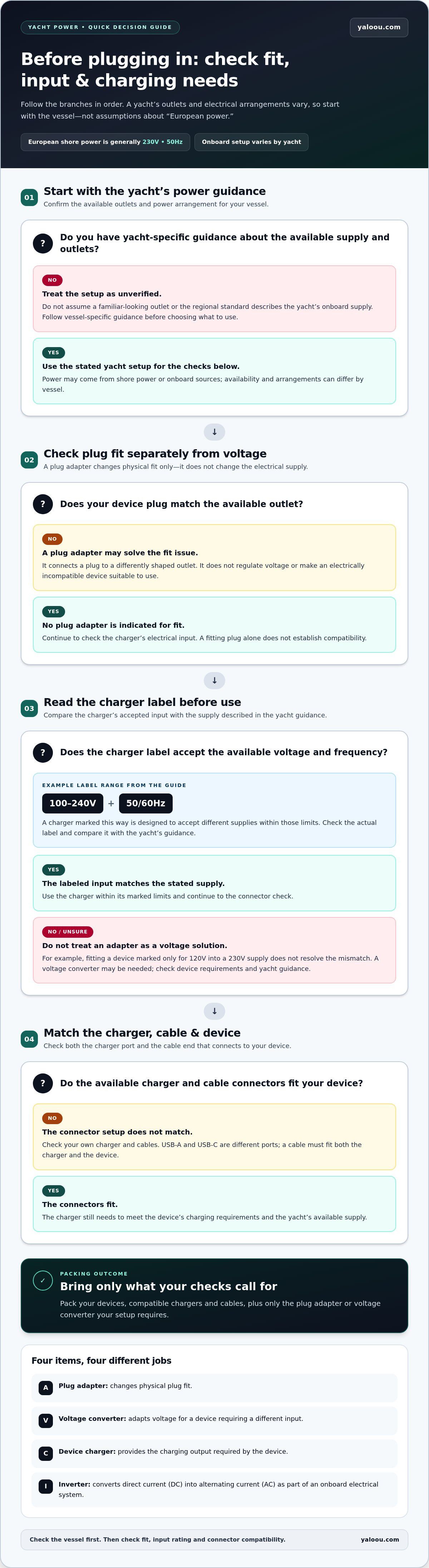
Your charger links the electrical supply to your device. Read its label for the accepted input range, voltage and frequency markings, and charging output. A label showing a broad input range, such as 100-240V and 50/60Hz, indicates that the charger is designed to accept different supplies within those limits. A narrower rating calls for closer attention before use.
Then check the connector. A charger may have a USB-A or USB-C port, while the cable’s device end must also fit. A USB-C cable won’t help if the available charger has only USB-A, and neither connector should be assumed available onboard. Check your own charger and cables, then compare them with the yacht-specific guidance.
Once your charging needs are clear, keep the rest of the trip just as personal. Explore YAL’OOU’s Greek yacht experiences as you plan a journey shaped around ease and authentic hospitality.
How to assess device compatibility on a European yacht
A smooth charging routine starts with four checks, in order: identify the device, read its charger label, match the connections, then compare its requirements with the yacht’s instructions. This process works for a phone or tablet and helps flag equipment that needs closer attention. Don’t rely on what worked at home; both the onboard supply and the device’s requirements matter.
- Identify the device. List what you plan to charge and note whether each item uses a dedicated power supply or a USB charger. A phone and a laptop may both charge by USB, but their power needs can differ.
- Read the charger label. Find the input markings on the charger itself, not just the device packaging. Check that the stated input is suitable for the supply described in the yacht’s guidance.
- Check connector fit. Confirm that the charger plug fits the available outlet and that the cable’s device end matches your phone, tablet, or other electronics. These are separate connections to verify.
- Verify the supply. Compare the charger’s accepted input with the yacht-specific instructions before plugging in. If the markings are missing, unreadable, or unclear, don’t connect the equipment until you have reliable guidance.
Read the charger label before bringing it aboard
Look for input voltage and frequency markings, often printed in small type on the charger body. These details show what supply it’s designed to accept. Familiarity with the same device at home doesn’t establish compatibility aboard. Keep the charger with its device while checking, since similar-looking accessories can have different ratings. For unfamiliar or higher-demand equipment, follow qualified guidance rather than guessing or trying it in an outlet.
Match plugs and charging cables to personal devices
Check both ends of the charging chain. The charger’s plug must physically fit the yacht’s available outlet, and the cable must connect properly to the device. A compact USB charger can be useful for personal electronics, but only if its input, output, and connectors suit your devices and the available supply. Don’t assume USB-A, USB-C, or any particular outlet will be available onboard.
Keep everyday electronics distinct from equipment with different power requirements. A phone or tablet charger isn’t a substitute for a device’s dedicated power supply, and a connector that fits doesn’t prove electrical compatibility. If a device draws more power or has an unfamiliar charger, pay close attention to its markings and instructions.
The yacht-specific instructions govern onboard use. Vessel layouts and electrical arrangements differ, so the selected yacht, not a general European assumption, is the relevant reference. YAL’OOU’s listed yacht fleet is a useful place to start thinking about which vessel you’ll travel aboard. Use the relevant onboard instructions to check your equipment. This is the practical core of the electronics and charging converter setup on European luxury yachts: match the device to its charger, then match that charger to the vessel’s supply. If anything remains uncertain, leave it unplugged.
Prepare a simple yacht charging kit without overpacking
A well-planned charging kit is compact, purposeful, and matched to the devices you’ll actually use. Before packing, make a short list of your electronics and pair each one with its charger and cable. Then compare those items with the yacht’s guidance. This helps you bring what you need without filling your luggage with duplicate plugs, extra converters, or cables that don’t fit.
Check each charger’s markings and the yacht’s instructions before connecting devices. Keep essential electronics and their charging accessories together in an easy-to-reach pouch. That saves time when you need your phone or camera and makes it easier to spot a missing cable before departure.
A practical checklist for phones, tablets, and cameras
Check each device’s needs, then pack only compatible accessories. Include a plug adapter only if it matches the yacht’s guidance and your charger’s physical plug. Don’t assume one cable or adapter suits every device.
- Phone: Pack the phone’s charger and a cable with the correct connector at both ends.
- Tablet: Check whether it uses the same charger as your phone or needs its own.
- Camera: Bring its designated charger and any compatible charging cable you rely on.
- Plug adapter: Include one only if your charger’s plug doesn’t fit the outlet described in the yacht’s instructions.
- Protection: Store sensitive electronics and their accessories together, protected from knocks and easy to locate.
For less-used equipment, consider whether it’s essential for the trip before adding its charger and accessories. A compact kit should reflect your real device needs, not every charging item you own.
Avoid common charging mistakes aboard
A plug that fits doesn’t prove the electrical supply is suitable. Don’t connect a device if its charger markings are unclear or don’t match the yacht’s instructions. Avoid damaged cables, improvised connections, and unverified charging equipment. If something doesn’t look right, pause. Follow the yacht’s instructions and crew guidance rather than testing an uncertain setup.
- Inspect cables and charger plugs for visible damage before packing and use.
- Keep chargers with the devices they’re intended for to avoid mix-ups.
- Don’t add a converter or adapter simply because it seems useful; pack only what your confirmed setup requires.
With your essentials organized and the onboard guidance in mind, you can spend less time sorting accessories and more time enjoying the Greek setting. Explore YAL’OOU’s Greek yacht experiences for a journey shaped around personal ease.
Make charging preparation part of a personal Greek yacht experience
A little preparation can make onboard life feel simpler. Before departure, set aside the devices you’ll rely on, their matching chargers and cables, and only the additional equipment supported by your device markings and yacht-specific instructions. Keep them together and easy to find. The aim isn’t to plan every moment around a battery percentage; it’s to settle the practical details early, then turn your attention to the Greek journey.
That’s the useful balance behind the electronics and charging converter setup on European luxury yachts: prepare thoughtfully, without assuming every vessel has the same electrical arrangements or packing a collection of accessories “just in case.” If an instruction or device marking is unclear, pause and follow the yacht’s guidance before connecting it.
Keep vessel choice and electrical assumptions separate
A yacht’s name tells you which vessel you’re considering, not what outlets or electrical capabilities it has. YAL’OOU’s listed fleet includes Tesoro 40 Inboard, Baglietto 100, and 83 Tecnomar Velvet, but none of those names alone establishes a particular charging setup. Treat electrical guidance as specific to your selected yacht, and base your packing on that information rather than assumptions about yacht size, style, or category.
This distinction keeps planning clear. Consider the vessel you’re choosing and the devices you want to bring, then use the relevant onboard instructions to connect those decisions. Your personal charging kit should serve your actual needs, not imagined features.
Connect practical preparation with an unhurried Greek journey
Once you’ve checked the essentials, put your chargers and cables in one place, make them easy to access, and let the rest of the day unfold. You won’t need to revisit the same packing questions or carry extra gear that doesn’t match your devices. A calm routine creates more room for what makes time aboard feel personal: privacy, ease, authentic Greek hospitality, and attentive service.
For YAL’OOU, luxury is personal rather than excessive. Practical preparation fits that approach: bring what you need, understand the vessel-specific guidance, and leave unnecessary complexity behind. The result is a more confident start to your time in Greece, with the logistics considered and your attention free to enjoy the experience.
As you plan, explore private Greek yacht experiences and imagine a journey shaped around your own pace. A considered charging plan is a small detail, but it can help make the time around it feel effortless.
Set your sights on a more effortless Greek escape
Once your charging plan is settled, let it take a back seat. Decide which devices truly matter for your time aboard, then give yourself permission to be present for moments that don’t need a screen. A little forethought can make room for a calmer, more personal journey.
The right electronics and charging converter setup on European luxury yachts starts with respect for the vessel’s own guidance. Keep that same thoughtful approach as you shape the rest of your trip. YAL’OOU’s fleet includes Tesoro 40 Inboard, Baglietto 100, and 83 Tecnomar Velvet, while its approach puts privacy, ease, and authentic Greek hospitality at the heart of the experience.
YAL’OOU’s Greek yacht journeys connect travelers with destinations including Mykonos, Paros, Antiparos, Athens, Aegina, Poros, Spetses, Syros, Tinos, Sifnos, Serifos, Milos, Poliaigos, Kimolos, Santorini, Ios, Koufonisia, Amorgos, Crete, Corfu, and Zakynthos. Choose the setting that speaks to you, and explore private yacht experiences to begin imagining your time in Greece.
Frequently Asked Questions
Do I need a voltage converter on a European yacht?
Not always; it depends on your charger’s input rating and the yacht’s instructions. European shore power is generally 230V at 50Hz, but onboard arrangements can vary. For the electronics and charging converter setup on European luxury yachts, check each charger’s label. A charger marked for 100-240V and 50/60Hz is designed for a range of supplies, while a 120V-only device may need appropriate voltage conversion. Don’t connect it if compatibility is uncertain.
What is the difference between a plug adapter and a voltage converter?
A plug adapter helps a plug fit a differently shaped outlet; it doesn’t change voltage. A voltage converter changes electrical output to suit a device with different voltage requirements. For example, an adapter may solve a shape mismatch, but it won’t make a 120V-only appliance suitable for a 230V supply. Check the appliance’s rating and the yacht’s guidance before deciding whether either item belongs in your kit.
Can I charge a US phone or laptop on a European yacht?
Often, yes, if the phone or laptop charger accepts the supply described in the yacht’s instructions. Check the charger itself, not just the device: its input markings show the range it can handle. A US plug may also need a suitable physical adapter, and the cable must match the device. Don’t assume a familiar outlet or a USB port is available onboard, especially when planning device use around Mykonos or Paros.
Are USB charging outlets available on every yacht?
No, USB charging outlets shouldn’t be assumed on every yacht. Their presence, connector type, and availability can differ by vessel, and a USB-A port isn’t interchangeable with USB-C without a compatible cable or adapter. Bring the charger and cables you need for your own devices, then follow the selected yacht’s instructions about where and how to charge. A power bank may be a personal backup, but it won’t replace checking onboard guidance.
How can I tell whether my charger is compatible with the yacht’s power?
Read the charger’s input markings and compare them with the supply information in the yacht’s instructions. Also check that its output suits the device and that the plug and cable connect correctly. A cable can fit the phone while its charger still has an unsuitable input rating. If the label is damaged, incomplete, or difficult to interpret, leave the charger unplugged until you have reliable guidance.
Can I use a power strip or extension lead aboard a yacht?
Only use one if the yacht’s instructions and crew guidance allow it. A strip or extension lead adds connections and may not suit the vessel’s outlets or onboard rules. Don’t link multiple strips together, use damaged leads, or improvise a connection to reach an outlet. If you need to charge several devices, follow the crew’s guidance on an appropriate arrangement rather than assuming a household setup is suitable aboard.
What should I pack to charge electronics on a yacht charter?
Pack the devices you plan to use, each device’s compatible charger and cable, and only the plug adapter or voltage converter required by their labels and yacht guidance. Keep essential items together in a protective pouch, and bring a spare cable only if it fits a device you’ll use. Before leaving for a Greek yacht charter, review the selected vessel’s instructions so your kit suits the trip rather than an assumption about onboard equipment.
Disclaimer
The YAL’OOU Travel Guide is curated with care to inspire and inform discerning travelers. While every effort is made to ensure the accuracy and relevance of the information provided, all content is offered for general guidance only and may evolve over time.
Details such as local regulations, availability, pricing, and services are subject to change without prior notice. We encourage guests to seek personalized advice and confirm arrangements directly when planning their journeys.
YAL’OOU accepts no liability for any inaccuracies, omissions, or outcomes arising from the use of this information. The Travel Guide may feature recommendations, insights, and selected third-party experiences, presented solely as a source of inspiration and not as formal endorsements.
By accessing this section of our website, you acknowledge and accept this disclaimer as part of your experience with YAL’OOU.