
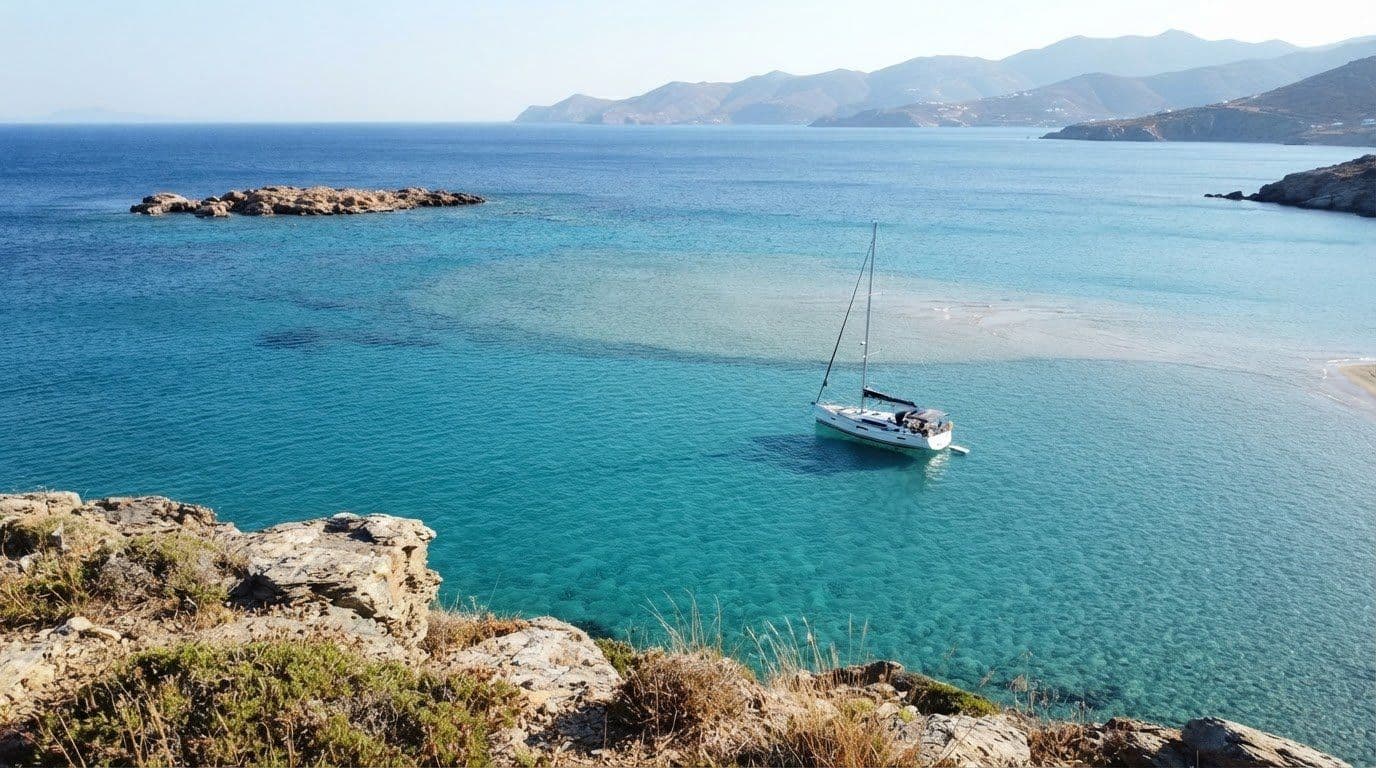
Manganari is a strong choice for a quieter overnight stop on Ios’s south coast. Its typical anchoring depth is 4–10 meters, and it’s well sheltered from the summer Meltemi, though open to southerly winds. Tris Klisies is another option, with typical depths of 4–6 meters and a mixed seabed of sand, weed, and rock.
If you’re looking for the top anchorages on Ios’s south coast for complete privacy, wind direction and seabed matter as much as the setting. A cove that looks calm can feel very different when the wind shifts, so choose an anchorage to suit the conditions and the kind of night you have in mind.
This guide covers the depths and holding at Manganari and Tris Klisies, including where each cove offers shelter and a quieter stay. You’ll also see how Manganari differs from busy Yialos, especially in July and August, and what to consider when choosing a south-coast anchorage with a more private feel.
Key Takeaways
- Manganari offers a quieter overnight option, with typical depths of 4–10 meters and good holding over sand. It’s sheltered from the Meltemi but open to southerly winds.
- Tris Klisies has typical depths of 4–6 meters, but its mixed sand, weed, and rock seabed makes checking the anchor’s hold important.
- Valley Cove in Maine is about 10 meters deep; seabed conditions and exposure shape how well an anchorage suits a stay.
- Choose an Ios south-coast anchorage by matching wind direction, depth, and the level of seclusion you want.
1. Which Ios anchorages are sheltered from the meltemi, the summer north wind?
Manganari is the clearest south-coast choice for Meltemi shelter, with good holding over sand and exposure to southerly winds. The Cyclades’ summer Meltemi typically reaches Force 5 to 7 and is strongest from mid-July to mid-August. In strong Meltemi conditions, yachts at Tris Klisies should move to Manganari. Tris Klisies has a mixed sand, weed, and rock seabed, so check the anchor’s hold carefully.
Manganari is described as quiet, while Yialos is busy with nightlife in July and August. Manganari is a taxi ride from Yialos, so you can choose a quieter anchorage while keeping a shore visit in mind. The better option depends on wind direction and whether privacy, access, or shelter matters most for your overnight stay.
Remote bays call for careful anchoring. At Tris Klisies, sand, weed, and rock can affect how the anchor sets. Slowly increase reverse engine speed to 1800–2000 RPM to test whether it holds, then watch for movement against fixed shore references. Manganari’s shelter does not extend to southerly winds, so consider that exposure when planning an overnight stop.
Manganari offers a quieter setting, while Yialos has nightlife and taxi access. Plan your arrival and provisions with the anchorage’s remoteness in mind. Don’t treat a secluded bay as an emergency-services point. Choose an anchorage based on the expected wind, confirm the anchor is holding, and keep your route flexible if conditions change.
2. Valley Cove depth, holding, and storm protection
Valley Cove is not an Ios south-coast anchorage, so its depth should not guide an Ios route. For local planning, use the Ios figures instead: Manganari typically has 4–10 meters of water, while Tris Klisies typically has 4–6 meters. Depth varies within a bay, so select an anchoring position using the vessel’s draft and the actual approach, not just the anchorage’s general range.
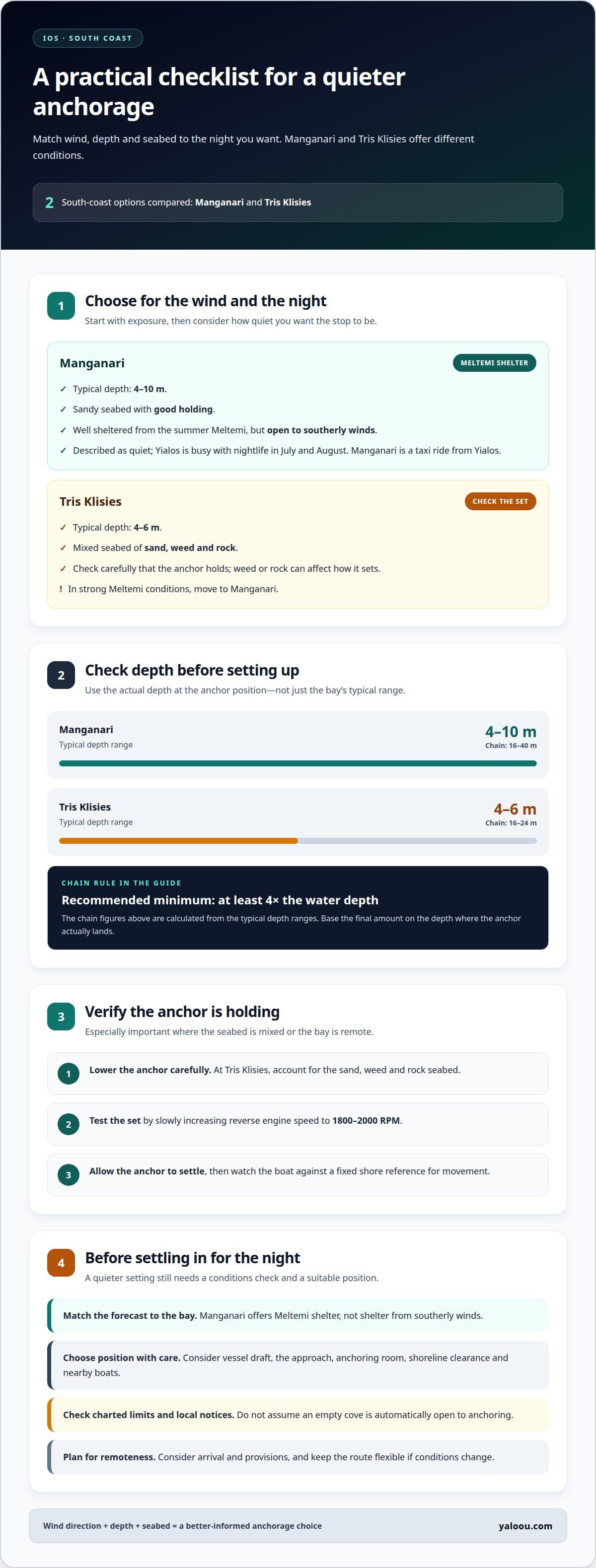
Chain length can help turn those depths into a practical setup. The recommended minimum is at least four times the water depth. Across Manganari’s typical range, that means a calculated 16–40 meters of chain; at Tris Klisies, the corresponding range is 16–24 meters. These calculations use the stated depth ranges, so base the final amount on the depth where the anchor actually lands.
Holding differs with the bottom. Manganari’s sand provides good holding, while Tris Klisies has sand, weed, and rock. At Tris Klisies, lower the anchor carefully and test its set by slowly increasing reverse engine speed to 1800–2000 RPM. Allow the anchor to settle before judging its grip, and watch the boat’s position against a fixed landmark.
For shelter, match the anchorage to the wind direction. Manganari is protected from the Meltemi but open to southerly winds, so it is not a universal storm refuge. Tris Klisies is a poor choice in strong Meltemi conditions; move to Manganari instead. Build flexibility into your Ios sailing plan, and use Ios experiences to shape time ashore around the route.
3. Manganari as a quiet south-coast overnight anchorage
Manganari pairs a quieter setting with practical anchoring depths: the typical range is 4–10 meters. Its sandy seabed offers good holding, and the bay is well sheltered from the summer Meltemi. It remains open to southerly winds, so make wind direction part of your arrival decision. For a calm overnight stop, consider both the forecast and the beach-facing setting, not privacy alone.
Yialos is busy with nightlife in July and August, while Manganari is described as quiet and a taxi ride away. That contrast makes Manganari a stronger option for couples seeking a more private evening near the beaches. Quiet doesn’t mean you’ll have the bay to yourself, though. Your experience depends on conditions, how many boats are present, and where you anchor.
Yachts can anchor overnight at Manganari, using its typical 4–10-meter depth range as a planning reference. Set the anchor carefully over sand and allow room from other boats and the shoreline. For restrictions, follow charted limits and local notices; don’t assume an empty cove is automatically open to anchoring. A protected-looking bay still needs a suitable wind direction, since Manganari is exposed to southerlies.
Reach Manganari by yacht along Ios’s south coast, then choose an approach that suits the vessel’s draft and the conditions. Use depth information to avoid a shallow approach, and assess the seabed before settling in. Arrival planning matters most when the wind is from the south, because the bay offers less shelter in that direction. In stronger Meltemi conditions, Manganari is a better option than Tris Klisies. For a private overnight charter, prioritize the forecast, anchoring room, and the kind of beach access you want.
4. What are the best south-coast anchorages in Ios for privacy?
To find the top anchorages on Ios’s south coast for complete privacy, compare Manganari and Tris Klisies by depth, seabed, and wind exposure. Manganari typically offers 4–10 meters over sand, while Tris Klisies is typically 4–6 meters deep over mixed sand, weed, and rock. That seabed difference matters when setting the anchor and choosing where to settle.
Manganari is the stronger choice when shelter from the Meltemi is the priority, though it’s open to southerly winds. Tris Klisies can feel more secluded, but strong Meltemi conditions favor moving to Manganari. The right choice among the top anchorages on Ios’s south coast for complete privacy depends on the forecast, anchoring room, and the setting you want for the night.
Arrive with time to assess depth and seabed instead of choosing a spot by appearance alone. At Tris Klisies, check that the anchor is set, as rock or weed can affect its hold. Leave room between neighboring boats and account for shifts in wind direction. These steps can help create a quieter stay without assuming any bay is private by default.
Privacy also varies with season and activity. Yialos is busy with nightlife in July and August, while Manganari is described as quiet and a taxi ride away. If calm is your priority, weigh the anchorage conditions first, then plan any shore visit around the setting. Manganari offers shelter in Meltemi conditions, but not from southerlies.
Explore Ios experiences to shape time ashore around a south-coast anchorage and your sailing itinerary.
Tris Klisies can feel more secluded, while Manganari is also described as quiet. Yialos is busy with nightlife in July and August.
YAL’OOU Exclusive Yachting & More: Daily Yacht Charters
YAL’OOU Exclusive Yachting & More offers Daily Yacht Charters to explore Ios’s south coast by sea. A charter lets you compare Manganari and Tris Klisies within a day and keep your itinerary focused on the water. For a longer island journey, Weekly Crewed Yacht Rentals offer another way to plan time afloat.
Shape your pace around the conditions: choose a sheltered stop, a quiet stretch of coast, or time ashore between anchorages. Pair your yacht journey with a High-End Villa Rental or VIP Ground Transfers if they suit your wider Ios plans. Each option supports a different kind of escape, while the core decision remains the same: match your stop to the wind, depth, and privacy you want.
Contact YAL’OOU Exclusive Yachting & More to discuss your Ios plans.
Plan a quieter Ios escape
The best anchorage is just one part of a memorable stay on the south coast. Shape the rest of your time around the experience you want: an unhurried day aboard, a peaceful evening ashore, or a change of pace between sailing and island life. Let privacy guide your plans, but leave room to adapt. Conditions can shift, so make your final anchoring choice with the day’s wind and sea state in mind.
Use what you’ve learned to choose the top anchorages on Ios’s south coast for complete privacy, then build an itinerary with room to explore. A thoughtful plan can make a quiet cove the start of a more personal island escape, whether you’re travelling as a couple or with friends.
Explore experiences for your Ios getaway and take the next step toward a stay shaped around your own pace. Set your course, make space for discovery, and enjoy the freedom of the island.
Frequently Asked Questions
How deep are the anchorages at Ios?
Depths vary by bay and position: Manganari typically offers 4–10 meters, while Tris Klisies typically offers 4–6 meters. Those ranges help with initial planning, but they don’t identify the depth at your exact anchoring spot. Compare the charted depth with your vessel’s draft and allow for the seabed and approach before choosing where to drop anchor.
What is the holding like at Ios?
Holding depends on the seabed. Manganari has good holding over sand, while Tris Klisies has a mixed sand, weed, and rock bottom that needs a careful set. After lowering the anchor, gradually increase reverse engine speed to 1800–2000 RPM to test whether it holds. Watch fixed shore references as the boat settles, and reassess if it drags.
Where can a yacht anchor at Ios?
Yachts can anchor in suitable bays such as Manganari and Tris Klisies, where depth, seabed, and wind exposure guide placement. Yialos is different: its east basin uses laid moorings, anchoring is not permitted there, and yachts lie stern-to the boulevard. Plan your approach around the specific basin or bay rather than assuming anchoring is allowed throughout the port.
Which Ios anchorages are sheltered from the meltemi, the summer north wind?
Manganari is well protected from the Meltemi and offers good holding over sand, making it a useful alternative in strong Meltemi conditions. It is open to southerly winds, so it isn’t equally sheltered from every direction. Tris Klisies is less suitable in strong Meltemi conditions; yachts there should move to Manganari when that wind is strong.
What are the GPS coordinates and depths of Ios south-coast anchorages?
Manganari’s typical anchoring depth is 4–10 meters, and Tris Klisies’ is 4–6 meters. A bay-wide depth range cannot pinpoint a safe anchoring position. Use a current nautical chart or chart plotter to identify coordinates for your intended spot, then compare the displayed depth with conditions on arrival. Avoid navigating by a bay name alone.
Which anchorages on southern Ios offer the best holding ground and protection?
Manganari offers good holding over sand and shelter from the Meltemi, but remains open to southerly winds. Tris Klisies has a mixed bottom of sand, weed, and rock, so its holding needs closer attention. Choose between them based on wind direction and the seabed at your intended spot. In strong Meltemi conditions, Manganari is the better option.
Disclaimer
The YAL’OOU Travel Guide is curated with care to inspire and inform discerning travelers. While every effort is made to ensure the accuracy and relevance of the information provided, all content is offered for general guidance only and may evolve over time.
Details such as local regulations, availability, pricing, and services are subject to change without prior notice. We encourage guests to seek personalized advice and confirm arrangements directly when planning their journeys.
YAL’OOU accepts no liability for any inaccuracies, omissions, or outcomes arising from the use of this information. The Travel Guide may feature recommendations, insights, and selected third-party experiences, presented solely as a source of inspiration and not as formal endorsements.
By accessing this section of our website, you acknowledge and accept this disclaimer as part of your experience with YAL’OOU.