

A local Greek charter company can matter before you ever step aboard. A Greek Charter Licence requires the yacht-owning entity to maintain a verifiable commercial presence in Greece, typically through a local charter management company. That requirement explains why using a local Greek charter company can shape the booking, while local guest support and travel planning influence the experience around it.
Choosing a yacht is only part of planning a Greek escape. You also want a clear picture of how charter management works, where local support can help, and how travel arrangements fit together. This article explains how a local presence connects to Greece’s charter framework, what it can mean for your trip, and how to plan a booking that suits the way you want to explore the islands. The goal is simple: help you understand the practical value of local expertise, so you can focus on the journey ahead.
Key Takeaways
- See how local guest support can connect your charter plans with the practical details of a Greek trip.
- Understand how charter management fits into the yacht’s local commercial arrangements.
- Learn why charter planning timelines matter and which travel details shape a smoother booking.
- Compare the roles of local charter companies and international yacht brokers to decide what kind of support best fits your trip.
Benefits for charter guests
A Greek yacht trip involves more than choosing a vessel. Your itinerary, boarding arrangements, and support plan all shape your time on the water. Local knowledge can help connect those details to the places you want to visit. A Cyclades itinerary, for example, calls for different destination planning from a trip focused on the Ionian Islands. Discussing your preferred pace, stops, and onboard arrangements helps turn a broad idea into a practical charter plan.
For the yacht itself, commercially operated EU-flagged yachts and non-EU-flagged yachts over 35 meters must hold a Greek Charter Licence to charter in Greek waters. This is the vessel’s commercial authorization. It does not answer what qualifications a guest needs to operate a yacht independently, so distinguish a crewed booking from a bareboat arrangement when discussing your plans.
Local coordination can also make the booking easier to understand. Before travel, clarify the details that will shape your experience:
- Route: Share the islands or coastline you hope to explore, such as the Cyclades or Ionian Islands.
- Trip style: Explain whether you want a relaxed day on the water or a longer island-hopping itinerary.
- Guest needs: Discuss who is travelling and what arrangements matter onboard.
For consumer protections and disputes, keep the signed charter agreement, payment record, and booking correspondence together. These documents show what was agreed and can support a complaint. Start with the agreement’s complaint or dispute terms; formal remedies are governed by applicable consumer law. Clear written terms are especially useful if a concern involves the itinerary, included arrangements, or a change to the booking.
That preparation helps you compare the planned experience with the agreement before departure. A local contact can discuss Greek destinations and trip details in context, while the contract gives both sides a shared reference. The practical benefit is a clearer plan, with fewer unanswered questions and a charter better aligned with how you want to explore Greece.
Local charter management company presence
Greek charter management connects a yacht’s commercial arrangements with the practical details of operating in Greek waters. For guests, local coordination can clarify who manages the vessel and how destination choices fit the charter.
Management can coordinate vessel upkeep and operational paperwork with the yacht’s owner and crew. Safety checks follow the vessel’s operating procedures, while insurance coverage depends on the policy and charter agreement. Those documents explain covered risks, exclusions, and responsibilities, helping guests understand how they apply to the booking.
In Greece, commercially operated EU-flagged yachts and non-EU-flagged yachts over 35 meters must hold a Greek Charter Licence to charter in Greek waters. The licence is granted for three years, subject to conditions. The application process can take roughly one to two months, making local management relevant to commercial setup and booking timelines.
Island, Route, and Anchorage Knowledge
Island and route knowledge means matching an itinerary to local geography, harbor access, and conditions at sea. On a route linking Mykonos and Paros, local insight can help balance time underway with island stops. Around Sifnos, it can inform choices between anchorages and visits ashore. These decisions shape the daily pace, overnight plans, and how easily a charter can adapt.
Verifying Licenses and Reputation
Verification means establishing which entity manages the charter, which yacht is involved, and what documents support its commercial operation. The charter agreement identifies the parties and their responsibilities, while the Greek Charter Licence relates to the yacht’s commercial chartering. Reviews are most useful when they describe specific experiences, such as communication, vessel condition, or itinerary coordination, rather than offering only general praise.
Maintenance records, safety procedures, insurance terms, and licence details each answer a different question. The licence concerns commercial chartering; the agreement and policy explain the guest’s arrangements and coverage. Keeping these roles distinct helps you understand what local management contributes and what the booking documents govern.
Destination preferences can guide a discussion about routes and time onboard. Explore Greek yachting experiences to see how a charter can connect with the places you want to discover.
Travel planning and booking
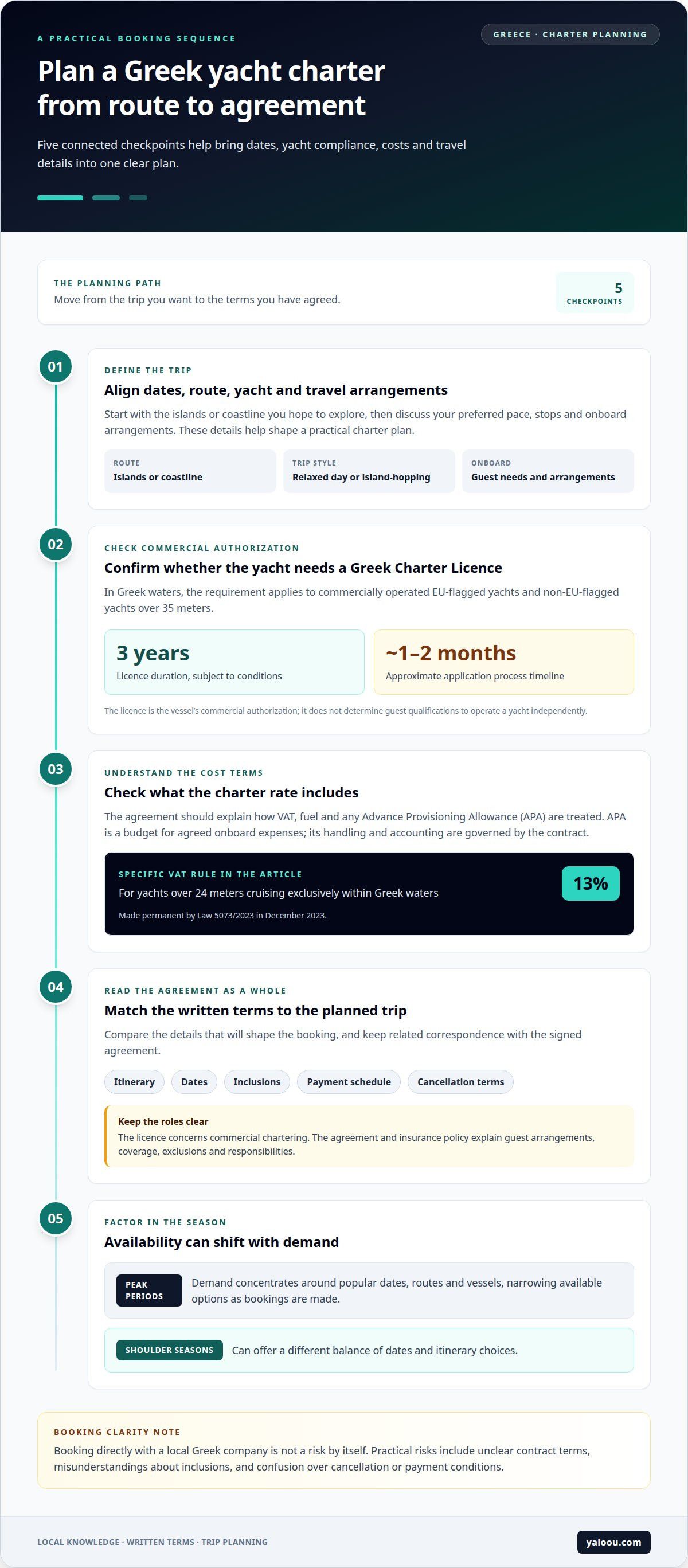
Booking a Greek yacht charter means aligning dates, route, vessel, and travel arrangements before departure. A local company can coordinate these details in context, while the charter agreement sets out the booking terms. The Greek Charter Licence application process can take roughly one to two months, so yacht compliance may also affect planning timelines.
Fees depend on the agreement and the yacht’s itinerary. It should state what the charter rate includes and how VAT, fuel, and any Advance Provisioning Allowance (APA) are treated. APA is a budget for agreed onboard expenses, with its handling and accounting governed by the contract. For yachts over 24 meters cruising exclusively within Greek waters, VAT is 13%, a rate made permanent by Law 5073/2023 in December 2023.
Booking directly with a local Greek company does not create a risk by itself. Practical risks include unclear contract terms, misunderstandings about what is included, and confusion over cancellation or payment conditions. Read the signed agreement as a whole: compare the itinerary, dates, inclusions, payment schedule, and cancellation terms. Keep booking correspondence with it so any agreed changes are documented.
Season affects both yacht choice and trip planning. During peak periods, demand concentrates around popular dates, routes, and vessels, narrowing the available options as bookings are made. Shoulder seasons can offer a different balance of dates and itinerary choices. The best fit depends on your travel window, destination, and flexibility, rather than on one season being right for everyone.
Build the booking around the experience you want. A day charter suits a focused outing, while a crewed weekly charter allows more time for island-hopping and overnight stays. Share your preferred dates, route, and pace early in the planning conversation. Then use the written agreement to understand how the charter, expenses, and travel arrangements fit together before confirming your trip.
In 1900, automobile enthusiasts gathered at San Francisco's Cliff House to form a club to help car owners travel with greater comfort, safety, and convenience. Those broad priorities also offer a useful way to approach yacht travel planning: clarify practical arrangements in advance and ensure the agreed details support a comfortable, safe, and convenient journey.
How do local Greek charter companies compare with international yacht brokers?
A local Greek charter company and an international yacht broker can play different roles in one booking. A broker may arrange a charter between a guest and a yacht provider; a local company may manage the Greek-side charter operation. The contract identifies the parties and responsibilities. For example, it shows whether you are booking directly with the company managing the yacht or through an intermediary.
The main difference is often the point of coordination, not a guaranteed difference in quality or choice. An international broker may search across a wider range of destinations, while a Greece-based company focuses on charters connected to Greek waters. The right fit depends on your trip: a Cyclades itinerary may benefit from detailed local planning, while a broader multi-country search may call for wider market coverage.
Before you book, use the written agreement to understand who handles each part. Identify the contractual provider, the yacht’s managing entity, and the contact responsible for booking questions. Then review the itinerary, inclusions, payment conditions, and cancellation terms together. This makes responsibilities clearer without assuming that every broker or local company works in the same way.
- Local company: Ask how its Greek charter management connects with your selected route and vessel.
- International broker: Establish which company will be the contractual provider and who coordinates the charter locally.
- Either option: Match the agreement’s names and responsibilities to the service you expect.
The practical answer to why use a local Greek charter company is closer coordination with the Greek charter context. This can be useful when your plans center on Greek islands and you want a clear discussion of the route alongside the booking. Compare the roles and documents, then choose the arrangement that suits your itinerary and preferred point of contact.
Explore Greek yacht experiences to shape your trip around the time and destinations you have in mind.
YAL’OOU Exclusive Yachting & More: Daily Yacht Charters
YAL’OOU Exclusive Yachting & More offers Daily Yacht Charters for guests who want to explore Greece by sea without planning a week-long voyage. For a longer escape, Weekly Crewed Yacht Rentals offer another way to spend more time on the water and visit the islands.
Make the booking fit the full journey. Pair a yacht charter with a High-End Villa Rental for time ashore, or arrange VIP Ground Transfers between parts of your itinerary. These options help bring accommodation and ground transportation into the same travel plan as your charter.
Choose the trip length and experience you have in mind, then discuss how YAL’OOU’s offerings fit your plans. Contact YAL’OOU Exclusive Yachting & More to talk through your Greek yacht charter.
Shape Your Greek Charter Around the Trip You Want
Your next step is to turn a broad idea into a trip that feels right for you. Consider the pace you enjoy, how you want to spend your time on the water, and how much planning you want to coordinate before departure. These preferences can guide a focused conversation and help you make clear choices.
If you’re considering why to use a local Greek charter company, focus on how its role fits your plans and how clearly it communicates. A good arrangement makes the booking and your priorities easy to understand, without adding complexity you don’t need.
Start shaping your Greek escape around the experience you have in mind. Talk with YAL’OOU about your charter plans and take the next step toward time well spent in Greece.
Frequently Asked Questions
What are the benefits of booking with a local Greek yacht charter company?
A key reason to use a local Greek charter company is that destination planning can reflect the specific places on your route. A trip combining Mykonos, Paros, Antiparos, Syros, Tinos, Sifnos, Serifos, Milos, Poliaigos, Kimolos, Santorini, Ios, Koufonisia, Amorgos, Crete, Corfu, Zakinthos, Athens, Aegina, Poros, or Spetses can be planned around your preferred pace and time ashore. This turns a list of destinations into a coherent charter brief.
Disclaimer
The YAL’OOU Travel Guide is curated with care to inspire and inform discerning travelers. While every effort is made to ensure the accuracy and relevance of the information provided, all content is offered for general guidance only and may evolve over time.
Details such as local regulations, availability, pricing, and services are subject to change without prior notice. We encourage guests to seek personalized advice and confirm arrangements directly when planning their journeys.
YAL’OOU accepts no liability for any inaccuracies, omissions, or outcomes arising from the use of this information. The Travel Guide may feature recommendations, insights, and selected third-party experiences, presented solely as a source of inspiration and not as formal endorsements.
By accessing this section of our website, you acknowledge and accept this disclaimer as part of your experience with YAL’OOU.