

The exchange rate that looks best may not deliver the most euros to a Greek yacht charter account. Currency exchange and wire transfer fees for Greek yacht charters can include more than a visible transfer charge: a conversion margin or deductions by intermediary banks may also affect what arrives. A reassuring headline rate does not always tell the whole story.
When you’re coordinating a Greek yacht experience, you want the agreed amount to reach the recipient without surprises. Comparing the total amount debited from your account with the euros expected to arrive gives you a clearer picture than comparing exchange rates alone.
This guide explains where charges may arise, how conversion and transfer routes can affect the final amount, and what to compare before sending payment. You’ll also find a practical checklist for preparing a transfer using the charter agreement and verified payment instructions.
Key Takeaways
- Compare payment options by the total amount leaving your account and the euros expected to reach the recipient, not by the headline exchange rate alone.
- Understand how currency exchange and wire transfer fees for Greek yacht charters may include conversion margins, sending-bank charges, and deductions by intermediary banks.
- Review the exchange rate, stated fees, estimated euro delivery, timing, and caveats for each payment route. Consider card payment only if the charter agreement permits it.
- Use the charter agreement to confirm the invoice currency and payment terms, then follow the exact beneficiary and reference details in verified payment instructions.
- Keep a record of your transfer and proof of payment so you can track the transaction as you prepare for your Greek yacht experience.
Why currency exchange and wire transfer fees matter for Greek yacht charters
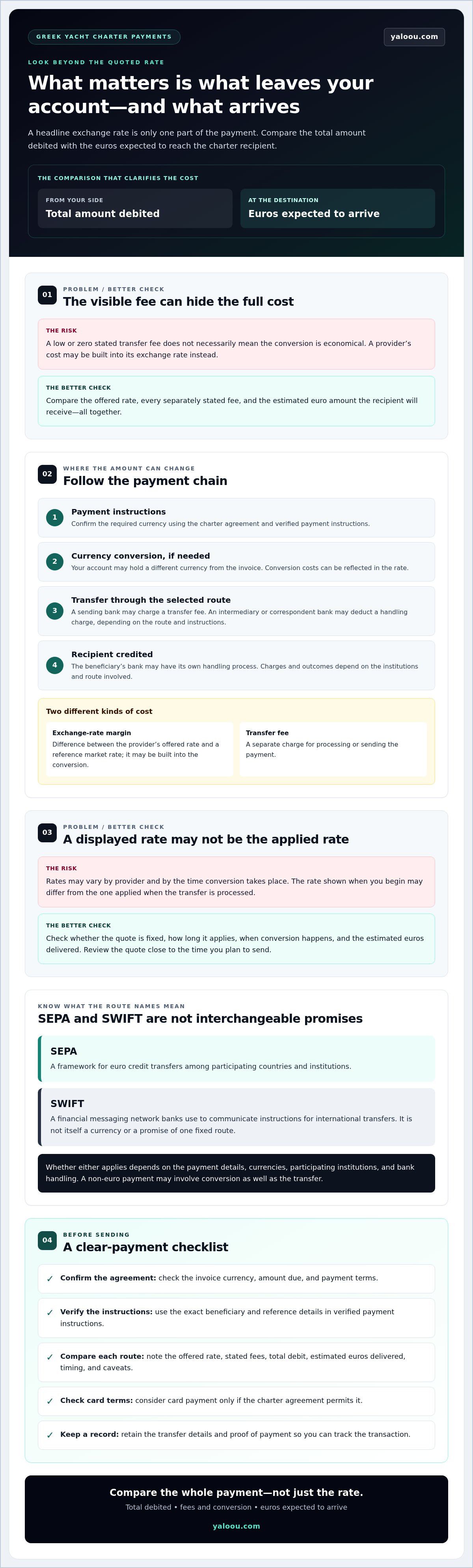
The amount due under a charter agreement and the amount that leaves your account may differ. Currency exchange and wire transfer fees for Greek yacht charters can affect both your total debit and the euros ultimately delivered. To understand the full payment impact, compare the euro amount the recipient is expected to receive with the conversion costs and transfer charges involved. The rate shown on screen is only one part of the picture.
Think of the payment as a chain. You follow the payment instructions, fund the transfer, convert currency if needed, and send the money through the selected route. A sending bank, conversion provider, or intermediary bank may charge a fee, depending on how the route is handled. Some costs appear as separate fees; others are reflected in the exchange rate. The Wire transfer overview explains the basic mechanics of sending funds between accounts. The specific charges depend on the institutions and route involved.
An exchange-rate margin is the difference between a provider’s offered conversion rate and a reference market rate. A transfer fee is a separate charge for processing or sending the payment. A low visible transfer charge does not necessarily mean the conversion is economical. The charter amount describes what is due under the agreement, not necessarily the final debit from a payer’s account in another currency.
Which currencies are relevant when paying for a Greek charter?
Greece uses the euro, but your bank account may hold a different currency. Keep the invoice currency and your account currency separate in your planning. The agreement may state an amount in euros while your funds are held in US dollars, pounds, or another currency. For example, a USD account may need to be converted to EUR before payment reaches its destination. Follow the charter agreement and payment instructions rather than assuming which currency is required.
Why the amount debited can differ from the amount received
Start with the amount you fund. Your sending bank may charge for the transfer, while a conversion provider or bank may build its cost into the exchange rate. If the payment passes through an intermediary bank, that institution may deduct a handling charge, depending on the route and instructions. The beneficiary’s bank may also have its own handling process. These charges are not universal, and the same transfer amount can produce different outcomes through different routes.
Distinguish what you pay from what arrives. A separate fee may be listed clearly, while an exchange-rate margin can be less obvious because it is built into the conversion. Before sending funds, compare the amount debited with the estimated euros delivered, and check how the institutions involved apply charges. Use the agreement as your reference for the amount due and verified payment instructions for the transfer details. This gives you a sound basis for comparing routes.
How currency conversion and international wire fees work for Greek yacht charters
A cross-border charter payment moves through several steps, and costs can arise at more than one point. First, read the payment instructions and identify the required currency. Then check whether your account already holds that currency or whether conversion is needed. The payment is sent through a bank or transfer route, may pass through other institutions, and is credited to the recipient. Each step can affect the timing or amount delivered.
Exchange rates may vary by provider and by the time conversion takes place. A rate displayed when you begin a transfer may not be the rate applied when it is processed. Check whether the quote is fixed, how long it applies, and when conversion occurs. You cannot assess the full cost of currency exchange and wire transfer fees for Greek yacht charters from the advertised rate alone. The rate margin, separate charges, and final euro amount all matter.
Exchange-rate margin versus a separately stated fee
A rate margin is the difference between a provider’s offered exchange rate and a reference rate. It may be built into the conversion rather than shown as a separate charge. A transfer fee, by contrast, is a distinct amount charged for processing or sending funds. For a useful comparison, note the offered rate, every stated fee, and the estimated euros the recipient will receive. Check the quote close to the time you plan to send, since rates and terms can change.
For example, if the invoice is in euros and your funds are in US dollars, compare how much of your account currency each route would debit to deliver the required euros. Do not treat a “no transfer fee” message as proof that a route has no conversion cost. Look at the amount delivered after conversion and any listed charges together. If the provider cannot show an estimated recipient amount, the headline rate alone will not give you a complete comparison.
SEPA and SWIFT transfers: understand the route
SEPA is a framework for euro credit transfers among participating countries and institutions. SWIFT is a financial messaging network used by banks to communicate instructions for international transfers; it is not itself a currency or a promise of one fixed route. Whether either applies depends on the payment details, currencies, participating institutions, and bank handling. A non-euro payment may involve conversion as well as the transfer.
Charges can come from the sending bank, an intermediary or correspondent bank, or the receiving bank, but a particular payment will not necessarily incur all of them. The route and each institution’s terms determine which fees apply and whether they are deducted before funds arrive. Review the payment instructions and current bank or provider terms, including the expected delivery currency and how charges are handled. Use the charter agreement as your guide to the amount and currency due.
With the payment mechanics in mind, you can focus on the trip itself. Explore private yacht experiences in Greece as you plan a journey around your priorities.
Compare payment routes for a Greek yacht charter without overlooking fees
The easiest-looking option is not always the easiest to cost. A bank transfer may feel familiar, a specialist transfer provider may display its conversion quote clearly, and a card may seem convenient. Each route can handle exchange rates, fees, and delivery differently. Compare current information from your bank or provider, and use a card only if the charter agreement permits it.
Use the same required euro amount for each comparison, then check what each route would debit from your account. The table below offers prompts for gathering current quotes. It does not assume what a particular bank, provider, or charter accepts.
RouteExchange rateStated feesEstimated euro deliveryTimingCaveats
Bank conversion and transfer
Ask for the rate applied and when it’s set
Check outgoing and any other disclosed charges
Use the bank’s estimate after conversion and fees
Check the bank’s current delivery estimate
Other institutions may handle charges differently
Specialist transfer provider
Review the live quote and how long it remains valid
Record each fee shown before confirming
Compare the recipient amount shown
Check the quoted processing and delivery window
Terms and supported routes vary by provider
Card, if permitted
Check who converts the payment and at what rate
Review card issuer and payment terms
Check the amount charged and currency used
Review the payment and posting timeline
May not be permitted by the agreement
What to compare before choosing a transfer route
Put the quotes side by side. For each one, note the total amount debited, expected euros delivered, separately stated charges, and timing of both the rate and transfer. A quote may change if the rate is not locked until later, so read the provider’s current terms rather than relying on a saved or generic example. Make sure the route and currency follow the charter payment instructions.
Here is the practical test for currency exchange and wire transfer fees for Greek yacht charters: compare the full debit and estimated recipient amount, not just the fee label. A route with no obvious transfer charge may still include a conversion margin, while a route with a visible charge may show its total more clearly. A simple screen or fewer steps does not automatically reveal the clearest total cost.
Who pays transfer charges: OUR, SHA, and BEN
If your bank offers them, OUR, SHA, and BEN describe how certain transfer charges are allocated. OUR generally indicates that the sender pays applicable charges; SHA indicates charges are shared; and BEN indicates charges are assigned to the beneficiary. These labels do not guarantee a particular euro amount will arrive. Banks and routes differ, and the options may not cover every charge or institution in the same way.
Read the payment instructions alongside your bank’s current terms before selecting an option. If the instructions specify how charges should be handled, follow them. Keep the quote and transfer confirmation so you can refer to the details used when arranging payment.
A practical checklist for sending charter funds to Greece
Careful preparation helps prevent avoidable delays and makes it easier to trace a payment if something needs attention. Work from the charter agreement and its payment instructions, then review the transfer details before authorizing anything. Use a clear sequence: check the agreement, verify the recipient details, confirm the transfer information, and then send the funds.
Before initiating a transfer
Keep the agreement and payment instructions available as you prepare the transaction. Do not substitute details from an old payment or unrelated correspondence.
- Review the agreement. Identify the invoice currency, exact amount due, payment deadline, and beneficiary information. Note the relevant payment terms so you are working from the current charter documents.
- Check the transfer estimate. Ask your sending bank or chosen provider for its current exchange rate, disclosed charges, estimated delivery time, and the amount expected to arrive. This gives you a transaction-specific estimate rather than relying on generic fee examples.
- Verify recipient details. Compare the beneficiary name and account information with the charter payment instructions. If details arrive unexpectedly or appear to have changed, verify them through a trusted channel before sending. Do not authorize payment based only on an unverified message.
- Copy the payment reference exactly. Use the reference text specified in the instructions, including any letters or numbers. Accurate reference details can help the recipient match the transfer to the correct charter.
- Review the transfer before authorizing it. Confirm the currency, amount, beneficiary, reference, and any charge-allocation selection against the instructions. Read the bank’s current terms for how fees and delivery are handled, then pause if any detail does not match.
After sending the payment
Keep a clear record. Save the transfer confirmation and note the date, sending currency, amount debited, and any estimated euro amount shown. Retain relevant correspondence and use your bank’s own channels to track the transfer. These records give you a practical reference if you need to follow up.
- Track the transfer and retain proof. Keep the confirmation with the charter payment documents, and check the transaction status through your bank or provider.
- Compare records if there’s a difference. If the expected receipt or delivery timing does not match what you anticipated, review the confirmation, current transfer details, and original payment instructions. The route and its handling can affect the amount received, so keep the relevant records together as you investigate.
These steps also put currency exchange and wire transfer fees for Greek yacht charters in context: you’ll have the actual quote, selected instructions, and transfer record to refer to. Once your payment preparation is in hand, explore curated Greek yacht experiences and start shaping the journey around what matters to you.
Plan your Greek yacht experience with payment clarity
Payment planning can be straightforward: confirm the invoice currency in your agreement, compare the total cost using current quotes, then follow verified payment instructions. Keep your bank’s or transfer provider’s rate, charges, and handling terms together with your payment records so you can refer to the details that apply to your transaction.
Keep the charter agreement, payment instructions, and your bank’s or provider’s quote together. That way, you can check the exact amount and currency due, recipient details, quoted rate and charges, and transfer estimate without relying on memory or a generic example. These records are also useful if you need to review the transaction later.
Use this simple decision framework as you prepare:
- Confirm the invoice currency. Take it from the charter agreement rather than assuming it matches your account currency.
- Compare the total cost. Consider the amount debited, any stated fees, and the expected euros delivered, using current quotes.
- Follow verified instructions. Check the beneficiary and reference details against the charter payment instructions before authorizing a transfer.
Bring payment questions into the wider charter plan
Once your payment details are organized, set them alongside your other planning notes. Clear records make the financial task easier to manage while you consider the kind of journey, route, and experience you want. For broader private-yachting context, explore Greek yacht charter options as you shape your plans. Keep the agreement and current provider information close at hand when reviewing currency exchange and wire transfer fees for Greek yacht charters.
Exchange rates and transfer terms can vary, so a saved estimate is a useful record, not a substitute for checking the terms that apply when you arrange payment. With the details at hand, you can give more attention to the personal choices that make a Greek yacht experience feel right for you.
Explore private yacht experiences in Greece
YAL’OOU curates private yacht experiences in Greece with a personal, unhurried approach rooted in authentic Greek hospitality. The listed itineraries include Mykonos Southern Coast - Private 5‑hour yacht experience and Antiparos & Panteronisi from Paros - Private 5‑hour yacht experience, as well as Rhenia, Delos & Mykonos South Coast - Private 8‑hour yacht experience. Choose the kind of setting and journey that speaks to you, and let the practical preparation support the experience you’re imagining.
Explore private yacht experiences in Greece.
Make room for the journey ahead
Once the payment arrangements are in motion, turn your attention to the kind of time you want to spend in Greece. The details behind currency exchange and wire transfer fees for Greek yacht charters are part of preparing well. The next step is imagining the experience itself: quiet moments at sea, time together, and a journey shaped around what matters to you.
YAL’OOU curates private yacht experiences in Greece with personal service, privacy, and authentic Greek hospitality at their heart. Explore the possibilities at your own pace, and let your plans take shape around the experience you’re looking for.
Explore private yacht experiences in Greece and begin picturing your time on the water.
Frequently Asked Questions
How much do currency exchange and wire transfer fees add to a Greek yacht charter payment?
There’s no single amount that applies to every charter payment. The total depends on the sending bank or provider, the exchange rate used, any stated transfer charge, and possible deductions along the route. For a useful estimate, request a current quote showing both the amount that will leave your account and the euros expected to arrive. Compare quotes made around the same time, since rates can change and generic fee averages may not reflect your transaction.
Can I pay for a Greek yacht charter in US dollars?
Use the currency and payment method specified in the charter agreement. If the amount due is in euros and your account holds US dollars, your bank or payment provider may convert the funds under its current rate and terms. Check whether its quote shows the euro amount expected to reach the beneficiary, rather than only a conversion rate. Follow the stated payment instructions.
Is a SEPA transfer the same as a SWIFT transfer?
No. SEPA is a framework for euro credit transfers, while SWIFT is a messaging network institutions use to communicate payment instructions. They describe different parts of the payment process, so one is not simply another name for the other. Which route applies depends on the accounts, currencies, banks, and charter instructions. If your bank labels a payment as international, check what route it will use and how its current timing and charges apply.
What happens if an intermediary bank deducts part of a wire transfer?
If an intermediary bank deducts a charge, the recipient may receive less than the amount initially sent. Not every transfer passes through an intermediary or incurs a deduction. If the credited amount seems different from what you expected, compare your transfer confirmation with the payment instructions, then use your bank’s official channels to ask about the route and charge handling. Keep the transaction reference available so the payment can be traced.
How can I compare exchange rates for a Greek yacht charter payment?
Compare the account debit with the expected euro delivery, using live quotes from the providers you’re considering. A rate may look attractive but still leave you with a higher overall cost once charges are included. Check when the rate applies, whether it can be locked, and how long the quote remains valid. This gives you a more useful comparison of currency exchange and wire transfer fees for Greek yacht charters than the displayed rate alone.
What should I check before wiring charter funds to Greece?
Before authorizing payment, check the agreement for the required currency, amount, beneficiary, reference, and deadline. Verify recipient details through a trusted channel, especially if you receive a message saying the bank information has changed. Ask your bank for its current rate, charges, and estimated delivery details. After sending, save the confirmation and relevant correspondence. If the payment appears delayed or the received amount differs, those records give you a clear starting point for follow-up.
Disclaimer
The YAL’OOU Travel Guide is curated with care to inspire and inform discerning travelers. While every effort is made to ensure the accuracy and relevance of the information provided, all content is offered for general guidance only and may evolve over time.
Details such as local regulations, availability, pricing, and services are subject to change without prior notice. We encourage guests to seek personalized advice and confirm arrangements directly when planning their journeys.
YAL’OOU accepts no liability for any inaccuracies, omissions, or outcomes arising from the use of this information. The Travel Guide may feature recommendations, insights, and selected third-party experiences, presented solely as a source of inspiration and not as formal endorsements.
By accessing this section of our website, you acknowledge and accept this disclaimer as part of your experience with YAL’OOU.