
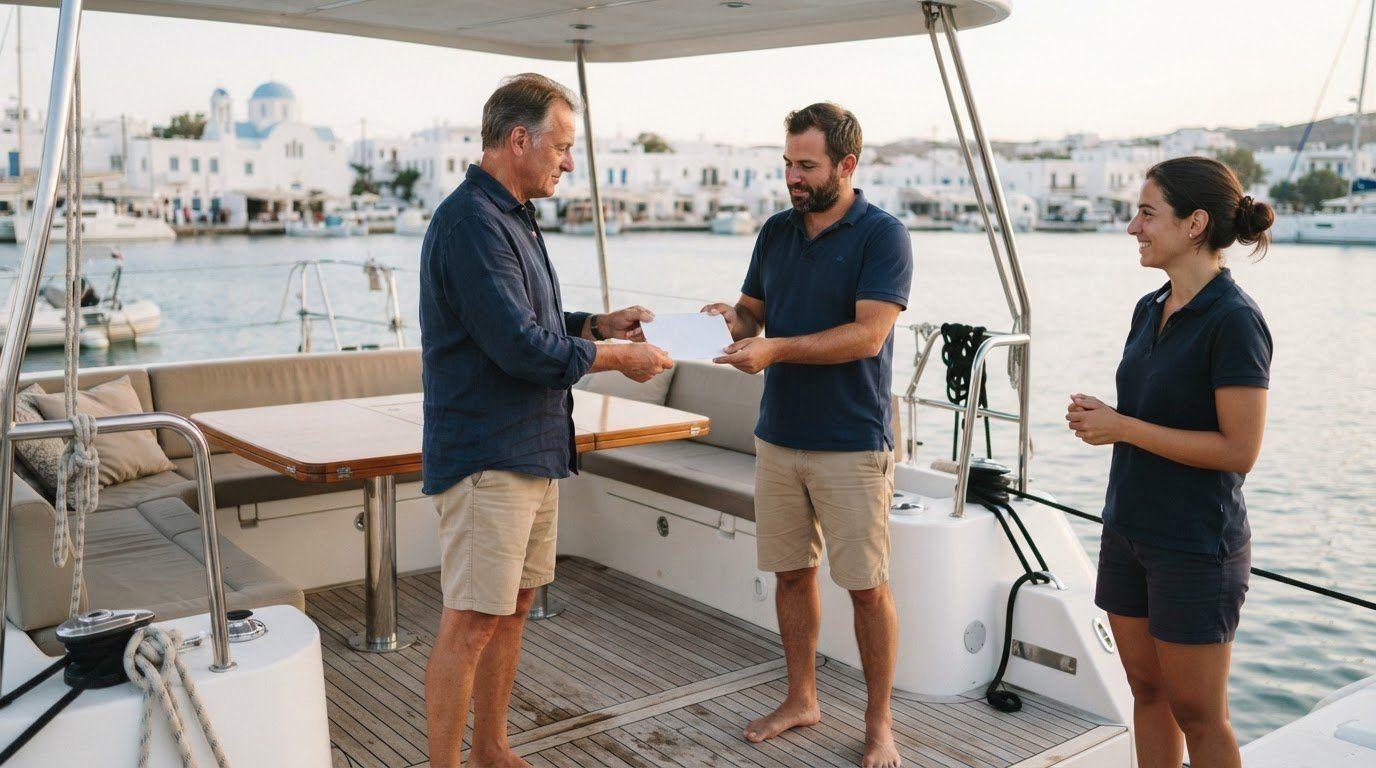
For an American yacht crew, a tip of at least 15% is the expected starting point. These yacht charter tipping standards for the captain, engineer, chef, and deck crew offer a clear baseline, but gratuities are discretionary and can reflect the service you received.
It’s natural to wonder whether the captain should receive more, or whether the chef and deck crew share the tip equally. Understanding yacht charter tipping standards for the captain, engineer, chef, and deck crew means looking beyond the amount to how gratuities are commonly handled.
You’ll learn how tipping expectations differ by destination and season, how crews commonly divide gratuities, and what each role contributes to your experience. Clear yacht charter tipping standards for the captain, engineer, chef, and deck crew can help you choose an amount that feels fair and end your charter on a gracious note.
Key Takeaways
- Use the crew’s destination and service as your guide: American and European charter expectations can differ.
- Plan for the gratuity to be shared across the crew; it’s commonly handed to the captain for distribution.
- Consider the work behind the scenes, from meal planning to maintaining the yacht’s technical systems.
- Learn how season and local customs can shape the amount and timing of your tip before your charter ends.
Dividing tips among the skipper, chef, and other crew
A charter gratuity usually recognizes the whole crew, not just the people guests see most. How it is handled depends on the yacht and the agreed payment arrangement.
Shared or Separate Crew Gratuities
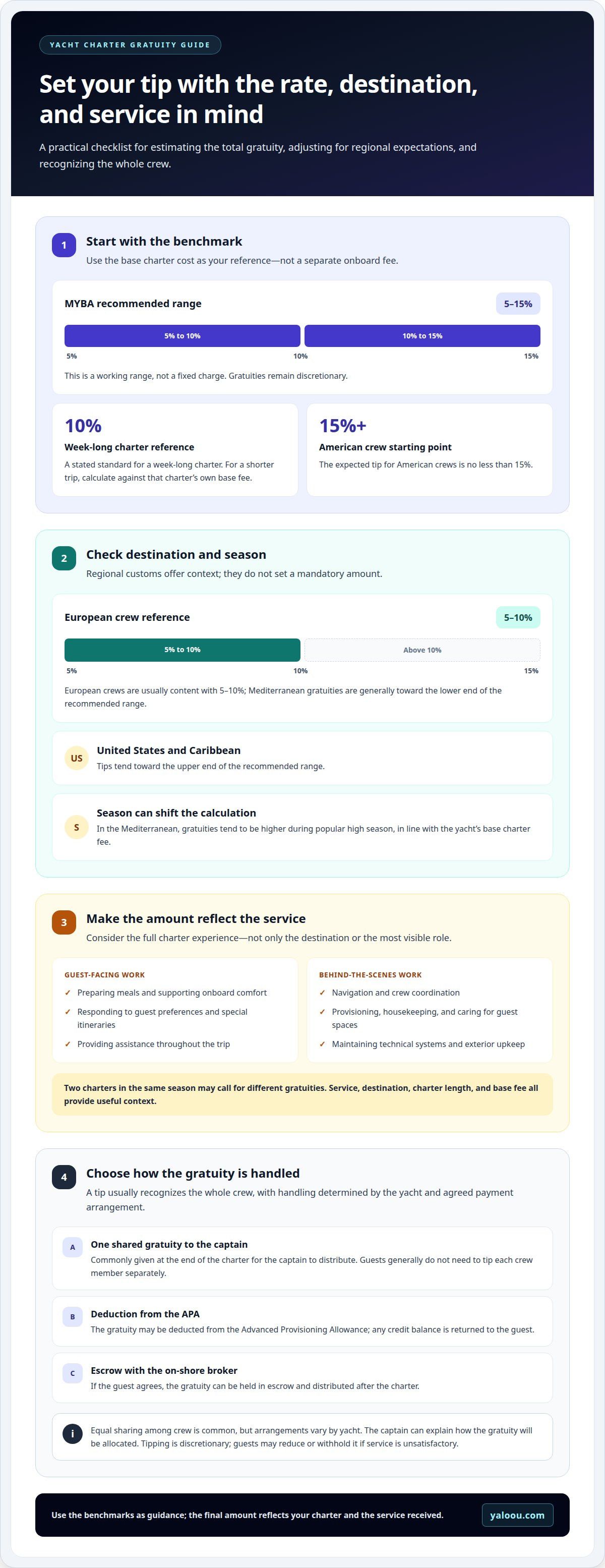
A shared gratuity is one tip given to the captain to distribute among the crew. Guests generally don’t need to tip the captain, chef, engineer, and deckhands separately. On smaller yachts, guests typically present the gratuity to the captain at the end of the charter. This recognizes how navigation, provisioning, housekeeping, and exterior upkeep all contribute to the trip, including work that happens behind the scenes.
Tips aren’t mandatory: according to the U.S. Department of Labor, whether to tip and how much are determined solely by the customer. If service was unsatisfactory, guests can reduce the gratuity or choose not to give one.
Crew Tip Allocation
Allocation is how the captain divides a shared gratuity among crew members. Many charter yachts distribute tips equally, regardless of role, so the engineer and chef may receive the same share as deck crew. An equal split recognizes the team’s combined work, from maintaining vessel systems to preparing meals and caring for guest spaces.
Equal distribution is common, but the crew’s arrangement can vary by yacht. The captain can explain how the gratuity will be shared, so guests know how their contribution recognizes the entire team, not only the most visible roles.
At the end of a charter, the tip is usually given to the captain for distribution. Depending on the arrangement, it may instead be deducted from the Advanced Provisioning Allowance (APA), with any credit balance returned to the guest. If the guest agrees, a gratuity can also be held in escrow with the on-shore broker and distributed after the charter.
For example, guests who prefer one shared tip can give it to the captain on the final day. With an APA deduction or escrow arrangement, the handling differs, but the gratuity still recognizes the crew’s service throughout the charter.
How destination and season affect gratuities
A base charter fee or an all-inclusive label doesn’t automatically mean the crew gratuity is included. Gratuities are discretionary, and the APA may be used to cover a crew tip at the charter’s end. Treat the tip as a separate part of your budget unless the charter terms explicitly include it.
Destination influences customary tipping. In the United States, yacht charter tips are often calculated toward the upper end of the recommended range. In the Mediterranean, gratuities are generally calculated toward the lower end. These regional patterns offer context, not a fixed rate for every crew or itinerary.
For a Mediterranean itinerary around Mykonos or Paros, the lower end of the recommended range is a useful reference. Service matters too: consider how well the crew handled your preferences, prepared the yacht, and supported the experience. The destination alone doesn’t determine the final amount, and expectations can vary between charters.
Season can also affect the calculation. In the Mediterranean, gratuities tend to be higher during the popular high season, in line with the yacht’s base charter fee. For a high-season trip from Athens toward the Cyclades, for example, factor in both the season and the base fee when planning a gratuity.
Consider the service delivered throughout the charter, not just the destination. Preparing for a special itinerary, provisioning, and assistance from deckhands can all shape the guest experience. These details help explain why two charters in the same season may call for different gratuities, even on similar routes around the Greek islands.
For a trip shaped around your preferred destination and season, explore yacht charter experiences as you plan the details.
Typical tipping rates for American and European crews
MYBA, the worldwide yachting association, recommends a crew gratuity of 5 to 15% of the base charter cost. For a week-long charter, 10% is a stated standard. These figures provide a working range, not a fixed charge, and the tip remains discretionary. Use the base charter cost as the reference point when estimating a percentage, rather than treating the gratuity as a separate onboard fee.
For American crews, the expected tip is no less than 15%. Tips for charters in the United States and Caribbean also tend to fall at the upper end of the recommended range. A guest comparing an American itinerary with a European one should therefore account for the different regional expectations before settling on an amount.
European crews are usually content with 5 to 10%. That lower range can still reflect attentive service throughout the course of a charter. A stewardess may support onboard comfort, while technical crew keep essential systems running. Their work contributes alongside guest-facing service, so consider the whole crew’s contribution rather than only the most visible role.
For example, a guest on a week-long European charter might use the 10% standard as a reference, then adjust the discretionary gratuity to reflect the service received. On an American charter, the 15% expectation provides a different starting point. Neither percentage determines each person’s share; distribution is handled separately from the overall amount.
The captain is responsible for navigation and coordinating the crew, while a chef or stewardess contributes directly to daily comfort. A larger yacht may also have dedicated technical and deck crew whose work is less visible. The MYBA range helps guests estimate a total gratuity; destination, charter length, and service inform the final choice.
Yacht crew departments and hierarchy
For a private yacht charter, MYBA recommends 5 to 15% of the base charter cost. A 10% gratuity is a stated standard for a week-long charter. For a shorter charter, calculate against its own base fee rather than treating the weekly benchmark as a fixed amount.
The captain leads the crew, plans the course with guests, monitors weather, and prioritizes safe passage. This leadership shapes the charter, but doesn’t mean the captain automatically receives a larger share. The yacht’s crew structure and distribution practice determine how a shared gratuity reaches each member.
Technical work often happens out of sight. An engineer maintains engines, generators, mechanical systems, power, water, and HVAC. On larger yachts, the engineer may also monitor water makers and other vessel systems. This work supports the comfort guests experience throughout the trip, even when the engineer isn’t serving drinks or working in the main guest areas.
In the galley, the chef plans meals around guest preferences and dietary needs, manages provisions, and prepares meals. Interior crew handle onboard service, housekeeping, and details such as al fresco dinners. A chief steward coordinates interior services, while deckhands maintain exterior spaces, manage water toys, and may drive the tender. Each role contributes a different part of the charter experience.
On smaller yachts, crew members may combine responsibilities. A chef or stewardess might also work as a deckhand, and some deck crew may serve drinks. The hierarchy describes responsibilities, not a simple ranking of effort. A fair gratuity recognizes the whole team, including overlapping roles that keep the charter running smoothly.
Explore yacht charter experiences to shape a trip around the onboard service and crew setup you value.
YAL’OOU Exclusive Yachting & More: Daily Yacht Charters
YAL’OOU offers daily yacht charters and weekly crewed yacht rentals for guests planning time on the water. Choose a day charter for a shorter escape or a weekly rental for a longer crewed experience. Private chef services can add tailored dining aboard, while luxury villa rentals offer a land-based stay alongside your yacht plans.
As you shape your itinerary, consider how the destination, charter length, and crew service fit together. Understanding local gratuity customs can help you plan a thoughtful end to your trip, while a clear picture of the onboard experience helps you decide what matters most.
Contact YAL’OOU Exclusive Yachting & More to discuss your yacht charter plans.
Plan a Charter That Feels Right for Your Group
Shape your charter around the experience you want, not just the vessel. Consider who’s travelling, the pace you prefer, and how much time you want to spend onboard. These choices can guide the destination, itinerary, and level of service that will make the trip feel personal.
Keep a simple gratuity plan alongside those decisions. Choose an amount that feels appropriate for the service and decide how you’d like to present it at the end. A clear plan leaves more room to enjoy the trip and recognize the people who helped make it special. Use yacht charter tipping standards for the captain, engineer, chef, and deck crew as a reference, then make your choice based on your experience.
Explore charter experiences and start imagining your next escape. With thoughtful planning, the journey can feel effortless from the first day aboard.
Frequently Asked Questions
Captain & Crew Gratuities (Tips): How much?
A common benchmark is 10% of the base charter cost for a week-long charter, within MYBA’s recommended range of 5 to 15%. The amount is discretionary, so use the benchmark as a reference rather than an automatic charge. For example, guests can weigh the service they received, the destination’s custom, and whether the charter was in the United States, Caribbean, or Europe.
How do I pay it?
Guests commonly give one gratuity to the captain, who distributes it among the crew. Depending on the arrangement, the tip may instead be deducted from the Advanced Provisioning Allowance (APA), or held in escrow with the on-shore broker for distribution after the charter, with the guest’s agreement. In Croatia, gratuities are typically presented in cash euros on the final morning.
When do I pay it?
Plan to give the gratuity at the end of the charter, not as a daily payment. On a smaller yacht, guests typically present it to the captain. In Croatia, the customary timing is the final morning. If the tip is handled through an APA deduction or escrow arrangement, it is distributed according to that arrangement after the charter ends.
When should I tip the crew and how much is appropriate?
Give a gratuity at the end of the charter if you choose to recognize the crew’s service. A 10% tip is a stated standard for a week-long charter, while MYBA’s recommended range is 5 to 15% of the base charter cost. Use the destination’s customs and the quality of service to decide where your tip fits within that range.
Who gets the tip?
The gratuity is generally intended for the crew as a team, including the captain, chef, engineer, and deck crew. The captain commonly receives it for distribution. Many charter yachts divide tips equally, though practices can vary by destination. On Croatian charters, for example, the skipper and chef usually receive larger shares, reflecting a local approach rather than a universal allocation rule.
What is the standard tip for a yacht charter crew in the United States?
For an American yacht crew, the expected tip is no less than 15% of the base charter cost. Tips on charters in the United States and Caribbean are often calculated toward the upper end of MYBA’s 5 to 15% recommended range. A tip remains the guest’s choice, and the service received can guide the final amount.
Disclaimer
The YAL’OOU Travel Guide is curated with care to inspire and inform discerning travelers. While every effort is made to ensure the accuracy and relevance of the information provided, all content is offered for general guidance only and may evolve over time.
Details such as local regulations, availability, pricing, and services are subject to change without prior notice. We encourage guests to seek personalized advice and confirm arrangements directly when planning their journeys.
YAL’OOU accepts no liability for any inaccuracies, omissions, or outcomes arising from the use of this information. The Travel Guide may feature recommendations, insights, and selected third-party experiences, presented solely as a source of inspiration and not as formal endorsements.
By accessing this section of our website, you acknowledge and accept this disclaimer as part of your experience with YAL’OOU.