

What if the yacht, route, and crew are exactly what you pictured, but the contract leaves you unsure what the price covers? The yacht charter contract red flags to watch for often hide in vague wording about extra expenses, cancellations, weather, or itinerary changes. Spotting them early can help prevent unwelcome surprises from disrupting your time at sea.
It’s natural to focus on the Greek islands you’ll explore and the experience waiting onboard. But the agreement matters too. It sets out the financial and practical commitments behind your charter, from what’s included in the base price to how additional expenses are handled. Clear terms help align expectations and support smoother coordination of routes, crew, and onboard services.
This practical checklist explains which clauses deserve a closer look before you sign or pay. You’ll learn how to distinguish an all-inclusive arrangement from a plus-expenses charter, identify unclear cost and payment language, and review cancellation, weather, and itinerary provisions. We’ll also explain common charter terms in plain English, so you can understand what you’re agreeing to and book your Greek yacht holiday with greater confidence.
Key Takeaways
- Use the yacht charter contract red flags to watch for as a practical guide to spotting unclear costs, cancellation terms, and responsibilities before signing.
- Compare the payment schedule with what the agreement says about included services, excluded expenses, taxes, and additional costs.
- Check that the vessel, dates, guest capacity, and onboard services match your booking expectations, while allowing for route changes due to conditions.
- Follow a clear pre-signing sequence to review booking details, payments, contingencies, responsibilities, and final documents.
- Coordinated routes, crews, and onboard services help set clear expectations for a smoother Greek-island charter.
Why a Yacht Charter Contract Deserves a Careful Review
Planning a yacht holiday can feel refreshingly simple: choose a vessel, settle on dates, and imagine days exploring the Greek islands. The paperwork may be less familiar. Terms about payments, responsibilities, or what happens when plans change can make a straightforward booking harder to assess. Some yacht charter contract red flags to watch for are details that need explaining; others may affect your expectations or the risks you’re taking on.
Read the agreement alongside the booking details, not as an isolated document. For a crewed charter, compare what’s written with the vessel, dates, route expectations, and onboard arrangements discussed during planning. Contract formats vary, so focus on whether the agreement clearly records the commitments relevant to your trip.
For an overview of common charter-related warning signs, watch:
What a yacht charter agreement should make clear
A yacht charter agreement records the vessel and booking terms, including the charter dates, payment arrangements, each party’s responsibilities, and how specified contingencies are handled.
Use that purpose as your starting point. Check whether the agreement identifies the essential details for your booking, such as:
- The yacht and charter period, including start and end dates.
- The payment schedule and any expenses treated separately from the quoted amount.
- The services and responsibilities assigned to the charterer, owner, or crew.
- The stated process for relevant changes or disruptions.
Compare these details with the booking description and written correspondence. If a crew arrangement, onboard service, or other promise influenced your decision, make sure the final documents reflect it accurately. A spoken assurance may be well-intentioned, but written terms give both sides a clearer record of what was agreed.
How to assess a clause without jumping to conclusions
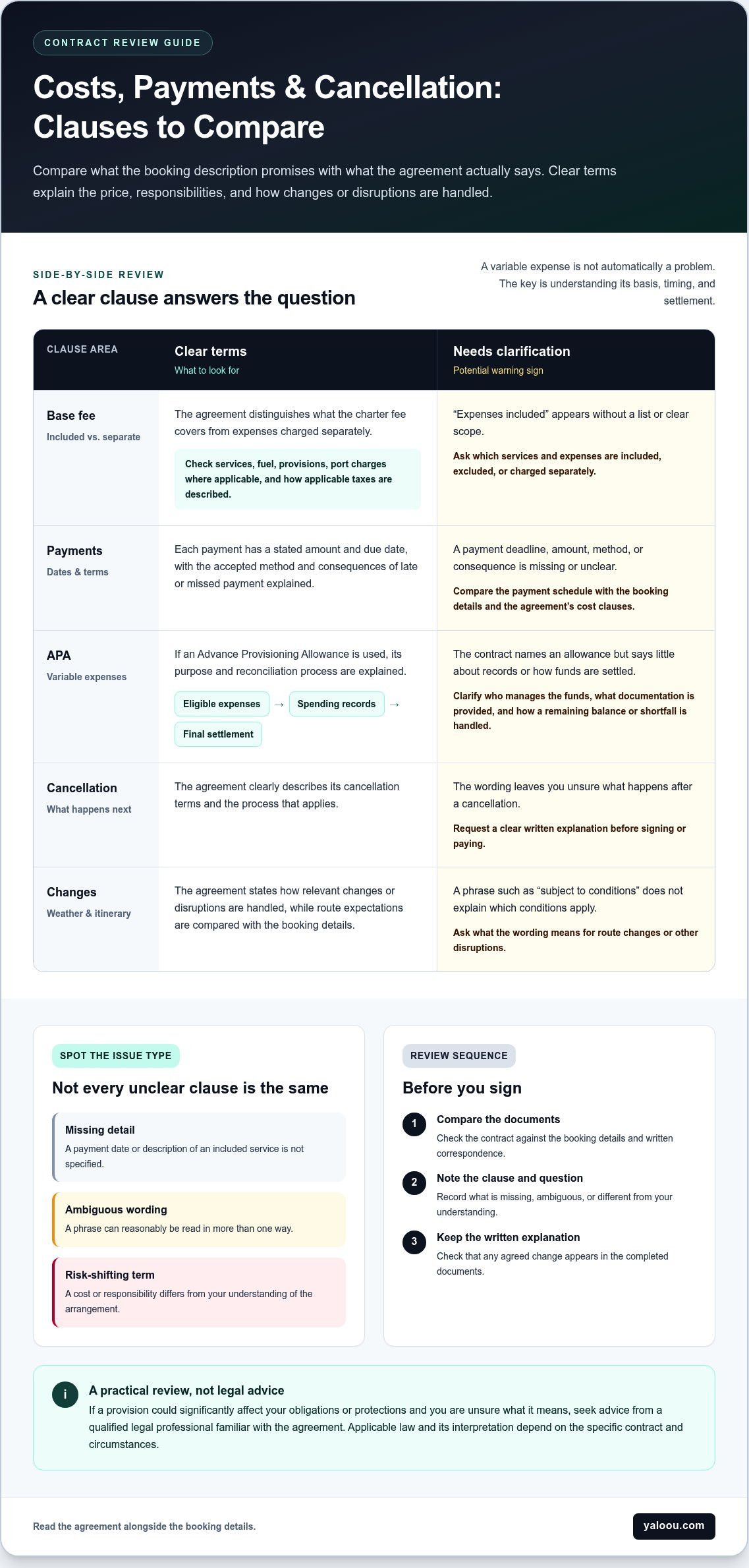
Not every difference in wording signals a problem. First identify the type of issue. A missing detail leaves a question unanswered. Ambiguous wording can reasonably be read in more than one way. A term that materially shifts risk may limit what you expected or assign you a responsibility that wasn’t clear during booking. Each deserves attention, but they aren’t the same issue.
- Missing detail: A payment date or description of an included service isn’t specified.
- Ambiguous wording: A phrase such as “subject to conditions” doesn’t explain which conditions apply.
- Risk-shifting term: A clause assigns you a cost or responsibility that differs from your understanding of the arrangement.
Write down questions as you review, note the relevant clause, and request a clear written explanation before signing. Keep the response with the final contract and check that any agreed change appears in the completed documents. Pay particular attention to the agreement’s governing-law language. The applicable law and its interpretation depend on the specific contract and circumstances.
This section is a practical review checklist, not legal advice. If a provision could significantly affect your obligations or protections and you’re unsure what it means, seek advice from a qualified legal professional familiar with the agreement.
Yacht Charter Contract Red Flags in Costs, Payments, and Cancellation
Money clauses deserve a close read before you commit. Yacht charter contract red flags to watch for often involve costs described only as “additional,” payment terms without clear deadlines, or cancellation language that leaves you unsure what happens next. A disclosed variable expense isn’t automatically a problem. The concern is not being able to understand how it’s calculated, when it’s due, or how it’s handled.
Unclear charter fees, APA, and payment schedule
Compare the price and payment clauses with the booking details. Look for the amount and due date of each payment, the accepted payment method, and the stated consequences of a late or missed payment. The agreement should distinguish what the charter fee covers from excluded expenses, such as fuel, provisions, or port charges where applicable. Check how any applicable taxes are described rather than assuming they’re included.
If the contract uses the term Advance Provisioning Allowance (APA), find out how it works under that agreement. The wording should explain which expenses it covers, who manages the funds, how spending is recorded, and how any remaining balance or shortfall is settled. Look for a clear post-charter accounting process, including supporting documentation for expenses. An APA is a disclosed variable expense when its purpose and reconciliation process are explained. An extra charge with no stated basis is harder to assess.
ClausePotential warning signWhy it mattersWhat to clarify
Included services and exclusions
“Expenses included” appears without a list or clear scope.
You may have different expectations about what the base fee covers.
Which services and expenses are included, excluded, or charged separately?
APA and other variable expenses
The agreement names an allowance but says little about spending records or settlement.
You can’t easily understand how funds are used or reconciled.
What expenses qualify, what documentation is provided, and how is the balance handled?
Payment schedule
Due dates, payment methods, or consequences of late payment are missing.
You may not know when a payment is required or what follows if it’s delayed.
What is due, when, by which method, and under what stated conditions?
Cancellation and force majeure
Refund terms conflict, or cancellation and disruption are not clearly addressed.
The financial and practical outcome may be difficult to anticipate.
What deadlines, consequences, refund terms, or rescheduling process apply?
Every charge should have a defined basis, due date, and process for review or settlement.
Cancellation, refunds, and events outside either party’s control
Read the cancellation terms from both sides. Note the deadlines, the stated consequences at each stage, and whether the contract explains refunds or rescheduling. Check that the deposit language aligns with the cancellation clause. If force majeure appears, see whether the agreement defines the events it covers and explains their practical effect on each party. Vague phrases or contradictory provisions call for written clarification before signing. These terms don’t establish legal entitlements by themselves. Interpretation depends on the specific agreement and its governing law, so get qualified legal advice if the consequences aren’t clear.
Clear cost and cancellation expectations are one part of a well-planned Greek yacht holiday. Explore Greek yachting experiences as you shape the trip you want.
Vessel, Itinerary, and Responsibility Clauses to Compare
A charter can sound clear in a booking description and still leave key details open in the agreement. Compare the documents side by side. Check that the vessel, charter dates, maximum guest capacity, and included services match what you selected. A mismatch may be a simple drafting error, but resolve it before relying on the written terms.
For vessel-specific details, compare the agreement with the relevant yacht listings. Look for consistent identification and descriptions of the features or services that shaped your choice. If the contract allows a substitute vessel, check who can propose the change, how much notice is provided, what “comparable” means in practical terms, and what options or remedies apply if you don’t accept the proposed replacement. A broad substitution clause isn’t automatically improper, but undefined standards can leave expectations misaligned.
Vessel identity, condition, and substitution terms
Read the substitution wording carefully rather than assuming it guarantees an identical yacht. The agreement may use comparative language without explaining whether comparison means capacity, layout, facilities, or another feature. Note any stated process for communicating a proposed change and its effect on the charter. If vessel details conflict across documents, record the discrepancy and get the final agreed description in writing.
Greek-island itinerary changes and onboard responsibilities
A planned route is a proposed sequence of destinations, while a guaranteed itinerary commits the parties to specific stops and timing regardless of changing conditions. Greek-island plans may need adjustment for weather, safety, or operational considerations, so check how route decisions are made and how guests are informed. If the agreement names destinations, see whether they’re firm commitments or preferences subject to change.
Check how responsibilities are divided onboard. The agreement should make the crew’s role, guests’ obligations, and communication of safety instructions or onboard limitations clear. Look for wording about guest conduct and any limits that could affect activities or access to parts of the vessel. For example, if a planned activity depends on specific onboard equipment, don’t assume it’s covered unless the agreement or booking documents say so.
Useful questions to note while reviewing include:
- Does the guest capacity in the contract match the booking details?
- Who may change the route, and how will guests be notified?
- What criteria define a comparable substitute vessel?
- Which crew instructions and guest responsibilities are expressly described?
- Are any expected services or onboard activities subject to stated limitations?
These are among the yacht charter contract red flags to watch for when details are missing, inconsistent, or open to more than one interpretation. A flexible route or substitution clause may reflect practical realities. The key is understanding its scope and the process it sets out. Put unresolved points in writing before signing, then compare the final version with the booking description so the vessel, route expectations, and onboard arrangements align.
A Pre-Signing Checklist for Reviewing a Yacht Charter Contract
Before you sign, make one final pass through the agreement with your booking details beside it. Start with the trip basics, then review the clauses that describe what happens if plans change. This order helps you catch mismatches while there’s still time to align the written terms with your expectations.
Five checks to complete before signing
- Match the booking details. Compare the named parties, vessel, charter dates, guest information, and included services with your booking description and written communications. Check that the guest capacity and onboard arrangements fit your group. If the contract describes a different yacht, date, or service, pause until the documents agree.
- Map every payment and expense. Trace each payment to a clause that states what it covers and when it’s due. Note separate expenses and how they’re calculated, recorded, or settled. Don’t rely on a total alone if the agreement leaves the components unclear.
- Inspect the contingencies. Locate the terms for cancellation, refunds, vessel substitution, itinerary changes, and force majeure. Check the process and consequences each clause describes. Make sure related terms don’t contradict one another or differ from the booking communications.
- Clarify responsibilities. Review what the agreement assigns to the charterer, crew, and other parties. Include guest conduct, safety instructions, and any onboard limitations that could affect your plans. Compare these terms with the services and activities you expect.
- Keep the final record. Obtain written answers to unresolved questions and check that any agreed changes appear in the final version. Save the signed agreement with the invoice, booking description, itinerary, and related communications so you can refer to one consistent record.
Use your expected itinerary as a comparison tool, not just a holiday outline. If you’re planning time around Mykonos or Paros, compare the route expectations and onboard services discussed during booking with what the agreement actually describes. A planned route may allow adjustments; the important point is to understand how the contract handles them.
When to pause and seek clarification
Pause if a key detail conflicts across the agreement, invoice, and written booking communications. Mark the exact wording and request a written explanation or correction before signing. Verbal assurances and assumptions aren’t a reliable substitute for terms reflected in the final documents. Red flags to watch for include unclear language that affects the vessel, itinerary expectations, responsibilities, or financial commitment.
If a term remains substantially ambiguous, creates significant financial exposure, or leaves you unsure about its legal effect or governing law, consider seeking advice from a qualified lawyer familiar with the agreement. This checklist supports a practical review; it can’t determine your rights or replace legal advice.
Once your expectations and paperwork are aligned, explore curated yacht experiences to shape a Greek-island trip around the route, crew, and onboard services that matter to you.
Plan a Greek Yacht Charter With Clear Expectations
A memorable Greek yacht holiday starts with a trip that reflects what matters to you and a booking record that describes those arrangements clearly. Contract review remains essential, but it works best alongside thoughtful planning. The clearer your priorities are from the start, the easier it is to compare the written terms with the experience you expect.
Bring your priorities into the charter-planning conversation
Before planning begins, outline the details that will shape your days at sea. Consider your preferred dates, who’s travelling, the destinations that interest you, and the onboard services that would make the trip feel right. For example, a group hoping to spend time around Paros may value a different route pace or onboard setup than guests focused on exploring several islands.
- Dates and pace: Note your preferred travel period and whether you picture relaxed days or a fuller itinerary.
- Guest needs: Share relevant group preferences so the vessel and arrangements can be considered against them.
- Route interests: Identify islands or experiences that matter most, while allowing for possible route adjustments.
- Onboard priorities: Describe the services and features that are central to your plans.
YAL’OOU Exclusive Yachting & More coordinates crewed yacht charters across Greek destinations, bringing together tailored routes, crews, onboard services, and travel logistics. Clear priorities help connect those planning details with the written booking terms. Keep the final agreement and booking documents as your reference for the specific vessel, services, and arrangements agreed for your charter.
Make the final agreement match the experience you expect
Before signing, compare the final version with the complete picture of your booking. Check that vessel details and dates align, the itinerary is described at the right level of certainty, and included services match what you understand you’ve arranged. Revisit payment terms and the clauses covering changes or other contingencies. If an agreed detail is missing or inconsistent, resolve it in writing before proceeding.
This final check isn’t about expecting every part of a Greek-island journey to unfold exactly as planned. Routes can be affected by conditions and operational decisions. It’s about understanding what the agreement says, where flexibility applies, and how changes are handled. A tailored charter feels more cohesive when guest expectations, route planning, crew arrangements, and onboard services are coordinated rather than assumed.
Keep a complete copy of the executed agreement with the booking description, itinerary, invoice, and written clarifications. That gives you a practical record to refer to as your trip approaches. Clear expectations support a smoother experience, while careful contract review helps you understand the commitments behind it. Explore yacht experiences across Greece as you begin shaping your charter plans.
Set Sail With Confidence in Your Plans
Let contract review be the point where your ideas become a well-aligned trip plan. Once the written terms reflect the experience you’re arranging, you can focus on the more exciting choices: the pace of your days, the places you hope to discover, and the moments you want to share onboard.
YAL’OOU specializes in Greek-island charters and coordinates crewed vessels, tailored routes, and onboard services around each trip. Charter destinations include Mykonos, Paros, Antiparos, Athens, Aegina, Poros, Spetses, Syros, Tinos, Sifnos, Serifos, Milos, Poliaigos, Kimolos, Santorini, Ios, Koufonisia, Amorgos, Crete, Corfu, and Zakynthos. Keep your priorities at the heart of the planning, and use the yacht charter contract red flags to watch for as a prompt to seek clarity wherever the written details leave room for doubt.
Explore curated yacht experiences and start shaping a Greek escape that feels considered from the first conversation to the days at sea. Clear expectations make room for a more relaxed journey. Bon voyage!
Frequently Asked Questions
What should be included in a yacht charter contract?
A yacht charter contract should identify the parties, vessel, charter dates, guest capacity, payment arrangement, included services, and how relevant changes are handled. The exact format can vary. Check whether attachments, such as a service schedule or itinerary, are part of the agreement and whether they match the final booking. For a Greek-island trip, note whether named stops are fixed commitments or planning preferences.
Is a yacht charter deposit refundable if I cancel?
Whether a deposit is refundable depends on the agreement’s cancellation terms and the circumstances of cancellation. Read the deadlines and consequences that apply at each stage, and distinguish the deposit from later payments. For example, a clause may describe different outcomes depending on how far ahead notice is given. Don’t assume a refund applies or that it’s automatically ruled out. If the wording is unclear, get a written explanation before paying.
What happens if bad weather changes the yacht charter itinerary?
The route may need to change, but the contract determines how itinerary changes are addressed and what process applies. Before booking, look for language about weather-related adjustments, who communicates a change, and whether alternatives are described. A route around Mykonos or Paros might be planned around preferred stops, but conditions can affect whether those plans are practical. Don’t assume a weather change automatically means a refund or rescheduling.
Can a charter company substitute the yacht named in the contract?
A substitution may be addressed in the contract, so check the specific clause rather than assuming the named yacht can never change. Look for what qualifies as a comparable vessel, when a replacement can be proposed, and what options the agreement describes if you don’t accept it. Compare practical features that matter to your group, such as capacity and layout. If the wording is broad, request written clarification before signing.
How does APA work in a yacht charter agreement?
APA, or Advance Provisioning Allowance, is an advance fund for specified charter expenses, which may include items such as fuel, food, or port charges depending on the agreement. Check how the funds are managed and what records you’ll receive. For example, look for how individual expenses will be itemized and how any remaining balance or shortfall is handled. The agreement should describe the reconciliation process so you can understand the final accounting.
Do I need a lawyer to review a yacht charter contract?
Not every booking requires legal review, but consider consulting a qualified lawyer if a clause is substantially ambiguous, the financial exposure is significant, or you’re unsure how the governing-law provision may affect interpretation. A lawyer can review the actual agreement and explain its potential legal effect in context. This can be especially useful if documents appear inconsistent or if cancellation, liability, or dispute terms are difficult to understand.
Can I negotiate yacht charter contract terms before signing?
You can raise requested changes before signing, but whether they’re accepted depends on the parties and the booking. Be specific: identify the clause, explain the wording you’re seeking, and request that any agreed revision appear in the final documents. For example, if a service discussed during planning is missing, ask for the booking record to reflect the agreed arrangement. Review the revised version before signing, not just the earlier draft.
Disclaimer
The YAL’OOU Travel Guide is curated with care to inspire and inform discerning travelers. While every effort is made to ensure the accuracy and relevance of the information provided, all content is offered for general guidance only and may evolve over time.
Details such as local regulations, availability, pricing, and services are subject to change without prior notice. We encourage guests to seek personalized advice and confirm arrangements directly when planning their journeys.
YAL’OOU accepts no liability for any inaccuracies, omissions, or outcomes arising from the use of this information. The Travel Guide may feature recommendations, insights, and selected third-party experiences, presented solely as a source of inspiration and not as formal endorsements.
By accessing this section of our website, you acknowledge and accept this disclaimer as part of your experience with YAL’OOU.