

Could two Greek yacht charters with similar quotes carry different VAT? Yes. The rate can depend on details such as charter duration, whether the yacht is crewed, and the vessel’s certification and itinerary. For anyone focused on understanding Greek VAT on yacht charters 2026, the headline rate alone won’t tell the whole story.
It’s easy to see why the figures can feel confusing. A charter fee, VAT, APA, fuel, and port expenses may all appear in the booking paperwork, but they cover different things. Understanding each line makes it easier to see what’s included and compare proposals on a like-for-like basis.
This guide explains which details may affect VAT on a Greek yacht charter, how to read the tax line in a quote and invoice, and how VAT differs from the Advance Provisioning Allowance and other expenses. With a clearer view of the figures, you can focus on choosing the yacht, route, and experience that fit your plans.
Key Takeaways
- Understanding Greek VAT on yacht charters 2026 starts with treating the quoted rate as transaction-specific, not as a one-size-fits-all figure.
- Compare the purpose and placement of each quote line so taxes, operating expenses, and discretionary charges stay distinct.
- Match the yacht description, charter dates, itinerary, and contracting parties across the proposal, agreement, and final invoice.
- Use the written itemization to compare the overall booking structure, not just the headline charter fee.
- Consider how your preferred vessel and route shape the charter proposal, then review the tax treatment against the final booking details.
Greek VAT on yacht charters: what the charge means in 2026
VAT, or value-added tax, is a consumption tax that may be charged on a yacht charter. A quote may show it as a separate amount alongside the charter fee, though formats and labels vary. Check what the tax line applies to rather than assuming every proposal uses the same layout or treatment.
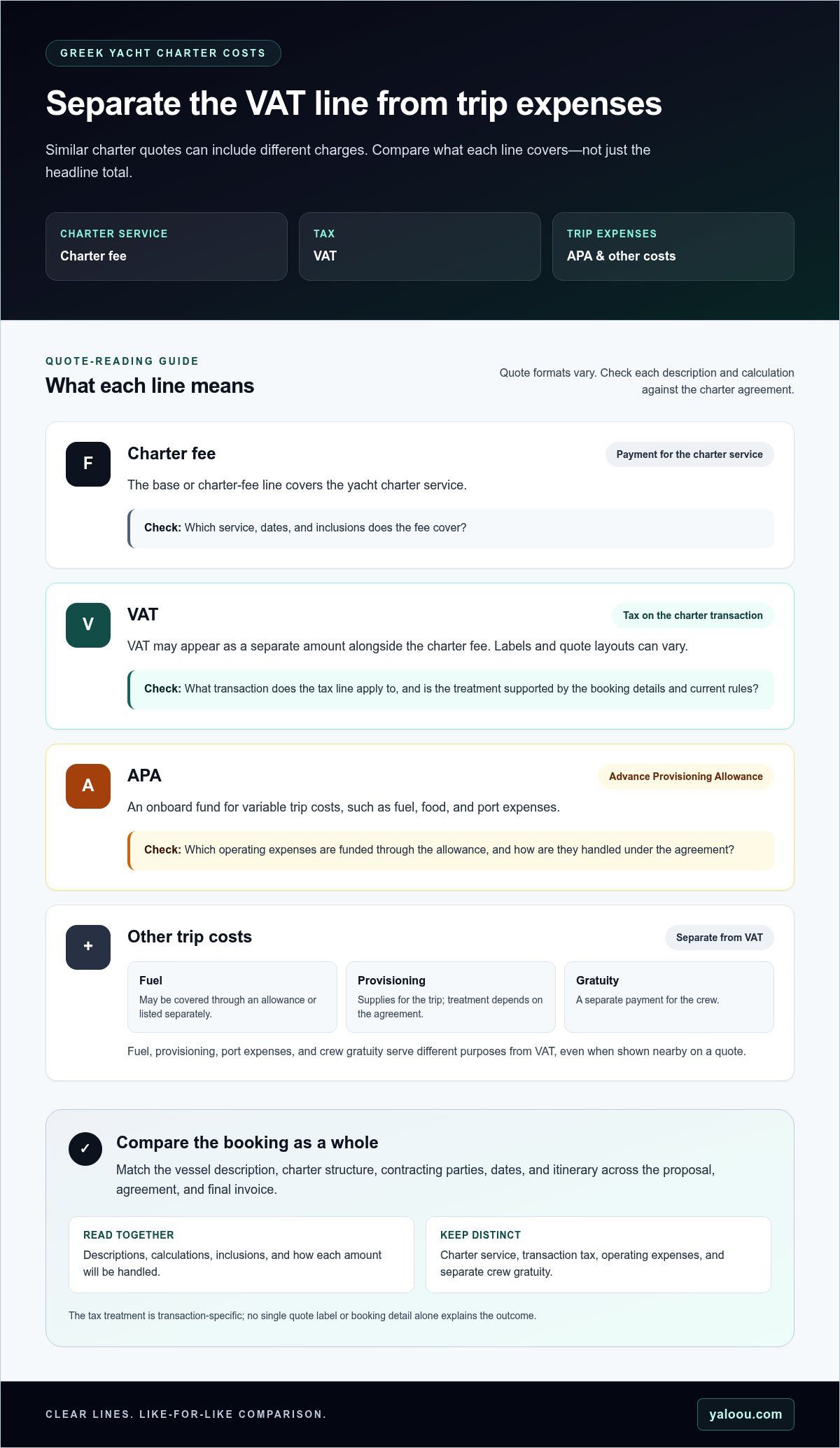
Put simply: VAT is a tax on the charter transaction; APA and other operating charges fund or reflect expenses connected with running the trip. Fuel, provisioning, and crew gratuity serve different purposes from VAT, even when they appear nearby on the quote. Clear, separate line items make the booking easier to assess.
For a broader introduction to the framework, see the EU's common system of value-added tax, which provides context for VAT across EU member states, including Greece.
For another perspective on charter costs, watch this Mediterranean-focused overview:
What does VAT mean on a yacht charter quote?
A proposal might show a charter amount, a VAT line, and separate allowances or estimated trip expenses. APA, or Advance Provisioning Allowance, is an onboard fund for variable costs such as fuel, food, and port expenses. Provisioning refers to supplies for the trip, while gratuity is a separate payment for the crew. The agreement sets out how these items are presented and handled.
Read the descriptions and calculations together. A line labelled “tax” or “VAT” is useful, but the label alone doesn’t explain whether the treatment is correct. The tax treatment should be supported by the transaction details and current rules.
Why does a Greek charter need a transaction-specific explanation?
Greece is the relevant charter jurisdiction for this guide, but a single headline rate can’t explain every booking. The applicable rules and transaction details matter. The vessel’s classification and status, charter arrangement, duration, and itinerary may all be relevant under current authoritative guidance. Don’t assume one detail automatically determines the outcome.
That’s the practical starting point for understanding Greek VAT on yacht charters 2026: treat the quote as a record of a particular booking, not a universal template. The proposal should make the charter fee, tax, and other charges understandable, with the tax treatment grounded in the actual arrangement and current guidance.
How Greek yacht charter VAT may be determined: the factors to understand
A charter’s tax treatment depends on verified transaction details, not a yacht’s prestige or a route name alone. When understanding Greek VAT on yacht charters 2026, treat each potential factor as something to document and assess under current rules, not as an automatic trigger for a particular rate.
Greek VAT analysis can involve the nature of the supply, the parties to the contract, the yacht’s status, and how the charter is arranged. The Greece's Independent Authority for Public Revenue (AADE) is the official source for Greek tax information. Because charter-specific treatment can turn on precise legal definitions, a tax professional should assess the booking documents against current Greek and EU rules.
Can vessel status or charter structure affect VAT?
Potentially, but labels alone don’t settle the question. A vessel’s registration, commercial status, applicable certification, and the contractual service being supplied may be relevant if current guidance says they are. The same applies to whether the arrangement is crewed or bareboat. Don’t infer a rate from yacht size, luxury category, or crew status by itself. Read those details alongside the contract and assess them under the rules that apply to the transaction.
Can itinerary and charter duration change the analysis?
They may need review. Record the charter’s start and end points, dates, duration, and planned route. A sailing plan through the Cyclades, for example, differs operationally from one in the Saronic Gulf, but that difference alone doesn’t establish a VAT result. Route planning tells guests and crew where the yacht is expected to travel; tax analysis separately considers applicable place-of-supply rules and the exact service contracted.
Duration also belongs in the booking record. A short day charter and a multi-day booking are different transaction facts, but no single fact should be treated as decisive without checking the relevant 2026 guidance. If the itinerary changes after booking, review the written route and tax analysis together.
Before comparing proposals, make sure the vessel description, charter structure, contracting parties, dates, and itinerary are clear and consistent. This gives a qualified reviewer a more reliable basis for evaluating the tax treatment and helps you understand the booking. Explore Greek yacht charter experiences with your preferred route and onboard style in mind.
Greek charter VAT versus APA and other costs: compare the quote clearly
A clear quote separates the cost of the charter from tax and trip expenses. VAT is a tax line; APA is an allowance for agreed operating expenses. Fuel and provisioning may be covered through an allowance, listed separately, or handled another way under the charter agreement. Compare the written inclusions, not just the totals.
Use this table as a reading guide, not a substitute for the contract. Quote formats differ, so check what each amount covers and how it will be handled.
ItemPurposeTypical quote placementClarify separately?
Charter fee
Payment for the yacht charter service
Base or charter fee line
Yes. Check the service, dates, and inclusions it covers.
VAT
Tax treatment of the transaction
Tax line or stated rate beside the charter fee
Yes. Review the basis and treatment against current rules.
APA
Allowance for operating expenses during the trip
Separate allowance or advance payment
Yes. Check covered costs and settlement terms in the agreement.
Fuel
Propulsion and generator use, where applicable
Included, separately estimated, or accounted for through an allowance
Yes. Confirm how it is estimated and charged.
Provisioning
Food, drinks, and other supplies for guests
Separate estimate, allowance, or stated inclusion
Yes. Check what is provided and how preferences are handled.
Gratuity
Additional recognition for crew service
Separate note or suggested amount, if shown
Yes. Check whether it is optional and how it is paid.
Is VAT the same as APA or fuel?
No. VAT is a tax, while APA is an allowance with handling and settlement terms set out in the charter agreement. Fuel and provisioning are expenses, but whether they’re included, paid through an allowance, or charged separately depends on the arrangement. Understanding Greek VAT on yacht charters 2026 means keeping these categories distinct and comparing proposals with the same inclusions in view.
How can two Greek charter quotes look different?
One proposal might itemize fuel and supplies, while another groups some expenses under an allowance. A separate VAT line may also be presented differently from a stated tax treatment. Those differences don’t automatically mean either quote is wrong. Vessel choice, route, and service arrangements can shape the proposal, while the tax treatment should be assessed against the actual booking details.
For broader context, explore this Greek yacht charter selection alongside your preferred itinerary. A useful “Greek crewed yacht charter guide” can help you understand the experience; the quote and contract show how its charges are structured.
How to review a Greek yacht charter quote and VAT invoice
Read the proposal, signed contract, and final invoice as one set. Each should describe the same booking, although the final invoice may reflect agreed changes made along the way. A consistent paper trail helps you understand what was charged and gives a tax professional the details needed to review the VAT treatment.
What should the charter quote show?
Start with the written proposal. Look for the charter fee, a clearly described tax line, stated inclusions, and separately identified allowances or expenses. The quote should make its currency, charter dates, service details, and payment terms easy to follow. A label such as “VAT” is not, by itself, an explanation of why a particular treatment applies.
Use this checklist to review the documents:
- Compare the charter description. Make sure the yacht and service described in the quote match the signed agreement.
- Match the dates and itinerary. Check the start and end dates, departure and return points, and planned route across the proposal and contract.
- Check the contracting parties. Compare the named customer and contracting entity across all documents.
- Review the itemization. Identify the charter fee, VAT basis and amount, inclusions, and any separately described allowances or expenses.
- Verify the tax treatment. Compare its stated basis with current authoritative guidance, such as information from Greece’s Independent Authority for Public Revenue, or seek qualified tax advice for the transaction.
- Reconcile the final invoice. Match billed amounts and tax details against the signed agreement and proposal, accounting for any documented changes.
What should you compare against the final invoice?
Check that the invoice reflects the actual contracted service, dates, itinerary, and parties. Review how the tax is described and calculated, then compare the total with the agreed payment terms. If a figure or description differs, use the supporting booking documents to understand the change rather than relying on a line-item label alone.
In short: compare the contract, itemized quote, and invoice before settling. Keep them together with any written amendments and payment records. For route inspiration, explore Greek island yacht destinations; the chosen route and vessel can help shape a tailored charter proposal.
Ready to shape a Greek charter around your preferred route and onboard experience? Explore Greek yacht charter experiences.
Plan a Greek yacht charter with clear VAT expectations
With the quote lines understood, take the next steps in order: compare each proposal’s itemization, verify the stated tax treatment against current guidance or qualified tax advice, then assess the full charter plan. A low headline fee doesn’t show the whole picture if inclusions, allowances, route, or services differ.
When understanding Greek VAT on yacht charters 2026, keep the tax review tied to the specific booking details. Then consider the experience as a whole: the route you want to sail, the vessel that suits your group, and the onboard arrangements that will make the trip feel right.
What details help shape a charter proposal?
Gather a few preferences before comparing vessel options. A clear starting brief helps connect the yacht and itinerary to the way you want to spend your time on the water.
- Preferred dates and trip length, so the proposal reflects your intended schedule.
- Guest needs, such as group composition, comfort priorities, and onboard preferences.
- Destination and route ideas, whether you’re drawn to Mykonos and Paros, Athens, or a wider Cyclades itinerary.
- Trip style, such as relaxed island-hopping, time at anchor, or a day focused on a particular destination.
These details help shape a relevant vessel and route proposal. Explore the Greek yacht fleet to compare vessel options as you refine your plans. Greek itineraries can range from Mykonos, Paros, and Antiparos to Athens, Aegina, Poros, and Spetses, or continue through Syros, Tinos, Sifnos, Serifos, Milos, Poliaigos, Kimolos, Santorini, Ios, Koufonisia, and Amorgos. Routes may also include Crete, Corfu, and Zakinthos. As the itinerary develops, keep the agreed dates, route, and charter description aligned with the details used to review the quote.
How can YAL’OOU Exclusive Yachting & More help make the planning feel seamless?
YAL’OOU Exclusive Yachting & More coordinates daily and weekly yacht rentals across Greek destinations, bringing route planning, crew logistics, and local supplier partnerships into the charter process. This coordination connects the practical details of the proposal with the experience you have in mind, from vessel selection to the flow of your itinerary.
VAT information in this guide is educational, not personalized tax advice. The tax treatment should be verified for the actual transaction using current authoritative guidance or advice from a qualified tax professional. With your preferences and booking details organized, you can plan the experience with a clearer view of both the proposed route and its itemized charges.
Ready to shape your trip? Explore Greek yacht experiences and find inspiration for your time on the water.
Plan your Greek charter with clarity
Understanding Greek VAT on yacht charters 2026 starts with looking beyond a single rate. The tax treatment depends on the verified details of the booking, so compare the itemized quote with the contract and invoice, and distinguish VAT from APA and other trip expenses. For transaction-specific tax questions, use current official guidance or qualified tax advice.
Once the charges are clear, weigh the full charter plan: the vessel, route, dates, and onboard experience. YAL’OOU coordinates daily and weekly private yacht rentals across Greek destinations, with tailored routes, crew coordination, and local supplier partnerships helping bring the practical details together.
Ready to turn your ideas into a considered itinerary? Explore curated yacht experiences in Greece and start shaping a charter that fits your plans. Clear details make room for a more relaxed journey, and the Greek islands are waiting to be discovered.
Frequently Asked Questions
What is the VAT rate on yacht charters in Greece in 2026?
Greek yacht charter VAT in 2026 may be 24%, 13%, or a lower effective rate where the relevant conditions are met. The 24% rate applies to charters of 48 hours or less, static charters, and bareboat charters; qualifying crewed charters lasting more than 48 hours may use 13%. Depending on certification and itinerary, invoiced rates may be 12%, 7.8%, 6.5%, or 5.2%. Verify the specific booking against current official guidance.
Is Greek VAT included in the yacht charter price?
It depends on how the quote presents the price. VAT may appear as a separate line, or the proposal may state that the quoted amount includes it. Check the written quote and contract for the charter fee, VAT basis and amount, and whether the total is tax-inclusive. Don’t infer inclusion from a headline price alone. Understanding Greek VAT on yacht charters 2026 means checking the itemization for the specific vessel, dates, and charter arrangement.
Does APA include VAT on a Greek yacht charter?
APA is a separate allowance for variable operating expenses, not the VAT line on the charter fee. Under the 2026 guidance summarized in this article, the APA itself is not subject to VAT. However, its covered items, such as fuel, food, or port expenses, and their handling depend on the agreement and underlying transactions. Read the APA terms to understand what it covers and how any unused balance or additional spending is settled.
Can the yacht or itinerary affect Greek charter VAT?
They can be relevant to the analysis, but neither the yacht’s luxury level nor a destination name determines the rate by itself. Vessel status or certification, charter structure, duration, and itinerary may matter under applicable rules. A route between Athens and the Cyclades, or around Mykonos, Paros, and Antiparos, should be assessed using the actual booking details. Route planning and tax conclusions are separate steps.
How can I check whether VAT is correctly shown on my yacht charter invoice?
Compare the invoice with the signed contract and itemized quote. Check that the named parties, charter service, dates, itinerary, tax basis, rate, and amount match the agreed transaction, including any documented changes. A VAT label alone doesn’t prove the treatment is correct. For a Greek charter, compare the stated basis with current guidance from the Independent Authority for Public Revenue or seek advice from a qualified tax professional.
Do yacht charter guests pay VAT on top of the charter fee in Greece?
Guests may pay VAT in addition to the charter fee when the quote states that tax is excluded. If the written total is tax-inclusive, VAT should be accounted for within that amount rather than added a second time. Check the proposal and contract for the tax line, calculation, and total due, then compare them with the final invoice. Other charges, such as APA and fuel, are separate items and should be reviewed on their own terms.
Disclaimer
The YAL’OOU Travel Guide is curated with care to inspire and inform discerning travelers. While every effort is made to ensure the accuracy and relevance of the information provided, all content is offered for general guidance only and may evolve over time.
Details such as local regulations, availability, pricing, and services are subject to change without prior notice. We encourage guests to seek personalized advice and confirm arrangements directly when planning their journeys.
YAL’OOU accepts no liability for any inaccuracies, omissions, or outcomes arising from the use of this information. The Travel Guide may feature recommendations, insights, and selected third-party experiences, presented solely as a source of inspiration and not as formal endorsements.
By accessing this section of our website, you acknowledge and accept this disclaimer as part of your experience with YAL’OOU.