

A global network can widen your yacht search, but it doesn’t automatically make the process more personal or locally informed. The limitations of using a large international yacht broker can include potential conflicts between agency duties and commercial incentives, commission terms that deserve close attention, and gaps between a firm’s reputation and your experience with the individual broker. A network of offices can also bring reach without guaranteeing local insight.
It’s reasonable to expect a large brokerage to offer broad connections and a polished process. The key is to understand what those advantages do, and don’t, mean for your transaction. This article explains how agency responsibilities, commissions, reviews, and international office networks can shape the service you receive.
You’ll get a practical framework for weighing scale against direct communication and attention to your specific transaction. That way, you can make a more informed choice about the support you want as you plan your time on the water.
Key Takeaways
- Clarify whom the broker represents and how potential conflicts could affect advice during a transaction.
- Understand how commission terms are set and what services and responsibilities the agreement covers.
- Look beyond a brokerage’s overall reputation to consider the communication and support you receive from the individual broker.
- Assess whether an international office network brings relevant local knowledge and coordination to your specific plans.
1. Agency duties and conflicts of interest
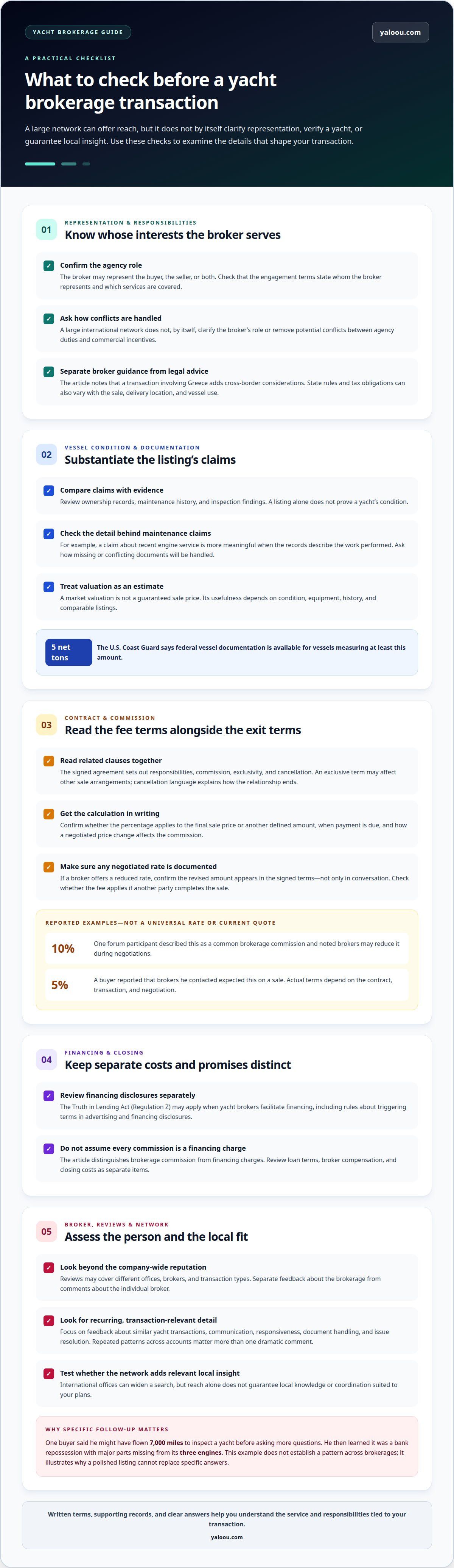
A yacht broker may represent the buyer, the seller, or both, depending on the agreement. That relationship affects whose interests the broker serves and what conflicts may arise. An international network doesn’t, by itself, clarify the broker’s role. The engagement terms should state whom the broker represents and which services are covered. Misrepresenting a yacht’s condition or capabilities can expose a broker to professional liability, as can failing to disclose known defects or making errors in closing documents.
How do state and federal rules affect yacht sales handled by international brokers? According to the U.S. Coast Guard, federal vessel documentation is available for vessels measuring at least five net tons. State rules and tax obligations can also vary based on the sale, delivery location, and vessel use. A transaction involving Greece adds cross-border considerations, so distinguish a broker’s guidance from legal advice.
How do international yacht brokers verify a yacht’s condition, ownership, and maintenance records? A broker can organize the relevant information and inspections, but a listing alone doesn’t prove a yacht’s condition. Compare specific claims with supporting documents, such as ownership records, maintenance history, and inspection findings. For example, a claim about recent engine service matters only if the records describe the work performed. Before relying on a listing, ask how missing or conflicting documents will be handled.
A market valuation is an estimate, not a guaranteed sale price. Its usefulness depends on the yacht’s condition, equipment, history, and comparable listings. If a listing omits known defects or overstates capabilities, a buyer may be making decisions with an incomplete picture. Treat each claim as something to substantiate, not as a substitute for an inspection.
How do yacht brokerage contracts, exclusivity clauses, and cancellation terms work in the United States? The signed agreement sets out the parties’ responsibilities, commission terms, exclusivity, and cancellation process. Read these clauses together: an exclusive term may affect other sale arrangements, while cancellation language explains how the relationship ends. Clear written terms help prevent misunderstandings about duties, fees, and next steps.
2. Broker fees and commissions
Commission terms affect the final economics of a yacht sale. One forum participant described 10% as a common brokerage commission, while noting brokers may reduce it during negotiations. A buyer reported on May 5, 2014, that brokers he contacted expected 5% on a sale. These are reported examples, not a universal rate or current quote. The contract, transaction, and negotiated terms determine the actual obligation.
With a large international brokerage, the main issue isn’t just the commission percentage. It’s understanding which services the commission covers and when it becomes payable. A written agreement can specify whether the broker represents the seller, buyer, or both, and whether the fee applies if another party completes the sale. Read the commission clause alongside the exclusivity and cancellation terms. Otherwise, a buyer or seller may misunderstand the financial consequences of ending the relationship.
Ask for the calculation method in writing. The agreement, for example, should make clear whether the percentage applies to the final sale price or another defined amount. It should also state when payment is due and how a negotiated price change affects the commission. If a broker offers a reduced rate, make sure the revised amount appears in the signed terms, not just in conversation. Clear documentation can help prevent disputes at closing.
Financing can add another layer. The Truth in Lending Act (Regulation Z) may apply when yacht brokers facilitate financing, including rules about triggering terms in advertising and financing disclosures. That doesn’t mean every brokerage commission is a financing charge. It does mean that financing-related promises and disclosures deserve separate attention from the sale agreement. Review loan terms, broker compensation, and closing costs as distinct items.
Finally, match the service to your goal. A commission-based purchase or sale is different from arranging time aboard without buying. If you’re planning a getaway instead, explore yacht experiences as a separate way to enjoy the water.
3. Client reviews and reputation
A global brokerage’s reputation can indicate its reach, but it won’t tell you about every interaction. Reviews may cover different offices, brokers, and transaction types. A strong company-wide rating won’t explain how your assigned broker communicates. Look for details about responsiveness, clarity, and follow-through, and focus on recurring patterns rather than a single dramatic comment. A review about a delayed update is more useful when it explains what happened next.
What should buyers and sellers check before choosing a large international yacht brokerage? Compare recent feedback about similar transactions with the named broker’s communication style and experience handling comparable deals. Consider, too, whether the brokerage responds to criticism with clear, relevant explanations.
A buyer’s account from May 5, 2014, illustrates why follow-up matters. He said he might have flown 7,000 miles to inspect a yacht, had he not asked more questions. He then learned it was a bank repossession, with major parts missing from its three engines. The example doesn’t establish a pattern across brokerages. It does show how a polished listing or recognizable name can’t replace specific answers about a vessel.
- Separate reviews of the brokerage from comments about the individual broker.
- Notice whether feedback concerns yacht sales, rather than unrelated services.
- Look for concrete examples of updates, document handling, and issue resolution.
- Compare praise and criticism across multiple accounts for repeated themes.
For a Greece-bound purchase, pay attention to communication across locations. Prompt replies from one office don’t establish how another team handles time-sensitive details. Note who provided updates, whether questions received direct answers, and whether responsibilities remained clear. These details help distinguish a company-wide reputation from the service you’ll actually experience.
Use reviews alongside the written agreement and transaction documents. A practical next step is to list unresolved questions and request clear answers before relying on a listing or committing to a purchase. Specific details matter: “the broker explained the inspection findings” is more informative than “excellent service.”
4. International reach and office networks
An international network can connect yacht listings, offices, and contacts across markets. But the number of offices doesn’t tell you who handles your transaction or how updates move between teams. For a yacht connected with Greece, clarify which office leads and who answers operational questions. This distinction matters when discussions span locations, time zones, and transaction stages.
Florida offers a concrete measure of international connections: about 20 percent of yachts sold worldwide in 2010 involved a Florida yacht broker. That historical figure shows the state’s role in global brokerage activity. It doesn’t establish that every international firm has current expertise in Greece, or that a particular office understands a specific vessel or route.
How can a large broker’s size affect personal service, communication, and negotiation? A broader network may offer more contacts, but multiple offices can also mean more handoffs. Ask for one named point of contact, clear responsibility for updates, and a direct way to discuss offers.
For example, a buyer discussing a yacht in Greece may speak with one office while another coordinates with the seller. Without clear roles, questions about inspection timing or offer revisions can pass between people. A brief written update naming the responsible broker and next step makes the process easier to follow.
Network size can also affect negotiation. A broker with contacts across markets may connect relevant buyers or sellers. The value, however, comes from useful introductions and timely communication, not the office count alone. Clarify who presents an offer, who relays a counteroffer, and how quickly changes reach the other party.
Look beyond the map. A branch near a yacht’s location may help coordinate local discussions, while a distant team may handle other parts of the transaction. Make these roles explicit, especially when a deal involves Greece and another country. Defined responsibilities help reduce confusion without assuming every office works alike.
If your goal is enjoying Greece rather than buying through a brokerage network, explore private chef experiences for a more personal onboard moment.
YAL’OOU Exclusive Yachting & More
YAL’OOU Exclusive Yachting & More helps you turn yacht research into time on the water, without making a brokerage transaction the focus. If your goal is to experience Greece rather than purchase a yacht, Daily Yacht Charters and Weekly Crewed Yacht Rentals let you plan at your preferred pace. High-End Villa Rentals and VIP Ground Transfers can also complement a stay beyond the yacht.
Choose the experience that fits your plans, whether you want a day at sea or a longer crewed escape. Keep the decision focused on the trip, your time, and the kind of getaway you want.
To discuss your plans, contact YAL’OOU Exclusive Yachting & More.
Choose the kind of time on the water you want
Before taking another step, decide what you want your yacht plans to make possible. Is ownership the goal, or are you looking for time on the water without buying a yacht? That distinction can shape your next move and keep the process focused on your priorities. The limitations of using a large international yacht broker matter most when the brokerage process doesn’t match what you want from your time at sea.
Let your next decision reflect your own pace, not the momentum of a transaction. If you’re ready to explore a yacht experience in Greece, contact YAL’OOU Exclusive Yachting & More to discuss your plans. Start with the experience you want, then make room for the details that will bring it to life.
Frequently Asked Questions
What are the disadvantages of using a large international yacht broker?
The limitations of using a large international yacht broker can include less continuity and communication that feels distant from the yacht’s location. For example, a seller in Mykonos and an overseas buyer may depend on separate contacts for updates. The practical question is whether one person remains accountable through closing. For a Greece-based transaction, clarify who coordinates communication and follows up on unanswered questions.
How do fees and commissions at large yacht brokerages compare with independent brokers?
The limitations of using a large international yacht broker don’t automatically mean higher or lower commissions than those of an independent broker. The written agreement sets out the compensation and how it is calculated. Compare the work the commission covers, when it becomes payable, and whether exclusivity affects other arrangements. Assess the fee structure alongside the services provided rather than assuming the brokerage’s size determines its rate.
What extra costs can arise when buying or selling a yacht through an international broker?
Expenses beyond brokerage compensation may include inspections, repairs, legal support, documentation, taxes, or delivery. Which ones apply depends on the yacht and transaction. For example, U.S. yacht sales tax requirements vary by state and circumstances, including the sale or delivery location and interstate use tax obligations. Keep these transaction expenses separate from the broker’s commission when planning a purchase or sale.
What conflicts of interest can arise when a yacht broker represents both buyer and seller?
Dual representation can create tension because buyer and seller interests may differ on price, timing, and conditions. The broker may also receive sensitive information from both parties. Read the written agreement to understand the broker’s role, how information will be handled, and what happens if interests diverge. For a transaction involving Greece, separate legal advice can help address cross-border questions.
Disclaimer
The YAL’OOU Travel Guide is curated with care to inspire and inform discerning travelers. While every effort is made to ensure the accuracy and relevance of the information provided, all content is offered for general guidance only and may evolve over time.
Details such as local regulations, availability, pricing, and services are subject to change without prior notice. We encourage guests to seek personalized advice and confirm arrangements directly when planning their journeys.
YAL’OOU accepts no liability for any inaccuracies, omissions, or outcomes arising from the use of this information. The Travel Guide may feature recommendations, insights, and selected third-party experiences, presented solely as a source of inspiration and not as formal endorsements.
By accessing this section of our website, you acknowledge and accept this disclaimer as part of your experience with YAL’OOU.