
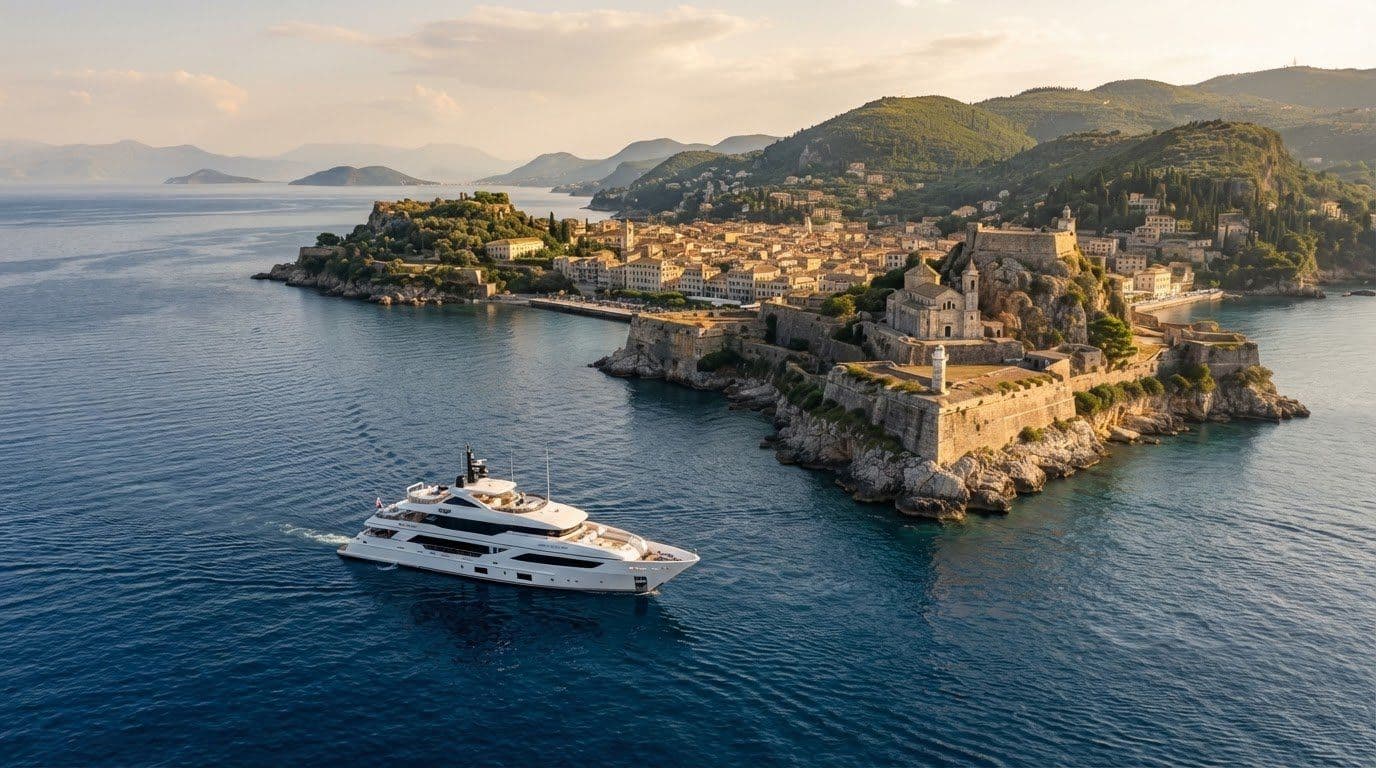
The Ionian Islands pair easy island-hopping with centuries of history, making a crewed yacht trip for exploring Venetian castles in the Ionian Islands a natural way to bring both together. Most of the islands were under Venetian rule for roughly 400 years, and Corfu’s fortresses offer striking reminders of that past. A yacht lets you connect coastal scenery and heritage stops as one trip.
If you love the idea of exploring historic sites but want the freedom to shape each day around the sea, the Ionian route delivers both. There are more than 14 islands to discover, each with its own character, from Corfu’s fortified landmarks to the Venetian architecture found elsewhere in the archipelago.
Read on to see why a crewed charter suits this kind of journey, how sailing yachts, catamarans, and motor yachts differ, and which routes can connect Corfu with Kefalonia, Ithaca, Meganisi, Lefkada, and Zakynthos. You’ll also find a focused guide to Corfu’s fortresses, so you can balance time ashore with the pleasure of travelling between islands.
Key Takeaways
- May through September is the main season to explore the Ionian Islands; choose your dates with weather, sea conditions, and crowd levels in mind.
- Corfu’s fortresses and UNESCO-recognized Old Town reveal layers of Venetian, Byzantine, French, and British heritage.
- Plan an island-hopping route around the time you want to spend sailing, swimming, and exploring ashore.
- Compare sailing yachts, catamarans, and motor yachts by the pace and style of trip you want.
- Choose a daily charter for a shorter escape or a weekly crewed rental for a broader Ionian itinerary.
Why Charter a Yacht in the Ionian Islands?
A yacht charter brings island scenery, coastal stops, and Venetian heritage together in one flexible journey. Choose the vessel and route around the weather, your departure point, and how much time you want ashore.
For an aerial view of Parga’s hilltop fortress, watch this short video:
Charter Seasons and Weather
The main season runs from May through September, with July and August as high season. Summer daytime temperatures reach 86°F to 95°F (30°C to 35°C) from June to August. Summer sea temperatures typically range from 22°C to 27°C (72°F to 81°F). Afternoon Maistro winds generally reach 10-20 knots, so consider daily conditions when planning passages and anchoring.
May, June, and September can suit travelers seeking warm water and fewer crowds. A typical itinerary visits several islands over 7-10 days. Decide whether your priority is relaxed time at secluded bays, more castle visits, or a wider route before choosing the charter length.
Crew and Onboard Services
A crewed charter suits guests who want the captain and crew to handle sailing while they focus on the route and shore visits. Crewed yachts in the Ionian can have at least four crew members. For your plans, compare the vessel’s layout, onboard service, and the balance between sailing time and time ashore.
Daily charters suit a shorter coastal outing, while a weekly rental allows more time to connect islands. A private chef can add a tailored touch to a holiday plan. Review the charter agreement to understand which meals, drinks, and onboard services are included.
Venetian Heritage and Castle Destinations
Most Ionian Islands were controlled by the Venetian Republic for roughly 400 years. Corfu’s Old Fortress dates to the 15th century, and Kassiopi’s Byzantine castle stands on a hillside above the coast. Fiskardo, on Kefalonia, retains traditional Venetian architecture and 18th-century houses that survived an earthquake.
Corfu and Kassiopi are island castle destinations, while Parga offers a mainland coastal fortress stop. A crewed yacht trip for exploring Venetian castles in the Ionian Islands can link sea passages with visits ashore. Plan each stop around the distance from the anchorage to the site and the time you want to spend exploring.
Unlike a shared sailing tour, a private crewed charter lets you shape the route and choose your stops. Land-based itineraries may involve separate travel between destinations. Choose a yacht when connecting coastal sites and island stays matters more than following a fixed land itinerary.
A yacht booking covers the sailing arrangement, not admission to each castle. Each site sets its own entry requirements and visitor arrangements, so plan shore visits separately and follow the guidance provided at the site.
Charter costs vary according to the yacht, season, route, and selected services. Ask for a quote and review the cost breakdown, including any variable expenses such as fuel, berthing, food, and drinks.
Corfu’s Venetian and Byzantine heritage and fortresses
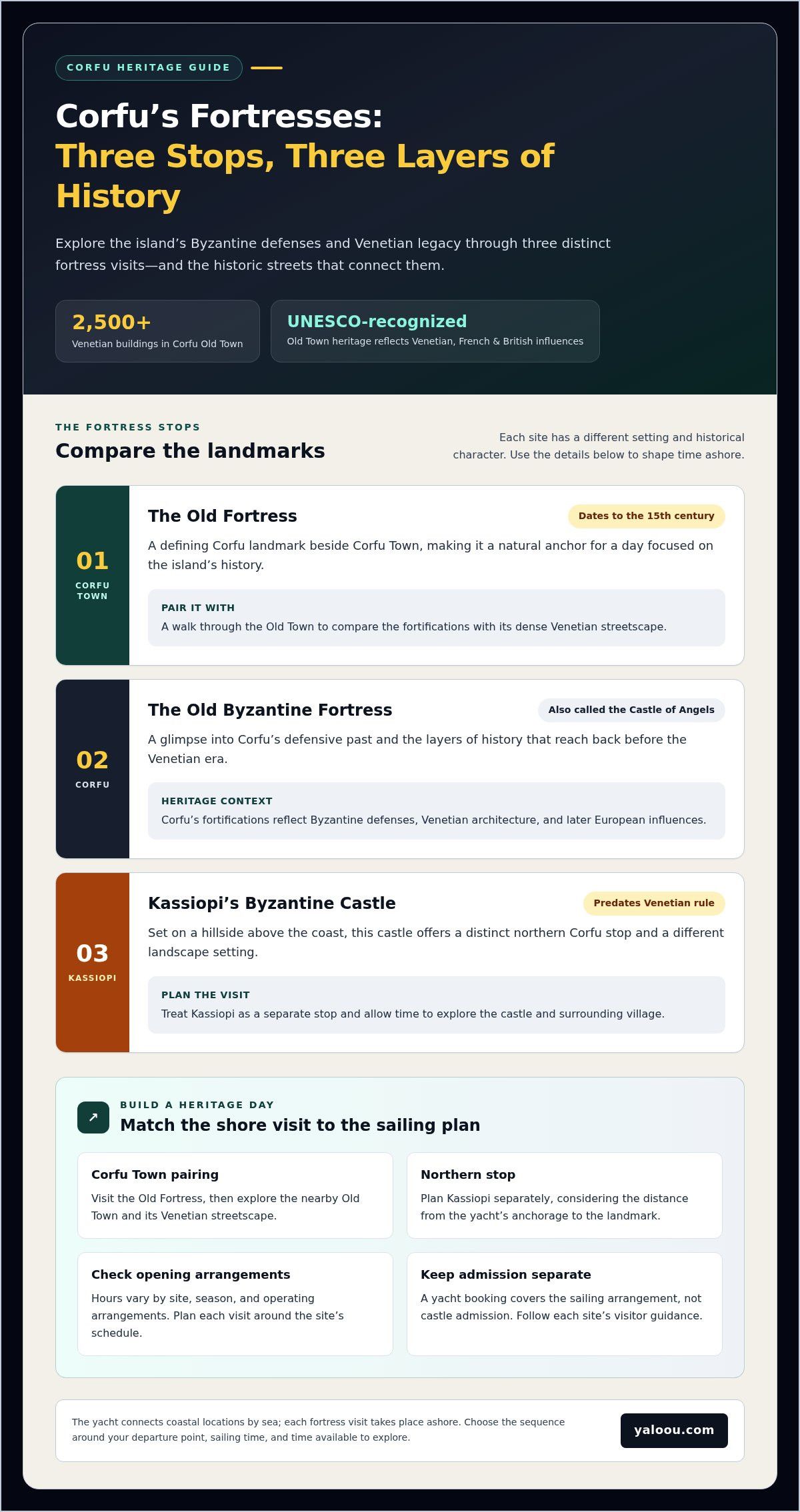
Corfu’s fortifications tell a layered story, from Byzantine defenses to Venetian architecture and later European influences. Start in Corfu Old Town, where more than 2,500 Venetian buildings shape the historic streetscape. UNESCO recognition reflects the town’s Venetian, French, and British heritage, visible in its architecture and urban character.
The Old Fortress is a defining landmark, dating to the 15th century. Its position beside Corfu Town makes it a useful anchor point for a day focused on the island’s history. Pair the fortress visit with a walk through the Old Town to compare fortified structures with the dense Venetian buildings around them.
Corfu’s Old Byzantine Fortress, also called the Castle of Angels, offers another glimpse into the island’s defensive past. Kassiopi’s Byzantine castle stands on a hillside and predates Venetian rule. Together, these sites show that Corfu’s fortifications reach back before the Venetian era, even as Venetian influence became central to its built heritage.
Visitors can include Corfu’s Old Fortress, the Old Byzantine Fortress, and Kassiopi’s castle in a fortress itinerary. Opening hours vary by site, season, and operating arrangements, so plan each visit around its schedule. Allow time to explore both the historic site and the surrounding town or village.
Plan coastal visits around the yacht’s anchorage and the distance to each landmark. Corfu Town’s fortress and Old Town work well together, while Kassiopi makes a separate northern stop. The yacht connects these locations by sea, but each castle visit takes place ashore.
Corfu’s coastline sets a striking scene for its history, with fortresses above the sea and the town’s streets unfolding inland. Notice how the Old Fortress, the Castle of Angels, and Kassiopi’s hillside setting relate to the landscape. Each stop has its own character, from coastal views to compact historic streets.
For a focused heritage day, choose one fortress, explore nearby streets, then return to the yacht. For a broader route, combine Corfu’s landmarks with other Ionian sites, such as Fiskardo’s traditional Venetian architecture on Kefalonia. Choose the sequence based on your departure point, sailing time, and how long you want to spend ashore.
Make Corfu the base for a slower stay if you want more time for museums, fortifications, and the Old Town. Pairing shore-based heritage visits with a comfortable island stay can give the itinerary room to breathe. Explore Corfu travel experiences as you shape a trip around the island’s history and coastline.
Sailing routes around Kefalonia, Ithaca, Meganisi, Lefkada, and Zakynthos
For a castle-focused itinerary, start with Kefalonia’s Venetian heritage, then shape the sailing route around Ithaca, Meganisi, Lefkada, and Zakynthos. Sample itineraries depart from Sami on Kefalonia, while another Southern Ionian route starts and finishes at Nikiana on Lefkada. Choose the starting point and island sequence according to your available time for sailing and shore visits.
On Kefalonia, a sample itinerary begins with embarkation at noon. Make Fiskardo a heritage stop: its traditional Venetian architecture includes 18th-century houses that survived an earthquake. The village’s Venetian-style waterfront gives you a compact place to explore on foot after anchoring. A yacht trip lets you approach by sea, then spend time ashore among the old buildings.
For a seven-day Sami itinerary, pair Kefalonia with Ithaca and nearby islands rather than trying to cover every Ionian destination. The sample route includes a passage from Agia Efthimia to Vathi, Ithaca, estimated at 3-4 hours. A fourteen-day sample from Sami allows a broader plan, while an extended ten-day itinerary covers approximately 250 nautical miles.
To bring Meganisi and Lefkada into the route, consider the Southern Ionian Explorer pattern. It starts and finishes at Nikiana and covers about 119 nautical miles in its first week, then about 110 nautical miles in its second. These distances help frame the sailing plan, but shore time, weather, and the desired pace also shape the final sequence.
Zakynthos adds a southern island destination, while the Peloponnese provides a broader geographic reference south of the Ionian Islands. A longer plan can combine Zakynthos with Kefalonia and Ithaca, using the Peloponnese as a point of reference for the route. Balance sailing legs with time at anchor, swimming in turquoise waters, and exploring hidden coastal corners.
An itinerary for visiting Venetian castles can combine Fiskardo on Kefalonia with Corfu’s fortresses, then add Ithaca, Meganisi, Lefkada, or Zakynthos to suit your plans. A crewed yacht trip for exploring Venetian castles in the Ionian Islands makes the transitions between sea and shore part of the experience, while keeping the route focused on the historic sites you most want to see.
Before settling on a route, mark each castle and heritage village, then group nearby stops into practical sailing legs. Short passages between Ionian islands are typically 15-25 nautical miles, while an extended itinerary can include longer days. That simple planning step helps protect time for the waterfront architecture of Fiskardo and the fortifications of Corfu, without turning every day into a passage.
Sailing yacht, catamaran, and motor yacht options
Choose a sailing yacht, catamaran, or motor yacht by balancing pace, comfort, and time ashore. Typical short passages between Ionian islands cover 15-25 nautical miles, making island-hopping practical across routes near Ithaca and Kefalonia.
A sailing yacht suits travellers who enjoy moving under sail and making the journey itself a central part of the experience. It works well when the route allows time for beaches, swimming, and unhurried stops. Plan around the wind and the sites you want to explore, such as Ithaca’s harbours or Kefalonia’s Venetian architecture.
A catamaran has a broad deck and living areas spread across twin hulls. This layout can make onboard lounging and access to the water part of the trip. Consider one for relaxed days near swimming spots, balancing passages between islands with time at anchor.
Motor yachts prioritize powered travel between destinations. They can average 10 to 15 mph, which may suit a tighter schedule or a route with more stops. That pace can help connect beaches and historic sites, though the best choice still depends on how much time you want underway versus ashore.
Summer conditions shape each option. July and August are generally calmer in the Ionian than in the Cyclades, while afternoon Maistro winds commonly reach 10-20 knots. Thermal winds can reach 20 knots from 15:00 to 18:00. Allow for changing conditions when planning passages, anchoring, and visits to exposed coastal stops.
Early October brings a different rhythm. Daytime temperatures are expected to be 20 to 25°C, with generally moderate sailing conditions and winds between force 2 and 5. The Ionian Sea is around 20°C in early October. Include flexibility in the route so conditions can guide the day’s passage and swimming plans.
For longer sailing days, the extended Ionian itinerary lists maximum passages of 4-6 hours. Use that as a planning reference, not a reason to pack every day with destinations. A crewed yacht trip lets the captain manage navigation while you choose whether to prioritize famous landmarks, quiet bays, or time in island villages.
Match the vessel to your itinerary: choose a sailing yacht for a wind-led journey, a catamaran for shared space, or a motor yacht when covering ground is a priority. Then plan the passages, seasonal winds, and shore visits around the architecture and beaches you most want to discover.
Ionian island-hopping destinations
The Ionian archipelago has more than 14 islands, so a good itinerary focuses on a few distinct stops rather than racing between them. Pair heritage-rich Corfu with Kefalonia’s Venetian-influenced settlements, then add Ithaca, Meganisi, Lefkada, or Zakynthos for different coastal scenery. Your destination mix can balance fortress visits, village walks, swimming, and evenings ashore.
On Kefalonia, make Fiskardo a stop for traditional architecture and a waterfront walk. The village retains 18th-century Venetian houses that survived an earthquake, giving the harbor area a clear historical character. From there, an itinerary can continue toward Ithaca, where Vathi’s red-roofed houses largely survived the 1953 earthquake. These named places offer a useful contrast between Venetian-era streets and an island harbor town.
Lefkada and Meganisi suit an itinerary built around shorter island connections and time near the coast. Nikiana on Lefkada is the start and finish point for the Southern Ionian Explorer route. Its first week covers about 119 nautical miles, and its second covers about 110 nautical miles. Use those route figures to think about how sailing time competes with visits inland or relaxed stops at anchor.
Zakynthos brings a different kind of destination. Laganas Bay hosts more than 1,500 loggerhead turtle nests yearly, making it an important natural feature to respect while planning coastal visits. Kefalonia adds a cultural detour inland: its Robola wine region produces 300,000 bottles of indigenous white PDO wine yearly. Together, these examples show how an island-hopping trip can include natural landscapes, local food, and heritage, not just beaches.
For a mainland contrast, add Parga, where a hilltop castle has faced pressure from conquerors for centuries. Paxos offers another boat-accessible stop: its Blue Caves along the west coast can only be reached by boat. Combine these with Corfu’s fortresses for a route shaped by castles and coastal approaches. Keep the destination list focused so each stop has room for exploration.
Plan the evening as carefully as the daytime route. In July and August, family-run Ionian tavernas are recommended after 9 PM. That timing can leave daylight for a village visit, a swim, or a walk through historic streets before dinner. Choose an overnight stop with the next day’s sailing and shore plans in mind, then adjust the itinerary to the weather and your preferred pace.
For an adventure that connects island heritage with coastline and local experiences, plan your Ionian island experiences around the places you most want to discover.
YAL’OOU Exclusive Yachting & More: Daily Yacht Charters
YAL’OOU Exclusive Yachting & More offers Daily Yacht Charters for travelers planning a focused day on the Ionian coast. Choose a shorter escape for a coastal visit, or consider Weekly Crewed Yacht Rentals when your plans include several islands and time ashore at historic sites such as Corfu’s fortresses.
For a trip that pairs sailing with a land stay, High-End Villa Rentals offer another way to shape the holiday. VIP Ground Transfers can support travel between your accommodation and departure point. Match the arrangement to your itinerary, preferred pace, and the destinations you want to explore.
Contact YAL’OOU Exclusive Yachting & More to discuss a yacht charter for your Ionian plans.
Shape Your Ionian Escape
Let the historic stops you care about set the pace. Before choosing a charter, decide whether you want a single day at sea or a longer island-hopping escape, and how much time you want ashore. A crewed yacht trip for exploring Venetian castles in the Ionian Islands can be planned around the balance that feels right for you.
YAL’OOU Exclusive Yachting & More offers Daily Yacht Charters for a shorter outing and Weekly Crewed Yacht Rentals for a broader itinerary. High-End Villa Rentals can complement a yacht holiday with time on land. Think about how you want your days to flow, then choose the arrangement that fits your plans.
Explore YAL’OOU Exclusive Yachting & More’s Ionian experiences and take the next step toward a memorable journey through Greece.
Frequently Asked Questions
How many crew will there be?
A crewed Ionian yacht charter can have at least four crew members. The number varies with the vessel and the onboard service planned for the trip. Larger superyachts in the Ionian can have more than 20 crew members. For castle-focused sailing, consider how the crew setup suits your group, preferred pace, and time spent moving between the yacht and shore.
What amenities and guest accommodations can I expect on board?
Onboard amenities and sleeping arrangements vary by yacht. Compare the cabin layout, shared spaces, and facilities that matter to your group before deciding. A trip focused on Corfu’s fortresses may call for a different balance of indoor comfort and outdoor lounging than an itinerary built around swimming stops. Use the vessel’s listed details to match onboard life to your plans.
What are the main ports, marinas, and airports in the Ionian Islands?
Corfu’s Gouvia Marina is the largest marina in the Ionian archipelago. Common airports for island charters include Corfu International Airport, Kefalonia International Airport, Zakynthos International Airport, and Aktion International Airport. Sample itineraries start from Sami on Kefalonia and Nikiana on Lefkada. Choose an arrival airport that fits your departure port and planned islands, then arrange onward travel around the route.
What other destinations are part of the Ionian Islands cruising grounds?
Beyond Corfu, Ionian cruising destinations include Paxos, Lefkada, Meganisi, Ithaca, Kefalonia, and Zakynthos. Paxos’s Blue Caves on the west coast can only be reached by boat, making them a distinctive coastal stop. Parga is a mainland destination near the Ionian cruising area, not an island. Build your route around the mix you want, from heritage visits and natural scenery to time ashore.
When is the best time to explore the Ionian Isles on a superyacht charter?
May through September is the main season, while July and August are the Ionian high season. Summer sea temperatures typically range from 22°C to 27°C (72°F to 81°F). The Ionian generally has gentler seas than the Cyclades during July and August. For a superyacht itinerary, weigh summer conditions and activity plans against the busier high-season period when choosing your dates.
Which Ionian ports and anchorages are closest to major Venetian castles?
For Corfu’s fortresses, plan a shore visit from Corfu Town or the island’s northeast near Kassiopi. Fiskardo on Kefalonia offers a harbour stop among traditional Venetian architecture, while Parga provides access to its hilltop castle from the mainland coast. These are practical destination pairings, not rankings by distance. Organise each stop around your chosen anchorage, shore access, and available time.
When is the best season for a crewed yacht trip in the Ionian Islands?
May, June, and September suit travelers seeking warm water with fewer crowds than peak summer. Ionian shoulder-season temperatures are given as 20-28°C in May and September, and summer sea temperatures reach 22°C to 27°C from June through August. July and August bring high season. Choose dates by balancing your preference for quieter visits, warm-water activities, and lively summer island life.
What yacht size and crew are best for exploring Ionian castles and coastal sites?
Choose a yacht around your group size, comfort preferences, and route, rather than size alone. Most Ionian charter yachts accommodate a maximum of 12 guests while cruising, and a crewed charter can have at least four crew members. The largest superyachts can carry more than 20 crew. For several castle visits, prioritize a layout that suits your guests and a crew arrangement aligned with your onboard plans.
Disclaimer
The YAL’OOU Travel Guide is curated with care to inspire and inform discerning travelers. While every effort is made to ensure the accuracy and relevance of the information provided, all content is offered for general guidance only and may evolve over time.
Details such as local regulations, availability, pricing, and services are subject to change without prior notice. We encourage guests to seek personalized advice and confirm arrangements directly when planning their journeys.
YAL’OOU accepts no liability for any inaccuracies, omissions, or outcomes arising from the use of this information. The Travel Guide may feature recommendations, insights, and selected third-party experiences, presented solely as a source of inspiration and not as formal endorsements.
By accessing this section of our website, you acknowledge and accept this disclaimer as part of your experience with YAL’OOU.