
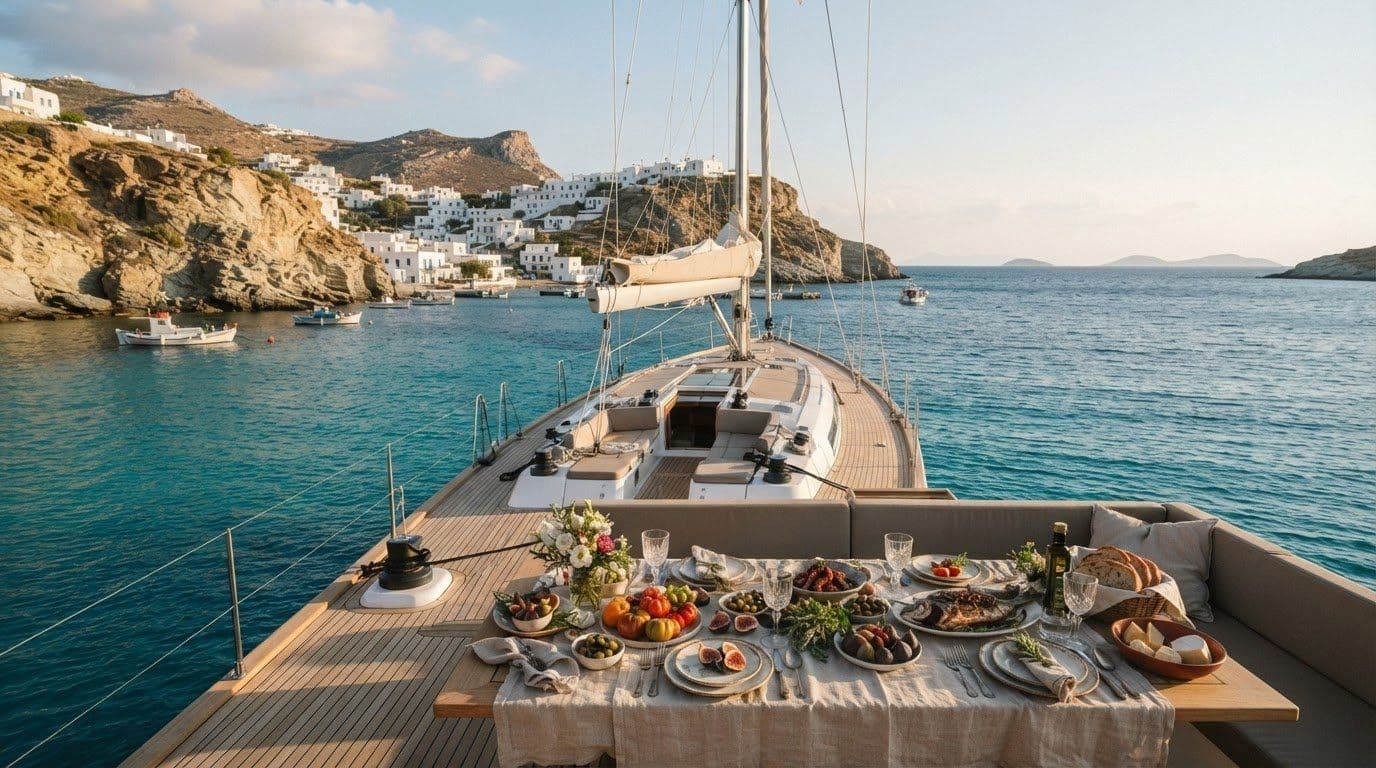
The most memorable Aegean meal may happen at anchor, not at a celebrated restaurant. For a yacht charter to feel connected to the islands, its food, route, and dining plans need to work together. The best yacht charters offering farm to table Aegean organic gastronomy make room for seasonal flavors while distinguishing locally sourced ingredients from certified organic produce.
“Local” doesn’t automatically mean “organic,” and a private chef doesn’t automatically make a menu distinctive. What matters is thoughtful coordination: planning meals around guest preferences, allowing time to explore island food, and describing organic sourcing precisely.
This guide compares chef-led dining aboard, meals ashore, and itineraries that combine both. You’ll learn what farm-to-table can mean on a yacht, how local sourcing differs from organic certification, and how seasonal planning can shape food stops. With private chef services, tailored routes, and concierge coordination, a culinary charter can balance relaxed sailing with a personal taste of the Aegean.
Key Takeaways
- Farm-to-table describes an approach to sourcing and dining, not a guaranteed charter standard. Understand how local, seasonal, and certified organic ingredients differ.
- Compare onboard chef-led meals, island dining, and a hybrid approach to find the right balance of privacy, flexibility, and island immersion.
- When comparing yacht charters offering farm to table Aegean organic gastronomy, look beyond the label to how food choices and route planning fit together.
- Build a food-led itinerary around your priorities, preferences, and pace, leaving room for both time on the water and island discovery.
- Yacht coordination, private chef services, tailored routes, and local supplier partnerships can help shape a more personal Aegean charter.
What Farm-to-Table Aegean Yacht Charters Can Actually Offer
A farm-to-table charter connects ingredients, menu planning, and the places a yacht visits. The phrase isn’t a universal charter standard, and it doesn’t guarantee that every item is locally sourced, seasonal, or certified organic. The experience depends on how guest preferences, sourcing choices, and the sailing route come together.
For travelers comparing yacht charters offering farm to table Aegean organic gastronomy, the distinctions matter. A local ingredient comes from a nearby area; a seasonal ingredient is available at a particular time of year; an organic ingredient is produced to meet applicable organic standards and certification requirements. These descriptions can overlap, but none automatically implies the others.
See how a yacht charter can set the scene for relaxed time on the water and island discovery:
What does farm-to-table mean on an Aegean yacht charter?
On board, farm-to-table means making deliberate choices about where ingredients come from and how they shape a meal. A private chef can tailor menus to guest preferences, dietary needs, and the pace of the charter. Coordinating meals with the route can also make time ashore part of the dining experience, rather than leaving the menu disconnected from the trip.
In brief: Local describes where an ingredient comes from; organic describes how it was produced and whether it meets applicable certification standards.
Working with local suppliers can support sourcing nearby products, but it doesn’t establish organic certification on its own. Likewise, an organic label doesn’t necessarily mean an ingredient was grown on an island along the route. Distinguishing the two helps guests set expectations and make informed choices without reducing the experience to a label.
Why pair yacht dining with Greek island food culture?
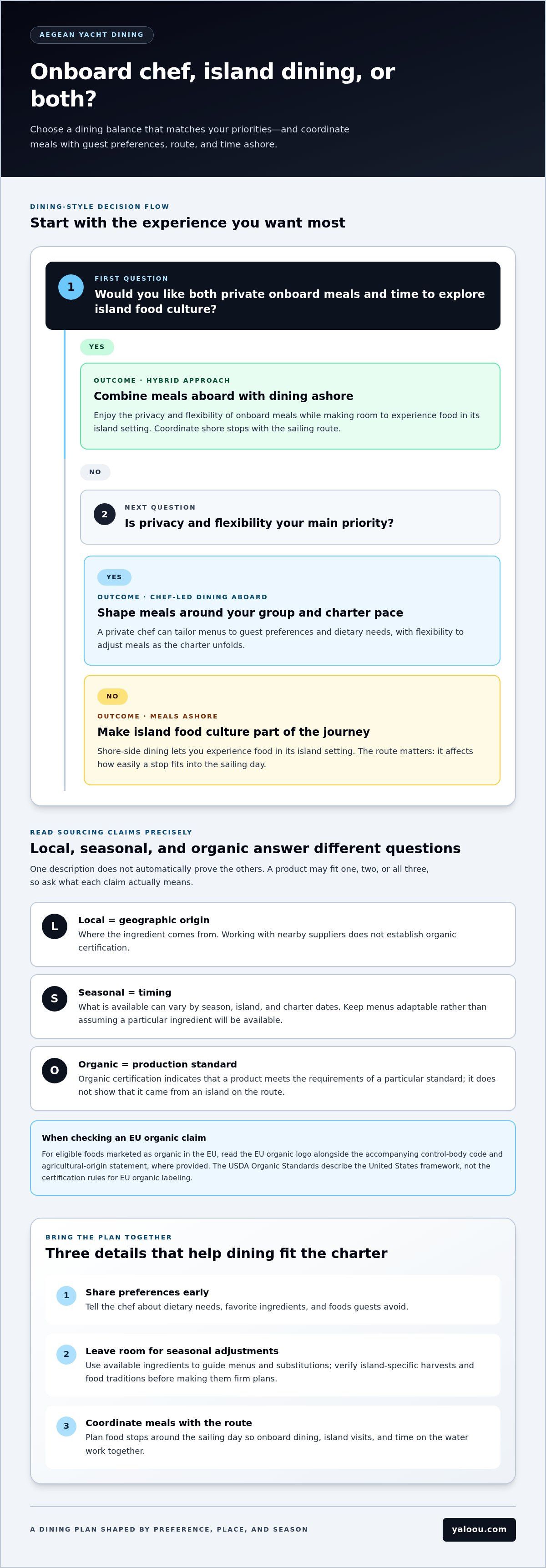
Meals aboard offer privacy and flexibility. Shore-side dining gives guests a chance to experience food in its island setting. Combining the two makes room for both: a relaxed meal on board one day, and time ashore to explore local food culture on another. The route matters because it determines how easily each experience fits into the sailing day.
The Cyclades offer a vivid setting for this balance. The islands sit within the wider Aegean Sea, a region shaped by connections across its islands and shores. A food-led itinerary can make those connections part of the journey, rather than treating meals as pauses between destinations. The goal isn’t to promise a particular dish or supplier, but to let the place inform the experience.
Start with the style of dining you enjoy, then bring those preferences into charter planning. A private chef, tailored routes, and local supplier partnerships can connect onboard meals with island visits while keeping the schedule comfortable. That’s the potential of farm-to-table at sea: a personal journey where food, place, and sailing belong together.
How Seasonal Sourcing and Organic Choices Shape Aegean Yacht Dining
Seasonal sourcing makes yacht dining more adaptable. Instead of planning every meal around a fixed menu, a private chef can work with ingredients available during the charter and adjust dishes to guest preferences. This can make meals feel connected to the time and place without promising that a particular ingredient will be available on a specific island or date.
Keep three ideas distinct: seasonal describes timing, local describes geographic origin, and organic describes production under a certification standard. An ingredient can fit one, two, or all three descriptions, but one label doesn’t prove the others.
How seasonality influences a private chef’s menu
Availability can vary with the season, the island, and the charter dates. A chef can use the available selection to guide menu choices or substitutions, while accounting for preferences such as vegetarian meals, favorite ingredients, or foods guests avoid. Share these details early and allow room for adjustments instead of expecting an unchanging menu.
For Aegean itineraries, don’t assume a particular fruit, vegetable, or specialty will be available everywhere. Island-specific harvests and food traditions should be verified before they become part of a firm plan. A more useful starting point is the kind of dishes guests enjoy, how flexible they are, and whether seasonal discovery is a priority.
How to assess organic claims without confusing them with local sourcing
Certification and origin answer different questions. A product’s origin tells you where it comes from; organic certification indicates that it meets the requirements of a particular organic standard. The USDA Organic Standards explain the United States’ certification framework. They offer useful context, but they aren’t the certification rules used to label food as organic under EU requirements.
For eligible foods marketed as organic in the EU, the EU organic logo is a useful recognition cue. Read it alongside the product’s accompanying control-body code and agricultural-origin statement, where provided. The logo relates to organic compliance, not proximity to the yacht or an island on the route. For guests comparing yacht charters offering farm to table Aegean organic gastronomy, precise descriptions of origin and certification are more meaningful than a broad “organic and local” claim.
- Seasonal: available at a particular time of year.
- Local: sourced from a stated place or region.
- Organic: produced in line with a named certification standard.
Share dietary preferences and sourcing priorities during menu planning. This gives private chef coordination room to balance guest tastes with changing availability, without promising ingredients that depend on timing and supply. Explore Aegean charter experiences to see how dining plans can fit with time on the water and ashore.
Onboard Chef, Island Dining, or Both? Compare Aegean Charter Options
Dining aboard, eating ashore, or alternating between the two can each shape an Aegean charter. The right format depends on what guests value most: privacy, an unhurried schedule, local exploration, or a mix. The chosen route matters too, since island stops and time on the water influence how each day unfolds.
Use this comparison to see how dining choices may fit into a trip. These are planning tendencies, not guarantees of particular restaurant access, menus, ingredients, or included arrangements.
Dining approachPrivacyFlexibilityIsland immersionEffect on daily plansChef-led onboard meals
High, with meals enjoyed aboard
Meals can be shaped around the charter’s rhythm and guest preferences
Food is enjoyed on the yacht; island context depends on sourcing and route
Can reduce the need to plan each meal around going ashore
Shore-side dining
Less private, in a public setting
Depends on the island stop and the day’s schedule
Creates time to experience an island setting and its food culture
Requires time ashore and coordination with the route
Hybrid dining
Alternates between private onboard meals and public dining
Balances planned meals with opportunities to adapt
Combines time aboard with selected island experiences
Calls for a route that leaves room for both
When onboard dining suits a private yacht charter
Dining aboard suits guests who want a private setting or fewer fixed meal commitments during the day. A private chef can tailor meal planning to preferences and dietary needs, while the charter’s pace helps determine when meals fit. Be specific about sourcing: a local ingredient isn’t automatically organic, and certification claims should have a reliable basis.
When shore-side dining or a hybrid approach adds value
A meal ashore gives guests a change of setting and a chance to encounter food in its island context. The experience varies by destination and itinerary, so don’t expect every stop to offer the same choices. A hybrid plan keeps some meals comfortably aboard while setting aside selected moments for exploration ashore.
For guests considering yacht charters offering farm to table Aegean organic gastronomy, the useful question isn’t which format is universally best. It’s which option suits the trip’s priorities. Choose onboard dining for privacy and a flexible meal setting; choose shore-side dining when exploring island life is central; or combine them to make room for both. A tailored route and coordinated chef services can bring those choices together without turning every day into a dining schedule.
Plan a Food-Led Aegean Yacht Itinerary Without Losing Island Time
A memorable food-focused charter isn’t a race between restaurants. It’s a well-paced trip where meals support the journey instead of filling every available hour. Start with the experiences that matter most, then plan the route, sailing time, and onboard dining around them. Paros or Mykonos might be part of a Cyclades itinerary, for example, but neither should be assumed as a stop before the route is shaped.
Use this planning sequence to turn broad ideas into a workable plan:
- Choose your priorities. Decide which experiences matter most, such as a meal ashore, relaxed dining aboard, or more time exploring islands. Separate must-haves from “nice if it fits” ideas.
- Share guest preferences. Communicate dietary needs, allergies, preferred dining style, and how much structure you want around meals. This helps private chef coordination reflect the group rather than defaulting to a generic plan.
- Shape the route. Match island choices and time ashore to your priorities. A tailored route can balance sailing, time at anchor, and opportunities to explore without assuming every stop offers the same dining options.
- Refine the meal plan. Coordinate onboard meals around the day’s pace. Leave room for flexibility when ingredient availability or plans change.
Match culinary priorities to the route and pace
Think about the rhythm you want. If a shore-side meal is a priority, allow enough time for the island visit rather than squeezing it between sailing and a tightly scheduled onboard dinner. If quiet time at anchor matters more, plan meals aboard as part of a slower day. Explore Greek island destinations to consider which settings fit your interests, then connect those choices into a realistic route.
Be selective. One or two meaningful food experiences may leave more room to swim, explore, and enjoy time on deck than a packed itinerary. For guests drawn to yacht charters offering farm to table Aegean organic gastronomy, food-led planning works best when sourcing interests guide the journey without dictating every stop or meal.
Share preferences that help shape the onboard experience
Give the chef and charter team useful details early: allergies, dietary preferences, favorite ingredients, foods to avoid, and whether you prefer leisurely shared meals or a flexible schedule. Guest input can guide menus and provisioning while leaving space to adapt. Be precise about sourcing requests too. If local or certified organic ingredients are a priority, distinguish between those preferences rather than treating the terms as interchangeable.
To connect dining ideas with a route that suits your pace, explore curated yacht experiences and consider how you want to sail, eat, and explore.
How YAL’OOU Brings Yacht, Chef, and Aegean Experience Planning Together
A food-led charter works best when its moving parts are coordinated from the start. YAL’OOU brings yacht coordination, private chef services, tailored routes, crew coordination, and concierge support into one planning conversation. Guest preferences can shape the onboard experience, while route choices make room for dining aboard and discovering the islands.
Food plans don’t exist separately from the day’s sailing. The yacht, the pace, and the balance between time at anchor and visits ashore all affect how meals fit into the trip. Rather than treating gastronomy as a promise of specific ingredients or fixed menus, the aim is to make dining an intentional part of a personalized Aegean journey.
What coordinated culinary charter planning can bring together
Yacht choice sets the practical framework for a charter, while crew coordination and route planning connect onboard comfort with island exploration. Guests can share dietary needs, preferred dining style, and interest in local sourcing. Private chef services can use that input to shape meals around the charter’s rhythm, with flexibility for changing plans and ingredient availability.
Local supplier partnerships can support sourcing from nearby businesses, but they don’t mean every ingredient is local, seasonal, or certified organic. Those qualities describe different things. Clear, specific sourcing language keeps expectations grounded while making food part of the experience. Vessel choice, route, and dining style all contribute to how the charter takes shape.
A tailored route can balance meals on board with island visits. If you want time ashore, the itinerary can make room for exploration rather than filling every day with planned dining. If privacy and a relaxed onboard pace matter more, meals can be coordinated as part of the time spent aboard. The right balance depends on your priorities, not a one-size-fits-all formula.
Take the next step toward a tailored Aegean experience
Before planning, decide what matters most: chef-led meals, island dining, or a mix; any dietary requirements; how important local or certified organic sourcing is; and how much time you want for sailing, anchoring, and exploring. These details give the team a useful starting point for coordinating the yacht, chef, route, and crew around your preferences.
YAL’OOU’s concierge support brings these elements together across daily and weekly yacht charters in Greek destinations, including the Cyclades. The company coordinates experiences across Mykonos, Paros, Antiparos, Athens, Aegina, Poros, Spetses, Syros, Tinos, Sifnos, Serifos, Milos, Poliaigos, Kimolos, Santorini, Ios, Koufonisia, Amorgos, Crete, Corfu, and Zakinthos. For travelers comparing yacht charters offering farm to table Aegean organic gastronomy, the value lies in considered planning: guest preferences inform the experience, sourcing descriptions stay precise, and the itinerary leaves room to enjoy the islands.
To shape a charter around your food priorities and preferred pace, explore YAL’OOU experiences and start planning an Aegean journey that connects yacht, chef, and island discovery.
Start Shaping Your Aegean Food Journey
Start by choosing the feeling you want the trip to leave with. Perhaps it’s an unhurried meal on board, a memorable afternoon ashore, or the freedom to decide as each island comes into view. Let that priority guide the details, while keeping the itinerary open enough for discovery. A thoughtful food journey doesn’t need to schedule every bite; it needs space for the unexpected, too.
For travelers drawn to yacht charters offering farm to table Aegean organic gastronomy, planning can turn a broad interest in good food into a personal way to experience the islands. Consider what matters most to your group, then build a charter around that vision, with room to sail, pause, and enjoy the moment.
YAL’OOU coordinates yacht experiences around your preferences and plans. Explore curated yacht experiences to start planning an Aegean escape shaped by your pace and appetite for discovery.
Frequently Asked Questions
What does farm-to-table mean on a yacht charter in the Aegean?
It means making food sourcing and meal planning part of the travel experience, rather than treating meals as unrelated to the route. For example, guests might plan a chef-prepared meal aboard on a sailing day and set aside another day for an island food experience. The phrase doesn’t guarantee particular ingredients or a standard charter feature. Specific descriptions of sourcing and menus make expectations clearer.
Is locally sourced food always organic?
No. “Local” refers to where food comes from; “organic” refers to production methods that meet the requirements of a certification standard. A product from a nearby island may not be certified organic, while certified organic food may come from elsewhere. If both qualities matter, state them separately in your preferences. This distinguishes a geographic sourcing request from a certification preference.
Can a private yacht chef accommodate allergies or dietary preferences?
A private chef can use guest-provided dietary information to guide meal planning. Share allergies and preferences as early and clearly as possible, including the ingredients involved and any cross-contact concerns. Distinguish an allergy from an ingredient you simply prefer to avoid. This gives the chef and charter team useful information for coordination, though guests with serious allergies should discuss their needs in detail before travel.
Can a Greek yacht charter combine onboard meals with island dining?
Yes. A charter can combine meals aboard with time ashore, with the balance shaped by the route and guest priorities. A day focused on sailing and time at anchor may suit an onboard meal, while another day can leave space to explore on land. Dining arrangements and island options vary, so build flexibility into plans for restaurant visits.
Which Aegean islands are known for food and wine experiences?
Paros is associated with wine-tasting experiences in culinary travel coverage, but food and wine options differ by island and itinerary. YAL’OOU coordinates charters across destinations including Mykonos, Paros, Antiparos, Syros, Tinos, Sifnos, Milos, and Santorini, as well as islands farther afield such as Corfu and Crete. These are destination possibilities, not a guarantee of particular tastings or culinary stops.
How can I include organic food preferences when planning a yacht charter?
State that certified organic sourcing matters to you, and distinguish it from a preference for food produced nearby. You can also identify priority ingredients or categories, such as produce or pantry items, and say where flexibility is acceptable. Clear preferences help shape private chef coordination and provisioning discussions. A “local” description doesn’t confirm organic certification, and a desired ingredient may not be available along the route.
Does farm-to-table dining mean every ingredient is certified organic?
No. Farm-to-table describes a sourcing and dining approach; it doesn’t certify ingredients. A meal might use ingredients sourced from nearby suppliers without every item meeting an organic standard. If certification is important, precise information about which ingredients are certified and which certification applies gives you a clearer picture than a broad farm-to-table label.
Disclaimer
The YAL’OOU Travel Guide is curated with care to inspire and inform discerning travelers. While every effort is made to ensure the accuracy and relevance of the information provided, all content is offered for general guidance only and may evolve over time.
Details such as local regulations, availability, pricing, and services are subject to change without prior notice. We encourage guests to seek personalized advice and confirm arrangements directly when planning their journeys.
YAL’OOU accepts no liability for any inaccuracies, omissions, or outcomes arising from the use of this information. The Travel Guide may feature recommendations, insights, and selected third-party experiences, presented solely as a source of inspiration and not as formal endorsements.
By accessing this section of our website, you acknowledge and accept this disclaimer as part of your experience with YAL’OOU.